AQA · A-Level · History
Course version: 7042 · Version from Sept 2017
USA, 1865–1975 – only) Crisis of identity, 1920–1945 (A-level only): The…
Full specification wording
1K The making of a Superpower: USA, 1865–1975 – only) Crisis of identity, 1920–1945 (A-level only): The economy: boom to bust and recovery; structural weaknesses and the impact of the New Deals and the Second World War on economic recovery
The 1920s US economic boom, driven by mass production and consumer credit, masked severe structural weaknesses like agricultural overproduction, unequal wealth distribution, and unregulated banking.
Checked against the AQA 7042 specification (opens in a new tab) on .
- Point 3 of 6
- 4 key terms
Study notes
From the checked teaching notes for this specification point.
The idea
The 1920s US economic boom, driven by mass production and consumer credit, masked severe structural weaknesses like agricultural overproduction, unequal wealth distribution, and unregulated banking. These flaws precipitated the 1929 Wall Street Crash and the ensuing 'bust' of the Great Depression. Roosevelt's New Deals attempted recovery through federal intervention, creating agencies like the NRA and PWA to stimulate employment and reform banking. However, the New Deals only provided partial economic recovery. Full recovery was ultimately achieved through the massive industrial mobilisation and federal spending necessitated by the Second World War, which eradicated unemployment and vastly expanded manufacturing capacity.
What earns the marks
- Identify specific structural weaknesses of the 1920s economy, such as the depressed agricultural sector and the over-reliance on credit.
- Evaluate the transition from boom to bust, linking the Wall Street Crash to underlying economic fragilities rather than viewing it as the sole cause of the Depression.
- Assess the economic impact of the New Deals, noting both successes in banking stabilisation and limitations regarding the persistence of high unemployment.
- Analyse the role of the Second World War in achieving full economic recovery through unprecedented federal spending and the Lend-Lease programme.
Common mistakes and how to put them right
Claiming the Wall Street Crash was the only cause of the Great Depression.
Put it right by explaining the underlying structural weaknesses like unequal wealth distribution and agricultural decline.
Stating the New Deal completely ended the Great Depression.
Put it right by noting that while it provided relief and reform, full economic recovery and full employment only occurred with the onset of the Second World War.
Ignoring the agricultural sector during the 1920s boom.
Put it right by highlighting that farmers experienced a 'bust' throughout the 1920s due to overproduction and falling prices.
Exam tips
- When evaluating the New Deal's economic impact, distinguish between short-term relief measures and long-term structural reforms.
- Use specific statistics, such as unemployment rates dropping from 25 percent in 1933 to under 2 percent by 1943, to demonstrate the comparative impact of the New Deal and the Second World War.
- Link the structural weaknesses of the 1920s directly to the severity of the 1930s bust to build a cohesive analytical argument.
Try the lesson
The start of the 1K The making of a Superpower: USA, 1865–1975 – only) Crisis of identity, 1920–1945 (A-level only): The economy: boom to bust and recovery; structural weaknesses and the impact of the New Deals and the Second World War on economic recovery lesson, made from checked teaching notes for this specification point.
Have a go first
Which of the following was a significant structural weakness in the United States economy during the boom years of the 1920s?
Listen
The 1920s US economic boom, driven by mass production and consumer credit, masked severe structural weaknesses like agricultural overproduction, unequal wealth distribution, and unregulated banking. These flaws precipitated the 1929 Wall Street Crash and the ensuing 'bust' of the Great Depression. Roosevelt's New Deals attempted recovery through federal intervention, creating agencies like the NRA and PWA to stimulate employment and reform banking. However, the New Deals only provided partial economic recovery. Full recovery was ultimately achieved through the massive industrial mobilisation and federal spending necessitated by the Second World War, which eradicated unemployment and vastly expanded manufacturing capacity. A strong answer earns marks for these points. Identify specific structural weaknesses of the 1920s economy, such as the depressed agricultural sector and the over-reliance on credit. Evaluate the transition from boom to bust, linking the Wall Street Crash to underlying economic fragilities rather than viewing it as the sole cause of the Depression. Assess the economic impact of the New Deals, noting both successes in banking stabilisation and limitations regarding the persistence of high unemployment. Analyse the role of the Second World War in achieving full economic recovery through unprecedented federal spending and the Lend-Lease programme. A common slip: Claiming the Wall Street Crash was the only cause of the Great Depression. Instead, explaining the underlying structural weaknesses like unequal wealth distribution and agricultural decline. Exam tip: When evaluating the New Deal's economic impact, distinguish between short-term relief measures and long-term structural reforms.
See it
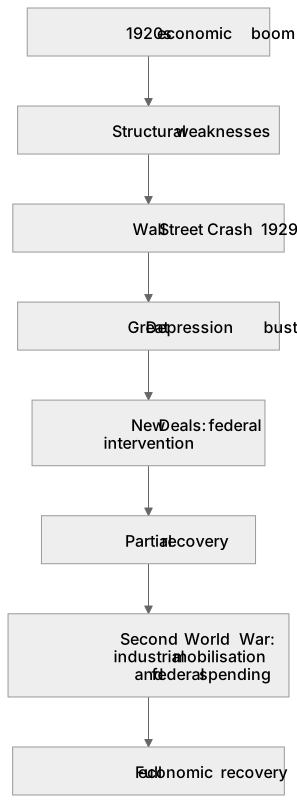
Put it in order
Put these steps in the order they happen.
- 1. New Deals: federal intervention
- 2. Full economic recovery
- 3. Partial recovery
- 4. 1920s economic boom
- 5. Structural weaknesses
- 6. Second World War: industrial mobilisation and federal spending
- 7. Wall Street Crash 1929
- 8. Great Depression bust
Key words
Say what each word means before you turn the card.
Structural weaknesses
Try answering aloud or in your head before turning the card.
Boom and bust cycles
Try answering aloud or in your head before turning the card.
Industrial mobilisation
Try answering aloud or in your head before turning the card.
Economic intervention
Try answering aloud or in your head before turning the card.
See every definition
- Structural weaknesses
- Severe flaws such as agricultural overproduction, unequal wealth distribution and unregulated banking that undermined the 1920s economic boom.
- Boom and bust cycles
- The 1920s economic boom, driven by mass production and consumer credit, followed by the bust of the Great Depression after the 1929 Wall Street Crash.
- Industrial mobilisation
- The massive expansion of manufacturing capacity and federal spending necessitated by the Second World War, which eradicated unemployment and achieved full recovery.
- Economic intervention
- Federal action through Roosevelt's New Deals, creating agencies like the NRA and PWA to stimulate employment and reform banking, though recovery was only partial.
Label the diagram
Some boxes have lost their names. Pick the right name for each number.
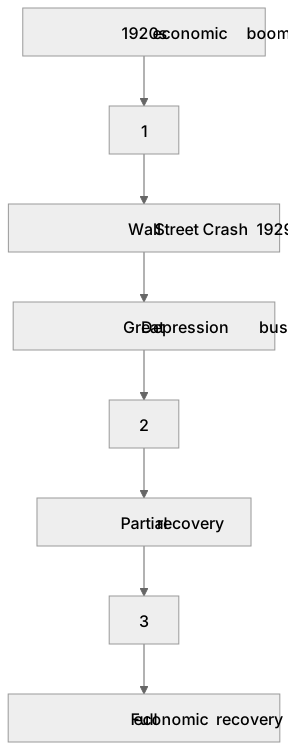
1Box 1
2Box 2
3Box 3
There is more to this lesson
The full lesson goes on to check your understanding and help you earn the marks. Create a free account to carry on, with your progress saved.
A week of Premium from your first lesson · Then the free plan continues · No card, no charge
Test your understanding of 1K The making of a Superpower: USA, 1865–1975 – only) Crisis of identity, 1920–1945 (A-level only): The economy: boom to bust and recovery; structural weaknesses and the impact of the New Deals and the Second World War on economic recovery
Active recall beats re-reading. Take an instant quiz now to test what you’ve learned and lock it into long-term memory.
A week of Premium from your first lesson · Then the free plan continues · No card, no charge