AQA · A-Level · History
Course version: 7042 · Version from Sept 2017
USA, 1865–1975 – Populism, progressivism and imperialism, 1890–1920:…
Full specification wording
1K The making of a Superpower: USA, 1865–1975 – Populism, progressivism and imperialism, 1890–1920: Economic change and developments: the rise of US dominance as an economic and industrial power and the consequences of this
Between 1890 and 1920, the United States experienced unprecedented economic change and development, transforming into the world's dominant economic and industrial power.
Checked against the AQA 7042 specification (opens in a new tab) on .
- Point 3 of 6
- 3 key terms
Study notes
From the checked teaching notes for this specification point.
The idea
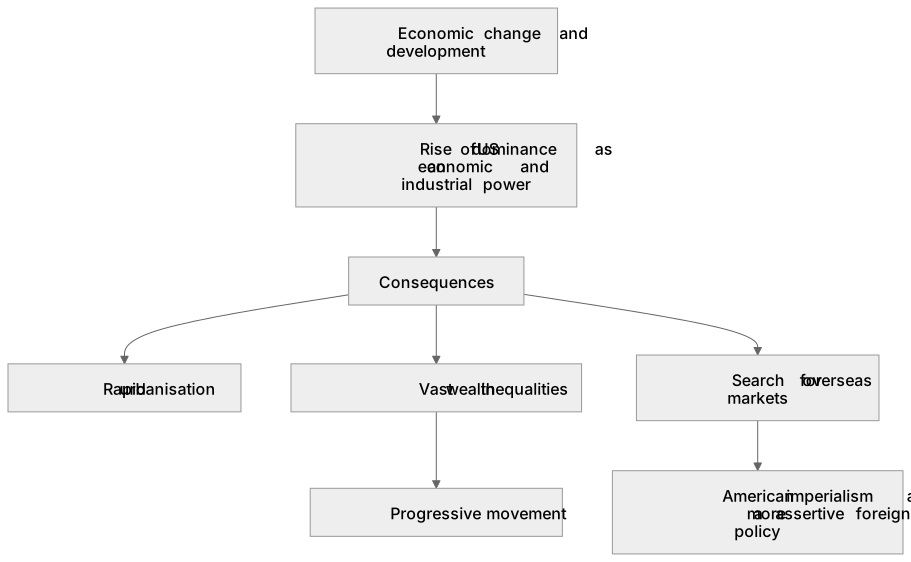
Between 1890 and 1920, the United States experienced unprecedented economic change and development, transforming into the world's dominant economic and industrial power. This era saw massive industrial expansion, driven by abundant natural resources, technological innovation, and the growth of monopolies like Carnegie Steel and Standard Oil. The rise of US dominance was cemented by the First World War, which shifted global financial power from London to Wall Street as European nations became heavily indebted to American banks. The consequences of this industrial and economic supremacy were profound: it fuelled rapid urbanisation, created vast wealth inequalities that spurred the Progressive movement, and necessitated the search for overseas markets, directly contributing to American imperialism and a more assertive foreign policy.
What earns the marks
- Identify key drivers of industrial growth, such as technological advancements, abundant raw materials, and a rapidly expanding labour force.
- Explain the role of trusts and monopolies in consolidating economic power and driving industrial efficiency at the expense of competition.
- Evaluate the impact of the First World War on the US economy, specifically its transition from a debtor nation to a major global creditor.
- Analyse the domestic consequences of economic dominance, including severe wealth disparity, the rise of organised labour, and Progressive reforms.
- Assess the foreign policy consequences, demonstrating how the need for new overseas markets drove imperialist expansion in Latin America and the Pacific.
Common mistakes and how to put them right
Assuming the US only became an economic power after the First World War.
Put it right: Recognise that the US had already surpassed Britain in manufacturing output by the 1890s.
Treating economic growth as universally beneficial.
Put it right: Acknowledge the severe wealth inequalities, poor working conditions, and cyclical depressions that accompanied industrialisation.
Ignoring the link between industrialisation and foreign policy.
Put it right: Explicitly connect the surplus of manufactured goods to the imperialist drive for new overseas markets.
Exam tips
- Use specific statistics, such as coal or steel production figures, to substantiate claims about the scale and speed of US industrial dominance.
- Link economic developments directly to political changes, showing how industrial monopolies prompted Progressive anti-trust legislation.
- When discussing consequences, ensure you balance domestic impacts, such as urbanisation, with international impacts, such as the shift in global financial power.
Try the lesson
The start of the 1K The making of a Superpower: USA, 1865–1975 – Populism, progressivism and imperialism, 1890–1920: Economic change and developments: the rise of US dominance as an economic and industrial power and the consequences of this lesson, made from checked teaching notes for this specification point.
Have a go first
Which of the following was a primary driver of the rapid expansion of United States industrial power between 1890 and 1920?
Listen
Between 1890 and 1920, the United States experienced unprecedented economic change and development, transforming into the world's dominant economic and industrial power. This era saw massive industrial expansion, driven by abundant natural resources, technological innovation, and the growth of monopolies like Carnegie Steel and Standard Oil. The rise of US dominance was cemented by the First World War, which shifted global financial power from London to Wall Street as European nations became heavily indebted to American banks. The consequences of this industrial and economic supremacy were profound: it fuelled rapid urbanisation, created vast wealth inequalities that spurred the Progressive movement, and necessitated the search for overseas markets, directly contributing to American imperialism and a more assertive foreign policy. A strong answer earns marks for these points. Identify key drivers of industrial growth, such as technological advancements, abundant raw materials, and a rapidly expanding labour force. Explain the role of trusts and monopolies in consolidating economic power and driving industrial efficiency at the expense of competition. Evaluate the impact of the First World War on the US economy, specifically its transition from a debtor nation to a major global creditor. Analyse the domestic consequences of economic dominance, including severe wealth disparity, the rise of organised labour, and Progressive reforms. A common slip: Assuming the US only became an economic power after the First World War. Instead, recognise that the US had already surpassed Britain in manufacturing output by the 1890s. Exam tip: Use specific statistics, such as coal or steel production figures, to substantiate claims about the scale and speed of US industrial dominance.
See it
Key words
Say what each word means before you turn the card.
Industrialisation
Try answering aloud or in your head before turning the card.
Capitalism and Monopolies
Try answering aloud or in your head before turning the card.
Progressivism
Try answering aloud or in your head before turning the card.
See every definition
- Industrialisation
- Massive industrial expansion driven by abundant natural resources, technological innovation and a rapidly expanding labour force.
- Capitalism and Monopolies
- The growth of monopolies and trusts consolidating economic power and driving industrial efficiency at the expense of competition.
- Progressivism
- A movement spurred by vast wealth inequalities created by industrial and economic supremacy.
Label the diagram
Some boxes have lost their names. Pick the right name for each number.
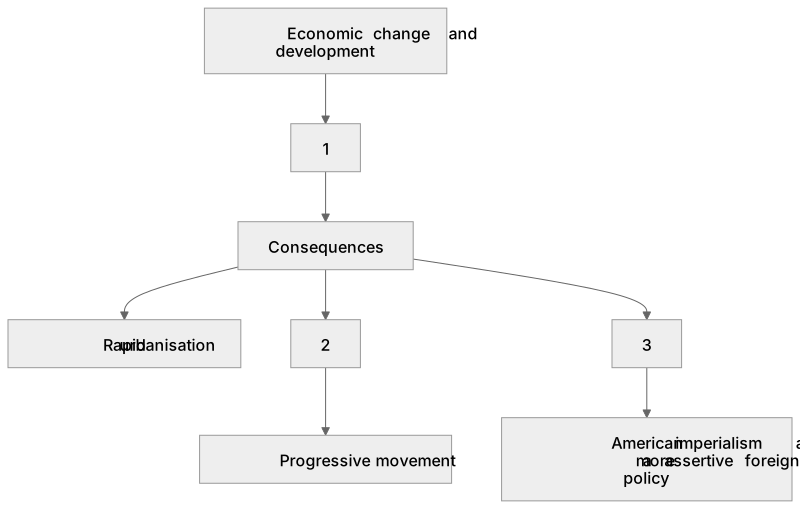
1Box 1
2Box 2
3Box 3
There is more to this lesson
The full lesson goes on to check your understanding and help you earn the marks. Create a free account to carry on, with your progress saved.
A week of Premium from your first lesson · Then the free plan continues · No card, no charge
Test your understanding of 1K The making of a Superpower: USA, 1865–1975 – Populism, progressivism and imperialism, 1890–1920: Economic change and developments: the rise of US dominance as an economic and industrial power and the consequences of this
Active recall beats re-reading. Take an instant quiz now to test what you’ve learned and lock it into long-term memory.
A week of Premium from your first lesson · Then the free plan continues · No card, no charge