AQA · A-Level · History
Course version: 7042 · Version from Sept 2017
USA, 1865–1975 – Populism, progressivism and imperialism, 1890–1920:…
Full specification wording
1K The making of a Superpower: USA, 1865–1975 – Populism, progressivism and imperialism, 1890–1920: Social developments: mass immigration and urbanisation and their consequences; the position of African-Americans
The period from 1890 to 1920 witnessed transformative social developments in the USA, primarily driven by mass immigration and rapid urbanisation.
Checked against the AQA 7042 specification (opens in a new tab) on .
- Point 4 of 6
- 4 key terms
Study notes
From the checked teaching notes for this specification point.
The idea
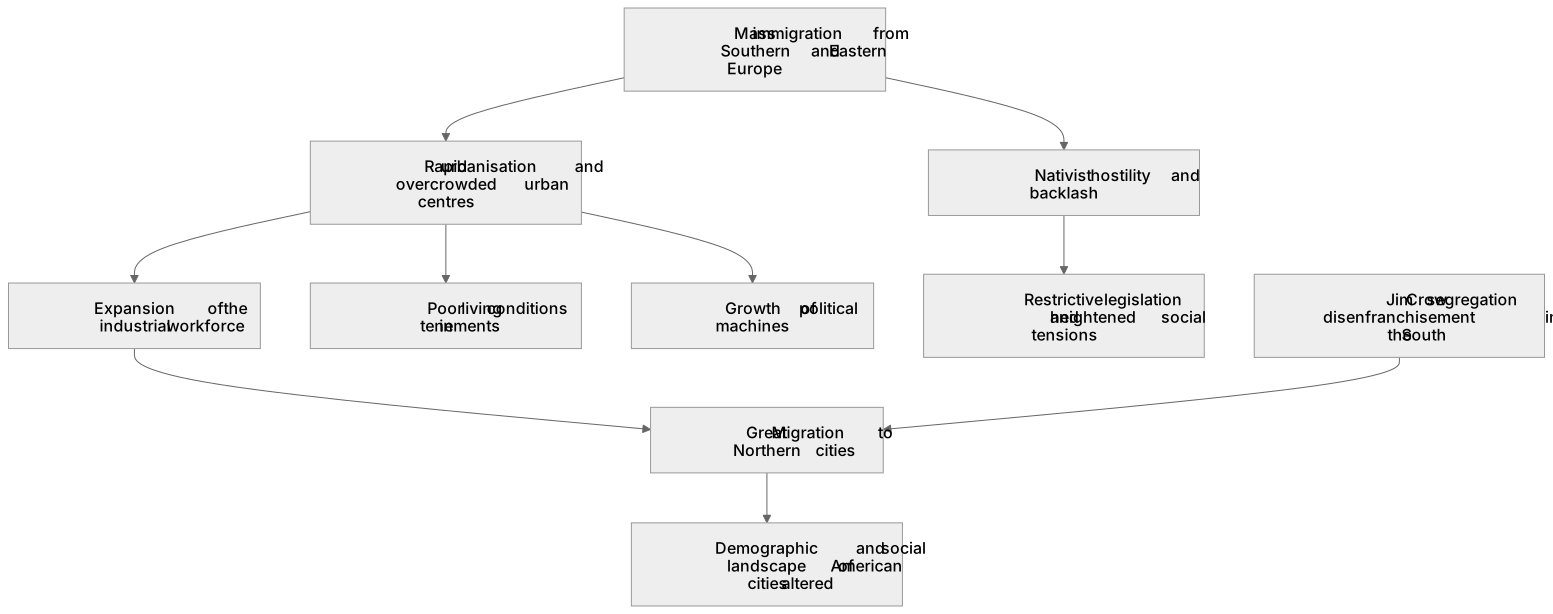
The period from 1890 to 1920 witnessed transformative social developments in the USA, primarily driven by mass immigration and rapid urbanisation. Millions of 'new immigrants' arrived from Southern and Eastern Europe, settling in overcrowded urban centres like New York and Chicago. The consequences included the rapid expansion of the industrial workforce, the rise of political machines like Tammany Hall, and increased nativist hostility. Concurrently, the position of African-Americans remained severely marginalised. Despite the abolition of slavery, Southern states enforced rigid segregation through Jim Crow laws and disenfranchised black voters. This systemic oppression, combined with the demand for industrial labour in the North, triggered the beginning of the Great Migration, fundamentally altering the demographic and social landscape of American cities.
What earns the marks
- Detail the demographic shift caused by 'new immigration' from Southern and Eastern Europe and its impact on urban population density.
- Analyse the consequences of urbanisation, including poor living conditions in tenements, the growth of political machines, and the expansion of the industrial workforce.
- Evaluate the nativist backlash against mass immigration, leading to restrictive legislation and heightened social tensions.
- Assess the position of African-Americans in the South, focusing on disenfranchisement, Jim Crow segregation laws, and the prevalence of lynching.
- Explain the causes and early consequences of the Great Migration of African-Americans to Northern cities during the First World War.
Common mistakes and how to put them right
Conflating 'old' and 'new' immigration.
Put it right: Distinguish between earlier Northern and Western European immigrants and the post-1890 influx from Southern and Eastern Europe.
Assuming African-Americans experienced equality in the North.
Put it right: Note that while escaping Southern Jim Crow laws, they still faced de facto segregation, discrimination, and race riots in Northern cities.
Treating urbanisation and immigration as separate phenomena.
Put it right: Explicitly link the two, showing how immigrant labour fuelled urban industrial growth and shaped city demographics.
Exam tips
- Use specific examples of legislation or Supreme Court rulings, such as Plessy v. Ferguson (1896), to illustrate the legal entrenchment of segregation.
- Contrast the differing philosophies of African-American leaders, such as Booker T. Washington and W.E.B. Du Bois, when discussing responses to their social position.
- Connect social developments to political movements, demonstrating how urban poverty and immigrant exploitation fuelled Progressive reform efforts.
Try the lesson
The start of the 1K The making of a Superpower: USA, 1865–1975 – Populism, progressivism and imperialism, 1890–1920: Social developments: mass immigration and urbanisation and their consequences; the position of African-Americans lesson, made from checked teaching notes for this specification point.
Have a go first
What was a major social consequence of the rapid urbanisation and mass immigration experienced by the United States between 1890 and 1920?
Listen
The period from 1890 to 1920 witnessed transformative social developments in the USA, primarily driven by mass immigration and rapid urbanisation. Millions of 'new immigrants' arrived from Southern and Eastern Europe, settling in overcrowded urban centres like New York and Chicago. The consequences included the rapid expansion of the industrial workforce, the rise of political machines like Tammany Hall, and increased nativist hostility. Concurrently, the position of African-Americans remained severely marginalised. Despite the abolition of slavery, Southern states enforced rigid segregation through Jim Crow laws and disenfranchised black voters. This systemic oppression, combined with the demand for industrial labour in the North, triggered the beginning of the Great Migration, fundamentally altering the demographic and social landscape of American cities. A strong answer earns marks for these points. Detail the demographic shift caused by 'new immigration' from Southern and Eastern Europe and its impact on urban population density. Analyse the consequences of urbanisation, including poor living conditions in tenements, the growth of political machines, and the expansion of the industrial workforce. Evaluate the nativist backlash against mass immigration, leading to restrictive legislation and heightened social tensions. Assess the position of African-Americans in the South, focusing on disenfranchisement, Jim Crow segregation laws, and the prevalence of lynching. A common slip: Conflating 'old' and 'new' immigration. Instead, distinguish between earlier Northern and Western European immigrants and the post-1890 influx from Southern and Eastern Europe. Exam tip: Use specific examples of legislation or Supreme Court rulings, such as Plessy v. Ferguson (1896), to illustrate the legal entrenchment of segregation.
See it
Key words
Say what each word means before you turn the card.
Migration and Immigration
Try answering aloud or in your head before turning the card.
Urbanisation
Try answering aloud or in your head before turning the card.
Racial Inequality
Try answering aloud or in your head before turning the card.
Nativism
Try answering aloud or in your head before turning the card.
See every definition
- Migration and Immigration
- Mass immigration of 'new immigrants' from Southern and Eastern Europe, settling in overcrowded urban centres, combined with the Great Migration of African-Americans to Northern cities.
- Urbanisation
- Rapid urban growth with overcrowded urban centres, poor living conditions in tenements, the growth of political machines and expansion of the industrial workforce.
- Racial Inequality
- The severely marginalised position of African-Americans, with rigid segregation through Jim Crow laws, disenfranchisement of black voters and the prevalence of lynching.
- Nativism
- Nativist hostility and backlash against mass immigration, leading to restrictive legislation and heightened social tensions.
Label the diagram
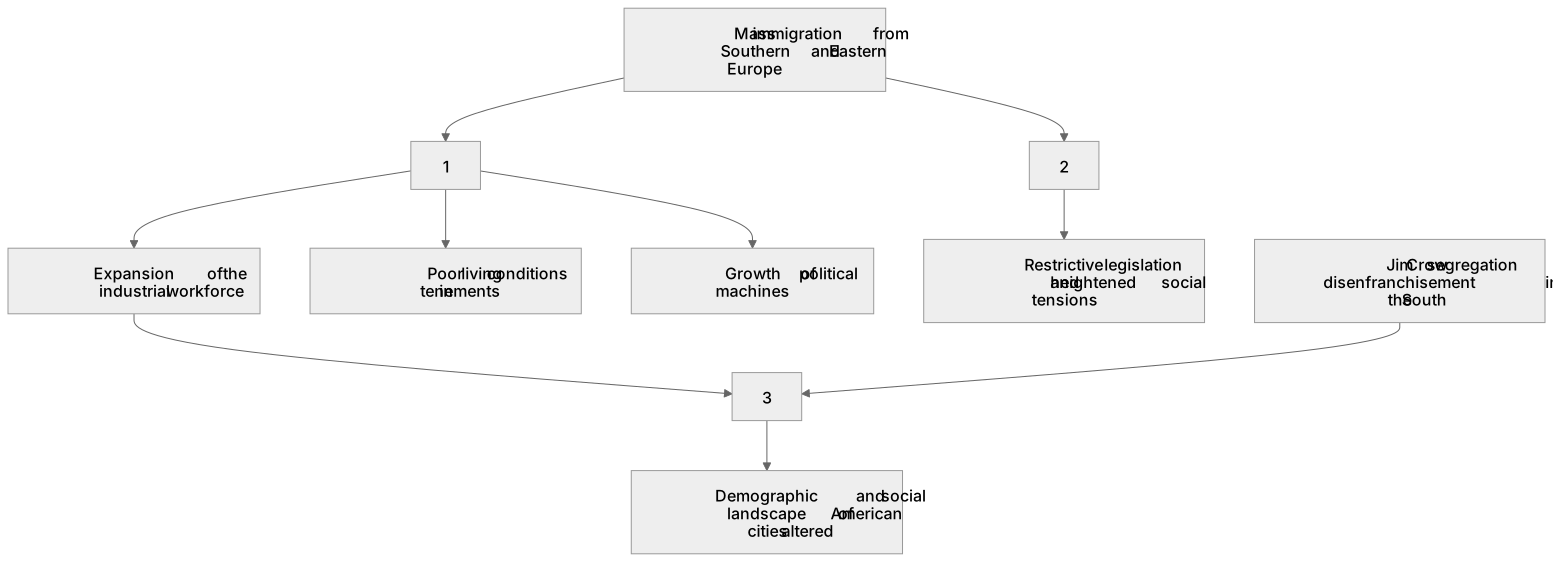
Some boxes have lost their names. Pick the right name for each number.
1Box 1
2Box 2
3Box 3
There is more to this lesson
The full lesson goes on to check your understanding and help you earn the marks. Create a free account to carry on, with your progress saved.
A week of Premium from your first lesson · Then the free plan continues · No card, no charge
Test your understanding of 1K The making of a Superpower: USA, 1865–1975 – Populism, progressivism and imperialism, 1890–1920: Social developments: mass immigration and urbanisation and their consequences; the position of African-Americans
Active recall beats re-reading. Take an instant quiz now to test what you’ve learned and lock it into long-term memory.
A week of Premium from your first lesson · Then the free plan continues · No card, no charge