AQA · A-Level · History
Course version: 7042 · Version from Sept 2017
USA, 1865–1975 – The Superpower, 1945–1975 (A-level only): Economic change…
Full specification wording
1K The making of a Superpower: USA, 1865–1975 – The Superpower, 1945–1975 (A-level only): Economic change and developments: the rise of the consumer society and economic boom
The post-1945 era witnessed an unprecedented economic boom in the USA, transforming it into a dominant global superpower.
Checked against the AQA 7042 specification (opens in a new tab) on .
- Point 3 of 6
- 3 key terms
Study notes
From the checked teaching notes for this specification point.
The idea
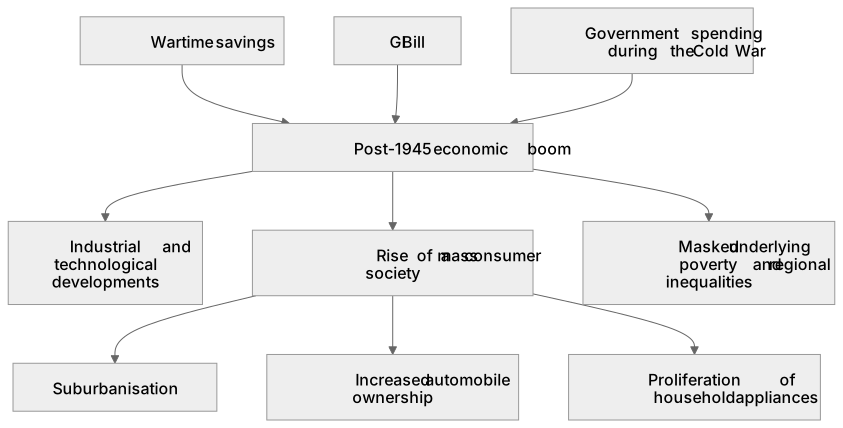
The post-1945 era witnessed an unprecedented economic boom in the USA, transforming it into a dominant global superpower. This economic change was driven by wartime savings, the GI Bill, and government spending during the Cold War, which stimulated industrial and technological developments. Consequently, a mass consumer society rose, characterised by suburbanisation (such as Levittown), increased automobile ownership, and the proliferation of household appliances. This shift from a production-focused economy to one driven by domestic consumption fundamentally altered American lifestyles, though it also masked underlying poverty and regional inequalities.
What earns the marks
- Identify the key drivers of the post-war economic boom, including the GI Bill, federal highway construction, and Cold War defence spending.
- Explain the characteristics of the new consumer society, such as the rapid growth of suburbs, shopping malls, and the advertising industry.
- Analyse the impact of technological developments on domestic life, specifically the widespread adoption of televisions, cars, and white goods.
- Evaluate the limitations of this economic change, noting that the boom disproportionately benefited white, middle-class Americans while leaving many minorities in poverty.
Common mistakes and how to put them right
Assuming the economic boom benefited all Americans equally.
Put it right by highlighting the persistence of poverty in inner cities and rural areas, particularly among ethnic minorities.
Attributing the rise of the consumer society solely to private enterprise.
Put it right by acknowledging the crucial role of federal government policies, such as the GI Bill and the Federal-Aid Highway Act.
Confusing the post-WWII economic boom with the 1920s boom.
Put it right by focusing on post-1945 specific developments like the military-industrial complex and suburbanisation.
Exam tips
- Use specific statistics, such as the increase in car ownership or Gross National Product (GNP) between 1945 and 1960, to substantiate claims about the economic boom.
- Link economic developments to social changes, demonstrating how the rise of the consumer society facilitated the growth of the suburbs and altered family dynamics.
- When evaluating the extent of economic change, always consider the counter-argument regarding those left behind by the affluent society.
Try the lesson
The start of the 1K The making of a Superpower: USA, 1865–1975 – The Superpower, 1945–1975 (A-level only): Economic change and developments: the rise of the consumer society and economic boom lesson, made from checked teaching notes for this specification point.
Have a go first
What was a primary driver of the rapid expansion of the American consumer society in the 1950s?
Listen
The post-1945 era witnessed an unprecedented economic boom in the USA, transforming it into a dominant global superpower. This economic change was driven by wartime savings, the GI Bill, and government spending during the Cold War, which stimulated industrial and technological developments. Consequently, a mass consumer society rose, characterised by suburbanisation (such as Levittown), increased automobile ownership, and the proliferation of household appliances. This shift from a production-focused economy to one driven by domestic consumption fundamentally altered American lifestyles, though it also masked underlying poverty and regional inequalities. A strong answer earns marks for these points. Identify the key drivers of the post-war economic boom, including the GI Bill, federal highway construction, and Cold War defence spending. Explain the characteristics of the new consumer society, such as the rapid growth of suburbs, shopping malls, and the advertising industry. Analyse the impact of technological developments on domestic life, specifically the widespread adoption of televisions, cars, and white goods. Evaluate the limitations of this economic change, noting that the boom disproportionately benefited white, middle-class Americans while leaving many minorities in poverty. A common slip: Assuming the economic boom benefited all Americans equally. Instead, highlighting the persistence of poverty in inner cities and rural areas, particularly among ethnic minorities. Exam tip: Use specific statistics, such as the increase in car ownership or Gross National Product (GNP) between 1945 and 1960, to substantiate claims about the economic boom.
See it
Key words
Say what each word means before you turn the card.
Economic prosperity and inequality
Try answering aloud or in your head before turning the card.
Suburbanisation and demographic shifts
Try answering aloud or in your head before turning the card.
Technological advancement and consumerism
Try answering aloud or in your head before turning the card.
See every definition
- Economic prosperity and inequality
- The post-war boom masked underlying poverty and regional inequalities, disproportionately benefiting white, middle-class Americans while leaving many minorities in poverty.
- Suburbanisation and demographic shifts
- A mass consumer society rose, characterised by suburbanisation such as Levittown, increased automobile ownership and the proliferation of household appliances.
- Technological advancement and consumerism
- Technological developments altered domestic life through the widespread adoption of televisions, cars and white goods, shifting the economy from production to domestic consumption.
Label the diagram
Some boxes have lost their names. Pick the right name for each number.
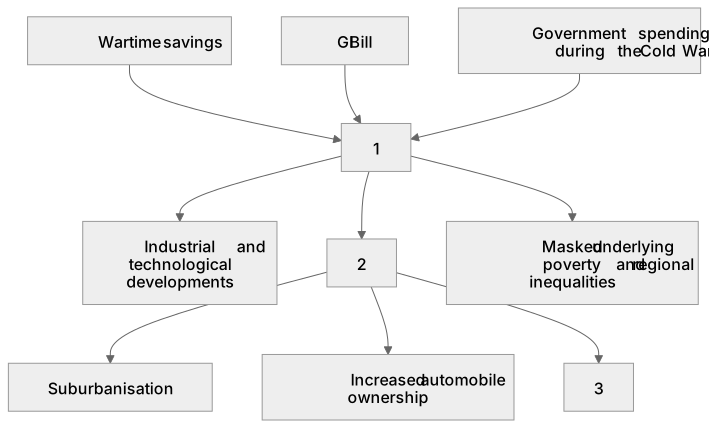
1Box 1
2Box 2
3Box 3
There is more to this lesson
The full lesson goes on to check your understanding and help you earn the marks. Create a free account to carry on, with your progress saved.
A week of Premium from your first lesson · Then the free plan continues · No card, no charge
Test your understanding of 1K The making of a Superpower: USA, 1865–1975 – The Superpower, 1945–1975 (A-level only): Economic change and developments: the rise of the consumer society and economic boom
Active recall beats re-reading. Take an instant quiz now to test what you’ve learned and lock it into long-term memory.
A week of Premium from your first lesson · Then the free plan continues · No card, no charge