AQA · A-Level · History
Course version: 7042 · Version from Sept 2017
Germany, 1871–1991 – The Kaiserreich, 1871–1914: Government and…
Full specification wording
1L The quest for political stability: Germany, 1871–1991 – The Kaiserreich, 1871–1914: Government and opposition: Kaiser Wilhelm II and his chancellors; personalities and policies; the place of the Reichstag; the struggle between autocracy and democracy; the development of parties and political opposition
Kaiser Wilhelm II’s reign was defined by his erratic personality and desire for 'personal rule', frequently clashing with chancellors like Caprivi, Bülow, and Bethmann-Hollweg.
Checked against the AQA 7042 specification (opens in a new tab) on .
- Point 3 of 6
- 4 key terms
Study notes
From the checked teaching notes for this specification point.
The idea
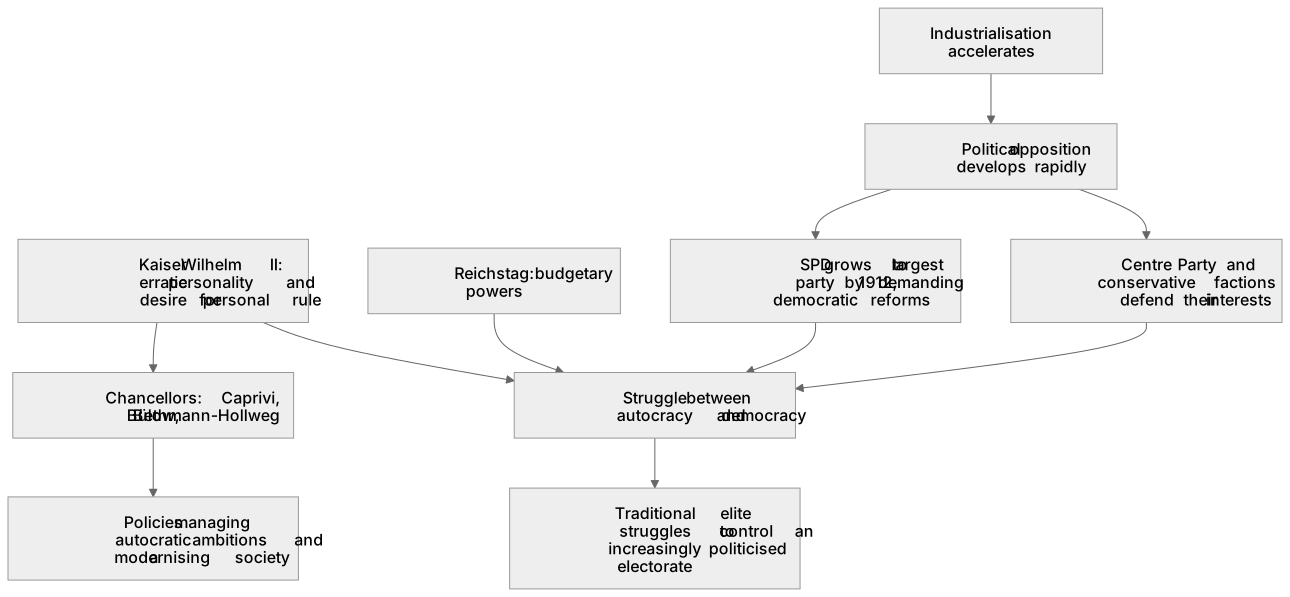
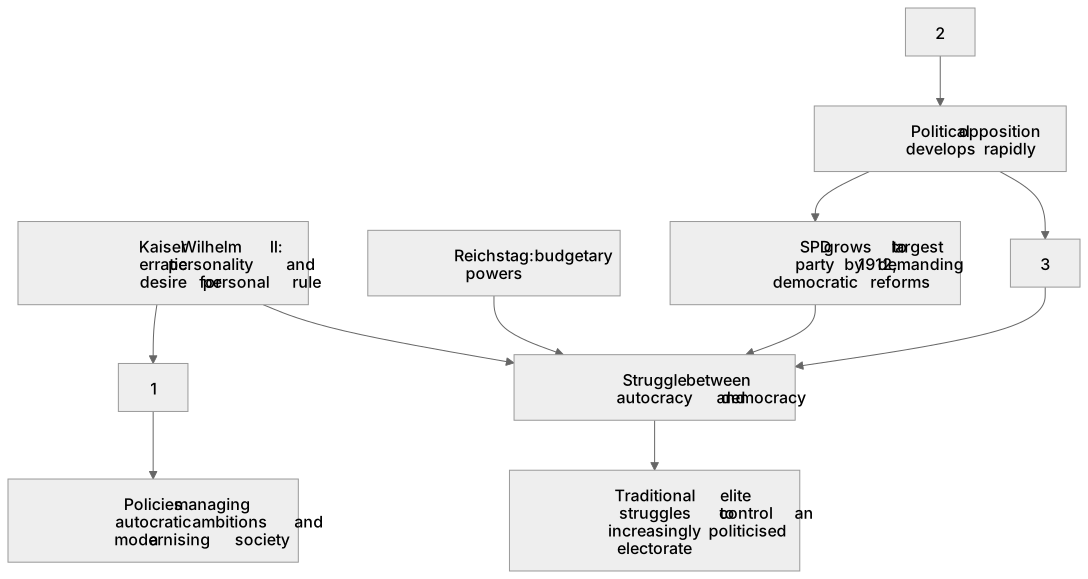
Kaiser Wilhelm II’s reign was defined by his erratic personality and desire for 'personal rule', frequently clashing with chancellors like Caprivi, Bülow, and Bethmann-Hollweg. Their policies reflected attempts to manage his autocratic ambitions while navigating a modernising society. The Reichstag held vital budgetary powers, making it a crucial battleground in the struggle between autocracy and democracy. As industrialisation accelerated, political opposition developed rapidly. The Social Democratic Party (SPD) grew to become the largest party by 1912, demanding democratic reforms, while the Centre Party and conservative factions defended their interests. This created a volatile landscape where the traditional elite struggled to maintain control over an increasingly politicised electorate.
What earns the marks
- Evaluate the impact of Wilhelm II's personality on the stability of the German government.
- Assess the effectiveness of the chancellors in managing both the Kaiser and the Reichstag.
- Analyse the constitutional role of the Reichstag and its limitations in challenging autocratic power.
- Explain the growth of the SPD and its significance as a source of political opposition.
- Discuss the tension between the autocratic executive and the democratic elements of the constitution.
Common mistakes and how to put them right
Assuming the Reichstag had no power.
Put it right: Acknowledge that while the Chancellor was not accountable to the Reichstag, it had significant legislative and budgetary powers, such as voting on the military budget.
Treating the chancellors as mere puppets of the Kaiser.
Put it right: Recognise that chancellors like Bülow and Bethmann-Hollweg had their own policy agendas and sometimes manipulated or opposed the Kaiser.
Viewing the SPD as a purely revolutionary threat.
Put it right: Understand that the SPD was divided between revolutionary Marxists and reformists who sought change through democratic parliamentary means.
Exam tips
- Use specific examples of clashes between the Kaiser and his chancellors, such as the Daily Telegraph Affair (1908), to illustrate the limits of personal rule.
- When discussing the struggle between autocracy and democracy, contrast the democratic franchise of the Reichstag with the autocratic Prussian three-class voting system.
- Track the electoral performance of the SPD and the Centre Party to demonstrate the growing challenge to the conservative establishment.
Try the lesson
The start of the 1L The quest for political stability: Germany, 1871–1991 – The Kaiserreich, 1871–1914: Government and opposition: Kaiser Wilhelm II and his chancellors; personalities and policies; the place of the Reichstag; the struggle between autocracy and democracy; the development of parties and political opposition lesson, made from checked teaching notes for this specification point.
Have a go first
Which of the following accurately describes the constitutional relationship between Kaiser Wilhelm II and his Chancellors?
Listen
Kaiser Wilhelm II’s reign was defined by his erratic personality and desire for 'personal rule', frequently clashing with chancellors like Caprivi, Bülow, and Bethmann-Hollweg. Their policies reflected attempts to manage his autocratic ambitions while navigating a modernising society. The Reichstag held vital budgetary powers, making it a crucial battleground in the struggle between autocracy and democracy. As industrialisation accelerated, political opposition developed rapidly. The Social Democratic Party (SPD) grew to become the largest party by 1912, demanding democratic reforms, while the Centre Party and conservative factions defended their interests. This created a volatile landscape where the traditional elite struggled to maintain control over an increasingly politicised electorate. A strong answer earns marks for these points. Evaluate the impact of Wilhelm II's personality on the stability of the German government. Assess the effectiveness of the chancellors in managing both the Kaiser and the Reichstag. Analyse the constitutional role of the Reichstag and its limitations in challenging autocratic power. Explain the growth of the SPD and its significance as a source of political opposition. A common slip: Assuming the Reichstag had no power. Instead, Acknowledge that while the Chancellor was not accountable to the Reichstag, it had significant legislative and budgetary powers, such as voting on the military budget. Exam tip: Use specific examples of clashes between the Kaiser and his chancellors, such as the Daily Telegraph Affair (1908), to illustrate the limits of personal rule.
See it
Key words
Say what each word means before you turn the card.
Autocracy vs Democracy
Try answering aloud or in your head before turning the card.
Political Opposition
Try answering aloud or in your head before turning the card.
Constitutional Power
Try answering aloud or in your head before turning the card.
Leadership and Personality
Try answering aloud or in your head before turning the card.
See every definition
- Autocracy vs Democracy
- The struggle between autocratic ambitions and democratic elements, with the Reichstag's budgetary powers making it a crucial battleground.
- Political Opposition
- Developed rapidly as industrialisation accelerated, with the Social Democratic Party demanding democratic reforms while the Centre Party and conservative factions defended their interests.
- Constitutional Power
- The Reichstag held vital budgetary powers, though the Chancellor was not accountable to it.
- Leadership and Personality
- Kaiser Wilhelm II's reign was defined by his erratic personality and desire for 'personal rule', frequently clashing with his chancellors.
Label the diagram
Some boxes have lost their names. Pick the right name for each number.
1Box 1
2Box 2
3Box 3
There is more to this lesson
The full lesson goes on to check your understanding and help you earn the marks. Create a free account to carry on, with your progress saved.
A week of Premium from your first lesson · Then the free plan continues · No card, no charge
Test your understanding of 1L The quest for political stability: Germany, 1871–1991 – The Kaiserreich, 1871–1914: Government and opposition: Kaiser Wilhelm II and his chancellors; personalities and policies; the place of the Reichstag; the struggle between autocracy and democracy; the development of parties and political opposition
Active recall beats re-reading. Take an instant quiz now to test what you’ve learned and lock it into long-term memory.
A week of Premium from your first lesson · Then the free plan continues · No card, no charge