AQA · A-Level · History
Course version: 7042 · Version from Sept 2017
Attempts to maintain the Yorkist cause: Margaret of Burgundy, the Earl of…
Full specification wording
2B The Wars of the Roses, 1450–1499 – The end of the Yorkist Dynasty, 1486–1499 (A-level only): Attempts to maintain the Yorkist cause: Margaret of Burgundy, the Earl of Warwick and the Pretender Perkin Warbeck
The Yorkist cause was sustained through a combination of legitimate claimants and foreign-backed pretenders.
Checked against the AQA 7042 specification (opens in a new tab) on .
- Point 2 of 4
- 4 key terms
Study notes
From the checked teaching notes for this specification point.
The idea
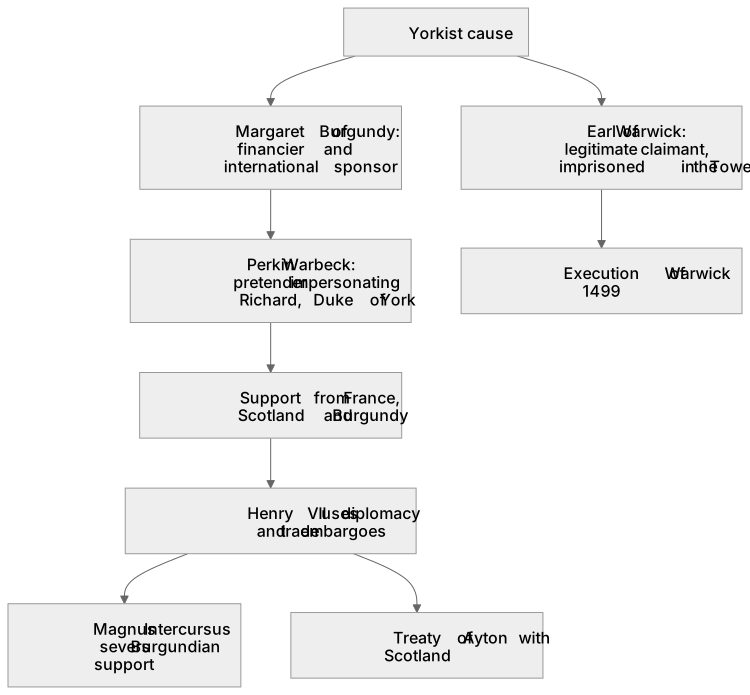
The Yorkist cause was sustained through a combination of legitimate claimants and foreign-backed pretenders. Edward, Earl of Warwick, the nephew of Edward IV, was the most legitimate Yorkist claimant; despite being imprisoned in the Tower by Henry VII, he remained a potent symbol for rebellions until his execution in 1499. Margaret of Burgundy, sister to Edward IV, was the chief financier and international sponsor of Yorkist plots, using her court as a safe haven for exiles. She heavily backed Perkin Warbeck, who impersonated Richard, Duke of York, for nearly a decade. Warbeck's persistent threat relied on support from France, Scotland, and Burgundy, forcing Henry VII to use diplomacy and trade embargoes to neutralise the network.
What earns the marks
- Analyse the strategic importance of Margaret of Burgundy as a financier and international sponsor of Yorkist opposition.
- Evaluate the threat posed by the Earl of Warwick as a legitimate figurehead, explaining why Henry VII kept him imprisoned and eventually executed him.
- Assess the longevity of the Perkin Warbeck threat, attributing his survival to the shifting diplomatic support from France, Burgundy, and Scotland.
- Examine Henry VII's methods for dealing with Warbeck, including the use of the Magnus Intercursus to sever Burgundian support and the Treaty of Ayton with Scotland.
Common mistakes and how to put them right
Stating that the Earl of Warwick actively led rebellions against Henry VII.
Put it right: He was imprisoned in the Tower of London from 1485 and was used as a figurehead by others.
Claiming Perkin Warbeck was a legitimate Yorkist heir.
Put it right: He was a pretender from Tournai who impersonated Richard, Duke of York, one of the Princes in the Tower.
Viewing Margaret of Burgundy's opposition as purely emotional.
Put it right by acknowledging her strategic use of trade and diplomacy to destabilise the Tudor regime.
Exam tips
- Link domestic Yorkist threats to foreign policy, demonstrating how Henry VII used treaties to strip pretenders of their international backing.
- Contrast the threat of Perkin Warbeck with Lambert Simnel, noting that Warbeck's threat was prolonged and diplomatic, whereas Simnel's culminated in a pitched battle.
- Discuss the execution of the Earl of Warwick in 1499 as a turning point that finally extinguished the direct male Yorkist line and secured the Spanish marriage alliance.
Try the lesson
The start of the 2B The Wars of the Roses, 1450–1499 – The end of the Yorkist Dynasty, 1486–1499 (A-level only): Attempts to maintain the Yorkist cause: Margaret of Burgundy, the Earl of Warwick and the Pretender Perkin Warbeck lesson, made from checked teaching notes for this specification point.
Have a go first
Which historical figure did the pretender Perkin Warbeck claim to be during his prolonged challenge to Henry VII's throne?
Listen
The Yorkist cause was sustained through a combination of legitimate claimants and foreign-backed pretenders. Edward, Earl of Warwick, the nephew of Edward IV, was the most legitimate Yorkist claimant; despite being imprisoned in the Tower by Henry VII, he remained a potent symbol for rebellions until his execution in 1499. Margaret of Burgundy, sister to Edward IV, was the chief financier and international sponsor of Yorkist plots, using her court as a safe haven for exiles. She heavily backed Perkin Warbeck, who impersonated Richard, Duke of York, for nearly a decade. Warbeck's persistent threat relied on support from France, Scotland, and Burgundy, forcing Henry VII to use diplomacy and trade embargoes to neutralise the network. A strong answer earns marks for these points. Analyse the strategic importance of Margaret of Burgundy as a financier and international sponsor of Yorkist opposition. Evaluate the threat posed by the Earl of Warwick as a legitimate figurehead, explaining why Henry VII kept him imprisoned and eventually executed him. Assess the longevity of the Perkin Warbeck threat, attributing his survival to the shifting diplomatic support from France, Burgundy, and Scotland. Examine Henry VII's methods for dealing with Warbeck, including the use of the Magnus Intercursus to sever Burgundian support and the Treaty of Ayton with Scotland. A common slip: Viewing Margaret of Burgundy's opposition as purely emotional. Instead, acknowledging her strategic use of trade and diplomacy to destabilise the Tudor regime. Exam tip: Link domestic Yorkist threats to foreign policy, demonstrating how Henry VII used treaties to strip pretenders of their international backing.
See it
Key words
Say what each word means before you turn the card.
Pretenders
Try answering aloud or in your head before turning the card.
Dynastic legitimacy
Try answering aloud or in your head before turning the card.
Foreign policy
Try answering aloud or in your head before turning the card.
Tudor consolidation
Try answering aloud or in your head before turning the card.
See every definition
- Pretenders
- Individuals such as Perkin Warbeck who impersonated a Yorkist claimant, relying on foreign backing and forcing Henry VII to use diplomacy and trade embargoes.
- Dynastic legitimacy
- The standing of a claimant such as Edward, Earl of Warwick, the nephew of Edward IV, as the most legitimate Yorkist claimant and a potent symbol for rebellions.
- Foreign policy
- Henry VII's use of diplomacy and trade embargoes to neutralise the network supporting Warbeck, including the Magnus Intercursus and the Treaty of Ayton.
- Tudor consolidation
- Securing the regime by keeping the Earl of Warwick imprisoned in the Tower and eventually executing him in 1499, a turning point that extinguished the direct male Yorkist line.
Label the diagram
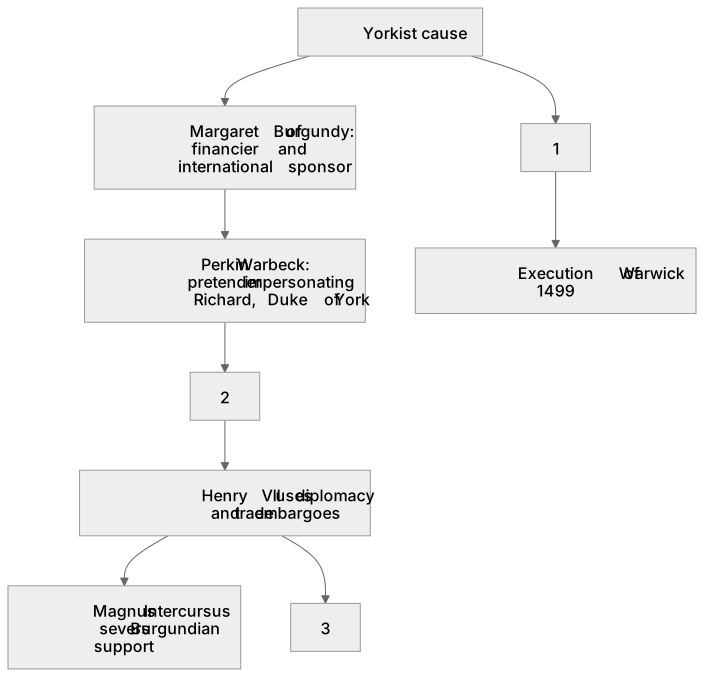
Some boxes have lost their names. Pick the right name for each number.
1Box 1
2Box 2
3Box 3
There is more to this lesson
The full lesson goes on to check your understanding and help you earn the marks. Create a free account to carry on, with your progress saved.
A week of Premium from your first lesson · Then the free plan continues · No card, no charge
Test your understanding of 2B The Wars of the Roses, 1450–1499 – The end of the Yorkist Dynasty, 1486–1499 (A-level only): Attempts to maintain the Yorkist cause: Margaret of Burgundy, the Earl of Warwick and the Pretender Perkin Warbeck
Active recall beats re-reading. Take an instant quiz now to test what you’ve learned and lock it into long-term memory.
A week of Premium from your first lesson · Then the free plan continues · No card, no charge