AQA · A-Level · History
Course version: 7042 · Version from Sept 2017
The Reformation Parliament: MPs and expression of grievances; pressures on…
Full specification wording
2D Religious conflict and the Church in England, c1529– c1570 – The break from Rome, c1529–1536: The Reformation Parliament: MPs and expression of grievances; pressures on the Papacy; legislation leading to the establishment of Royal Supremacy
The Reformation Parliament (1529–1536) was instrumental in dismantling papal authority in England.
Checked against the AQA 7042 specification (opens in a new tab) on .
- Point 2 of 4
- 2 key terms
Study notes
From the checked teaching notes for this specification point.
The idea
The Reformation Parliament (1529–1536) was instrumental in dismantling papal authority in England. Initially, MPs expressed deep-seated anti-clerical grievances, targeting Church abuses like pluralism and mortuary fees, which Thomas Cromwell weaponised to pressure the clergy. To exert pressure on the Papacy to grant Henry's annulment, Parliament passed the Conditional Restraint of Annates (1532), threatening Rome's revenues. When Pope Clement VII remained unyielding, the strategy shifted from pressure to a complete break. Radical legislation followed, notably the Act in Restraint of Appeals (1533), preventing legal appeals to Rome, and the Act of Supremacy (1534), which legally established Henry VIII as the Supreme Head of the Church of England.
What earns the marks
- Detail the specific anti-clerical grievances raised by MPs, such as the Supplication against the Ordinaries (1532), and how these were manipulated by the Crown.
- Explain the tactical use of early legislation, like the Conditional Restraint of Annates, as a diplomatic tool to pressure the Papacy rather than an immediate break.
- Trace the legislative progression from restricting papal revenue and legal jurisdiction (Act in Restraint of Appeals) to the formal declaration of Royal Supremacy.
- Evaluate the role of Thomas Cromwell in managing Parliament and drafting the statutes that legally severed ties with Rome.
Common mistakes and how to put them right
Stating that the Reformation Parliament was called specifically to break with Rome.
Put it right: It was initially called to pressure the Pope and address anti-clerical grievances.
Confusing the Act of Supremacy with the Act in Restraint of Appeals.
Put it right: The latter was the crucial legal mechanism that allowed Cranmer to annul the marriage before the Supremacy Act was passed.
Assuming MPs were universally Protestant.
Put it right: Most MPs were motivated by anti-clericalism and financial grievances rather than reformist theology.
Exam tips
- Memorise the chronological order of key legislation (Annates, Appeals, Supremacy) to accurately trace the escalation of the break with Rome.
- Distinguish between the Crown's use of Parliament to pressure the Pope (1529-1532) and its use to establish an independent national church (1533-1534).
- Highlight the concept of 'King-in-Parliament' to show how the legislative process enhanced the authority of both the monarch and Parliament.
Try the lesson
The start of the 2D Religious conflict and the Church in England, c1529– c1570 – The break from Rome, c1529–1536: The Reformation Parliament: MPs and expression of grievances; pressures on the Papacy; legislation leading to the establishment of Royal Supremacy lesson, made from checked teaching notes for this specification point.
Have a go first
Which of the following was a primary grievance expressed by Members of Parliament against the clergy during the early sessions of the Reformation Parliament?
Listen
The Reformation Parliament (1529–1536) was instrumental in dismantling papal authority in England. Initially, MPs expressed deep-seated anti-clerical grievances, targeting Church abuses like pluralism and mortuary fees, which Thomas Cromwell weaponised to pressure the clergy. To exert pressure on the Papacy to grant Henry's annulment, Parliament passed the Conditional Restraint of Annates (1532), threatening Rome's revenues. When Pope Clement VII remained unyielding, the strategy shifted from pressure to a complete break. Radical legislation followed, notably the Act in Restraint of Appeals (1533), preventing legal appeals to Rome, and the Act of Supremacy (1534), which legally established Henry VIII as the Supreme Head of the Church of England. A strong answer earns marks for these points. Detail the specific anti-clerical grievances raised by MPs, such as the Supplication against the Ordinaries (1532), and how these were manipulated by the Crown. Explain the tactical use of early legislation, like the Conditional Restraint of Annates, as a diplomatic tool to pressure the Papacy rather than an immediate break. Trace the legislative progression from restricting papal revenue and legal jurisdiction (Act in Restraint of Appeals) to the formal declaration of Royal Supremacy. Evaluate the role of Thomas Cromwell in managing Parliament and drafting the statutes that legally severed ties with Rome. Exam tip: Memorise the chronological order of key legislation (Annates, Appeals, Supremacy) to accurately trace the escalation of the break with Rome.
See it
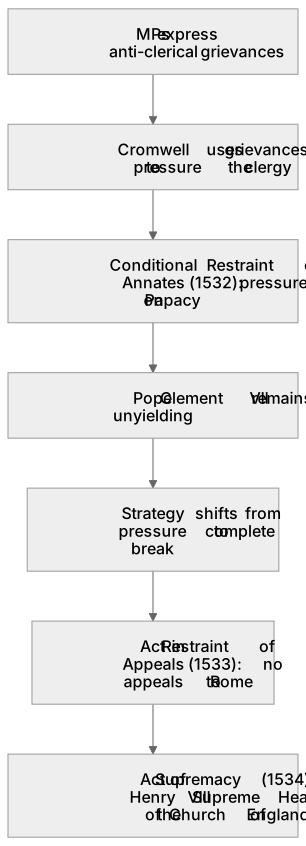
Put it in order
Put these steps in the order they happen.
- 1. Act of Supremacy (1534): Henry VIII Supreme Head of the Church of England
- 2. Act in Restraint of Appeals (1533): no appeals to Rome
- 3. Conditional Restraint of Annates (1532): pressure on Papacy
- 4. Strategy shifts from pressure to complete break
- 5. MPs express anti-clerical grievances
- 6. Cromwell uses grievances to pressure the clergy
- 7. Pope Clement VII remains unyielding
Put the events in order
Put these events in the order they happened, earliest first.
- 1. Supplication against the Ordinaries raised anti-clerical grievances
- 2. Act of Supremacy established Henry VIII as Supreme Head
- 3. Act in Restraint of Appeals prevented legal appeals to Rome
Key words
Say what each word means before you turn the card.
Anti-clericalism
Try answering aloud or in your head before turning the card.
Royal Supremacy
Try answering aloud or in your head before turning the card.
See every definition
- Anti-clericalism
- Deep-seated grievances expressed by MPs targeting Church abuses like pluralism and mortuary fees.
- Royal Supremacy
- Established by the Act of Supremacy (1534), which legally made Henry VIII the Supreme Head of the Church of England.
Label the diagram
Some boxes have lost their names. Pick the right name for each number.
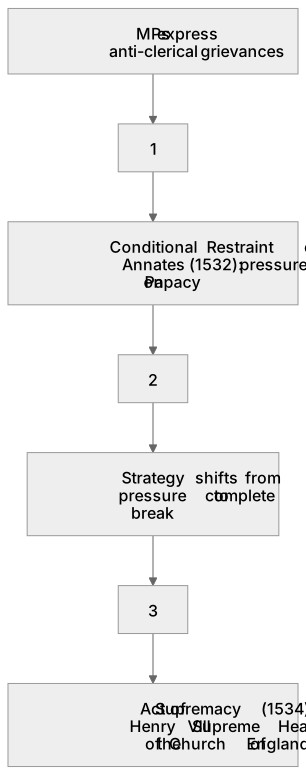
1Box 1
2Box 2
3Box 3
There is more to this lesson
The full lesson goes on to check your understanding and help you earn the marks. Create a free account to carry on, with your progress saved.
A week of Premium from your first lesson · Then the free plan continues · No card, no charge
Test your understanding of 2D Religious conflict and the Church in England, c1529– c1570 – The break from Rome, c1529–1536: The Reformation Parliament: MPs and expression of grievances; pressures on the Papacy; legislation leading to the establishment of Royal Supremacy
Active recall beats re-reading. Take an instant quiz now to test what you’ve learned and lock it into long-term memory.
A week of Premium from your first lesson · Then the free plan continues · No card, no charge