AQA · A-Level · History
Course version: 7042 · Version from Sept 2017
Mussolini’s foreign policy ambitions: the restoration of prestige; the…
Full specification wording
2L Italy and Fascism, c1900–1945 – Fascist foreign policies, 1926–1940 (A-level only): Mussolini’s foreign policy ambitions: the restoration of prestige; the Mediterranean and ‘Mare Nostrum’; empire in Africa
Mussolini’s foreign policy was driven by the desire to restore Italian prestige, aiming to overturn the 'mutilated victory' of 1918 and project Italy as a great power.
Checked against the AQA 7042 specification (opens in a new tab) on .
- Point 1 of 4
Study notes
From the checked teaching notes for this specification point.
The idea
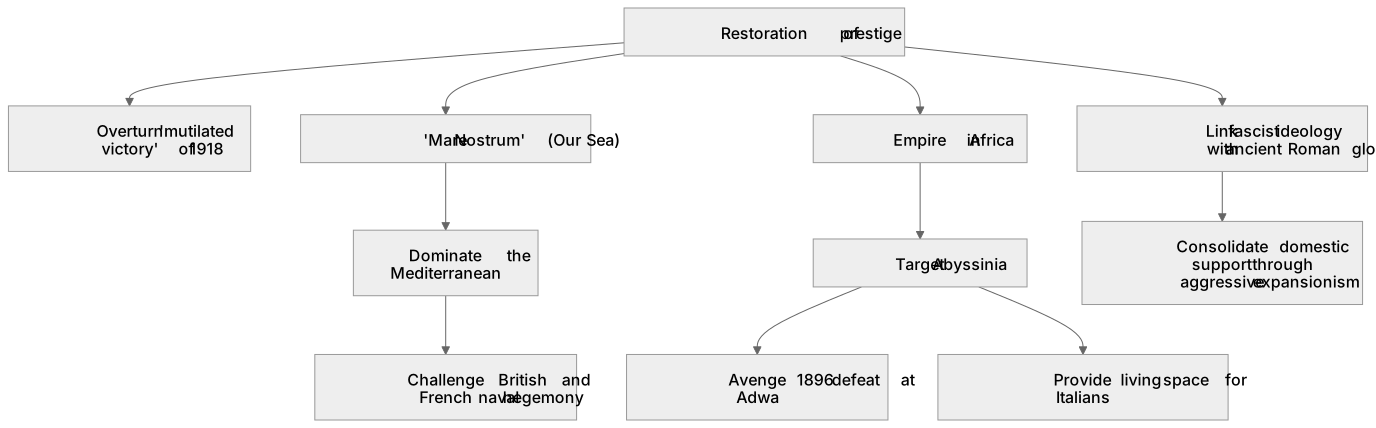
Mussolini’s foreign policy was driven by the desire to restore Italian prestige, aiming to overturn the 'mutilated victory' of 1918 and project Italy as a great power. Central to this was the concept of 'Mare Nostrum' (Our Sea), an ambition to dominate the Mediterranean and challenge British and French naval hegemony. This ideological drive for dominance extended to building an empire in Africa, specifically targeting Abyssinia to avenge the 1896 defeat at Adwa and provide living space for Italians. By linking fascist ideology with ancient Roman glory, Mussolini sought to consolidate domestic support through aggressive expansionism, ultimately destabilising the international order in his pursuit of imperial grandeur.
What earns the marks
- Identify the ideological link between the restoration of national prestige and the myth of ancient Rome in Fascist propaganda.
- Explain the strategic and ideological significance of 'Mare Nostrum', including the desire to control Mediterranean naval routes.
- Analyse the motivations behind the African empire, particularly the invasion of Abyssinia as a means to avenge Adwa and gain resources.
- Evaluate how foreign policy ambitions were used to distract from domestic economic issues and consolidate Mussolini's personal dictatorship.
Common mistakes and how to put them right
Assuming 'Mare Nostrum' was purely a defensive strategy.
Put it right: Recognise that it was an aggressive, expansionist ambition aimed at challenging British and French dominance in the Mediterranean.
Treating the invasion of Abyssinia solely as an economic venture.
Put it right: Acknowledge the crucial ideological motivation of restoring prestige by avenging the historical Italian defeat at Adwa in 1896.
Viewing Mussolini's foreign policy as entirely consistent from 1922.
Put it right: Understand that his ambitions became markedly more aggressive and imperialistic in the 1930s compared to his earlier, more cautious approach.
Exam tips
- Use the phrase 'mutilated victory' to contextualise why the restoration of prestige was so vital to Mussolini's domestic popularity.
- Link the concept of 'Mare Nostrum' directly to Italy's geopolitical tensions with Britain and France over naval bases and trade routes.
- When discussing the African empire, explicitly mention Abyssinia and Libya as concrete examples of Fascist expansionism.
Try the lesson
The start of the 2L Italy and Fascism, c1900–1945 – Fascist foreign policies, 1926–1940 (A-level only): Mussolini’s foreign policy ambitions: the restoration of prestige; the Mediterranean and ‘Mare Nostrum’; empire in Africa lesson, made from checked teaching notes for this specification point.
Have a go first
What did Mussolini mean by the concept of 'Mare Nostrum' in the context of his foreign policy ambitions?
Listen
Mussolini’s foreign policy was driven by the desire to restore Italian prestige, aiming to overturn the 'mutilated victory' of 1918 and project Italy as a great power. Central to this was the concept of 'Mare Nostrum' (Our Sea), an ambition to dominate the Mediterranean and challenge British and French naval hegemony. This ideological drive for dominance extended to building an empire in Africa, specifically targeting Abyssinia to avenge the 1896 defeat at Adwa and provide living space for Italians. By linking fascist ideology with ancient Roman glory, Mussolini sought to consolidate domestic support through aggressive expansionism, ultimately destabilising the international order in his pursuit of imperial grandeur. A strong answer earns marks for these points. Identify the ideological link between the restoration of national prestige and the myth of ancient Rome in Fascist propaganda. Explain the strategic and ideological significance of 'Mare Nostrum', including the desire to control Mediterranean naval routes. Analyse the motivations behind the African empire, particularly the invasion of Abyssinia as a means to avenge Adwa and gain resources. Evaluate how foreign policy ambitions were used to distract from domestic economic issues and consolidate Mussolini's personal dictatorship. A common slip: Assuming 'Mare Nostrum' was purely a defensive strategy. Instead, Recognise that it was an aggressive, expansionist ambition aimed at challenging British and French dominance in the Mediterranean. Exam tip: Use the phrase 'mutilated victory' to contextualise why the restoration of prestige was so vital to Mussolini's domestic popularity.
See it
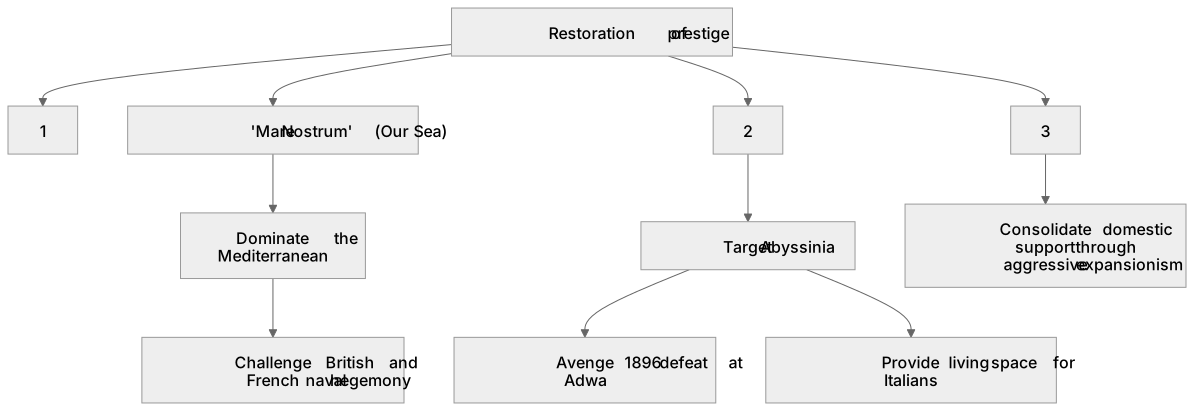
Label the diagram
Some boxes have lost their names. Pick the right name for each number.
1Box 1
2Box 2
3Box 3
There is more to this lesson
The full lesson goes on to check your understanding and help you earn the marks. Create a free account to carry on, with your progress saved.
A week of Premium from your first lesson · Then the free plan continues · No card, no charge
Test your understanding of 2L Italy and Fascism, c1900–1945 – Fascist foreign policies, 1926–1940 (A-level only): Mussolini’s foreign policy ambitions: the restoration of prestige; the Mediterranean and ‘Mare Nostrum’; empire in Africa
Active recall beats re-reading. Take an instant quiz now to test what you’ve learned and lock it into long-term memory.
A week of Premium from your first lesson · Then the free plan continues · No card, no charge