AQA · A-Level · History
Course version: 7042 · Version from Sept 2017
Mussolini the statesman: relations with Britain and France; Italian…
Full specification wording
2L Italy and Fascism, c1900–1945 – Fascist foreign policies, 1926–1940 (A-level only): Mussolini the statesman: relations with Britain and France; Italian influence in Austria; the Stresa Front
Mussolini cultivated the image of an international statesman in the early 1930s, balancing relations with Britain and France to secure Italian interests.
Checked against the AQA 7042 specification (opens in a new tab) on .
- Point 2 of 4
Study notes
From the checked teaching notes for this specification point.
The idea
Mussolini cultivated the image of an international statesman in the early 1930s, balancing relations with Britain and France to secure Italian interests. A key priority was maintaining Italian influence in Austria to prevent German expansion to the Brenner Pass, demonstrated when Mussolini mobilised troops to deter a Nazi coup following Dollfuss's assassination in 1934. This statesman era peaked with the 1935 Stresa Front, an agreement with Britain and France reaffirming the Locarno Treaties and opposing German rearmament. However, this diplomatic alignment was fragile and ultimately shattered by Italy's subsequent invasion of Abyssinia, revealing the limits of Mussolini's cooperation with the Western democracies.
What earns the marks
- Assess Mussolini's diplomatic strategies in maintaining cooperative relations with Britain and France prior to 1935.
- Explain the strategic importance of Austria as a buffer state and Mussolini's actions to protect it from German annexation in 1934.
- Analyse the formation and objectives of the Stresa Front as a collective response to German rearmament.
- Evaluate the contradictions between Mussolini's role as a European statesman and his underlying expansionist ambitions.
Common mistakes and how to put them right
Confusing the Stresa Front with a formal military alliance.
Put it right: Define the Stresa Front as a diplomatic declaration against German rearmament, not a binding military pact.
Assuming Mussolini was always allied with Hitler.
Put it right: Emphasise that in 1934, Mussolini actively opposed Hitler's ambitions in Austria by mobilising Italian troops to the border.
Overlooking the ambiguity of the Stresa Front regarding colonial expansion.
Put it right: Note that Mussolini believed the Stresa Front gave him tacit approval from Britain and France to pursue his African ambitions.
Exam tips
- Use the 1934 assassination of Austrian Chancellor Dollfuss as a concrete example of Mussolini acting to contain German influence.
- Discuss the Stresa Front as the high point of Mussolini's 'statesman' phase before the Abyssinian Crisis alienated him from the West.
- Contrast Mussolini's diplomatic cooperation with Britain and France with his simultaneous preparations for imperial expansion.
Try the lesson
The start of the 2L Italy and Fascism, c1900–1945 – Fascist foreign policies, 1926–1940 (A-level only): Mussolini the statesman: relations with Britain and France; Italian influence in Austria; the Stresa Front lesson, made from checked teaching notes for this specification point.
Have a go first
What was the primary purpose of the Stresa Front, agreed by Italy, Britain, and France in April 1935?
Listen
Mussolini cultivated the image of an international statesman in the early 1930s, balancing relations with Britain and France to secure Italian interests. A key priority was maintaining Italian influence in Austria to prevent German expansion to the Brenner Pass, demonstrated when Mussolini mobilised troops to deter a Nazi coup following Dollfuss's assassination in 1934. This statesman era peaked with the 1935 Stresa Front, an agreement with Britain and France reaffirming the Locarno Treaties and opposing German rearmament. However, this diplomatic alignment was fragile and ultimately shattered by Italy's subsequent invasion of Abyssinia, revealing the limits of Mussolini's cooperation with the Western democracies. A strong answer earns marks for these points. Assess Mussolini's diplomatic strategies in maintaining cooperative relations with Britain and France prior to 1935. Explain the strategic importance of Austria as a buffer state and Mussolini's actions to protect it from German annexation in 1934. Analyse the formation and objectives of the Stresa Front as a collective response to German rearmament. Evaluate the contradictions between Mussolini's role as a European statesman and his underlying expansionist ambitions. A common slip: Confusing the Stresa Front with a formal military alliance. Instead, Define the Stresa Front as a diplomatic declaration against German rearmament, not a binding military pact. Exam tip: Use the 1934 assassination of Austrian Chancellor Dollfuss as a concrete example of Mussolini acting to contain German influence.
See it
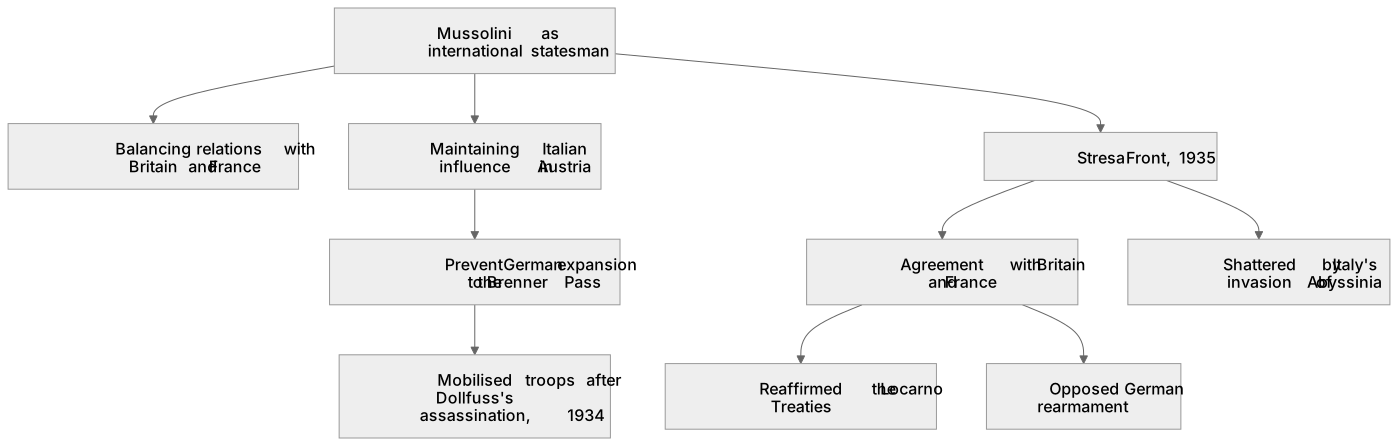
Label the diagram
Some boxes have lost their names. Pick the right name for each number.
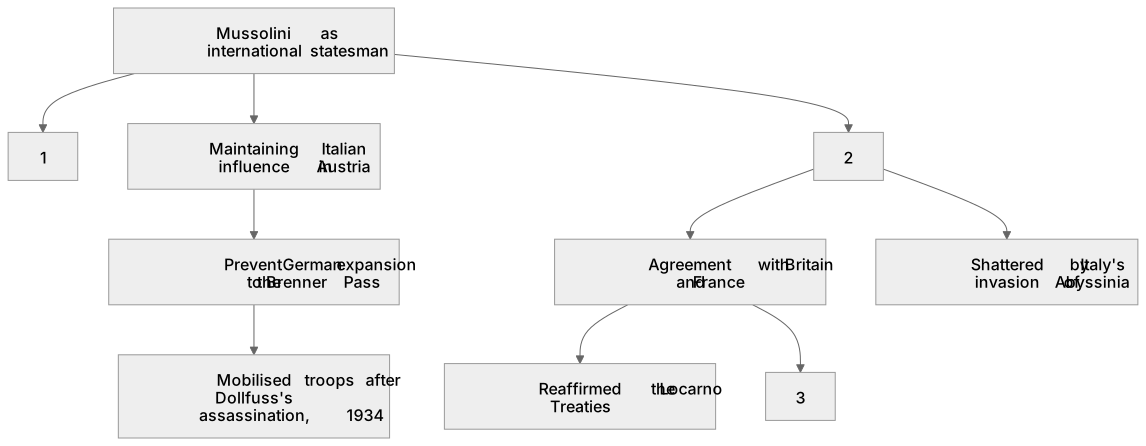
1Box 1
2Box 2
3Box 3
There is more to this lesson
The full lesson goes on to check your understanding and help you earn the marks. Create a free account to carry on, with your progress saved.
A week of Premium from your first lesson · Then the free plan continues · No card, no charge
Test your understanding of 2L Italy and Fascism, c1900–1945 – Fascist foreign policies, 1926–1940 (A-level only): Mussolini the statesman: relations with Britain and France; Italian influence in Austria; the Stresa Front
Active recall beats re-reading. Take an instant quiz now to test what you’ve learned and lock it into long-term memory.
A week of Premium from your first lesson · Then the free plan continues · No card, no charge