AQA · A-Level · History
Course version: 7042 · Version from Sept 2017
Germany, 1918–1945 – The Collapse of Democracy, 1928–1933: The appeal of…
Full specification wording
2O Democracy and Nazism: Germany, 1918–1945 – The Collapse of Democracy, 1928–1933: The appeal of Nazism and Communism; the tactics and fortunes of the extremist parties, including the role of propaganda
The Depression fuelled the fortunes of extremist parties, as the KPD and NSDAP offered radical solutions.
Checked against the AQA 7042 specification (opens in a new tab) on .
- Point 2 of 4
Study notes
From the checked teaching notes for this specification point.
The idea
The Depression fuelled the fortunes of extremist parties, as the KPD and NSDAP offered radical solutions. The appeal of Communism lay in its promise of a workers' state, attracting millions of unemployed labourers. KPD tactics included street violence and rent strikes. Conversely, the appeal of Nazism spanned broader demographics, promising national renewal and anti-Marxism. Nazi tactics combined the SA's physical intimidation with sophisticated propaganda orchestrated by Goebbels. This propaganda utilised mass rallies, targeted posters, and modern technology to project Hitler as Germany's saviour, ultimately making the NSDAP the largest Reichstag party by 1932, contrasting with the KPD's more limited electoral ceiling.
What earns the marks
- Analyse the specific appeal of the KPD to the unemployed and working classes, focusing on their promise to overthrow capitalism and establish a Soviet-style state.
- Evaluate the broad-based appeal of the NSDAP, noting their ability to attract the Mittelstand, farmers, and nationalists through promises of economic recovery and anti-communism.
- Assess the tactics used by extremist parties, including the deliberate use of paramilitary violence by the SA and the Rotfrontkämpferbund to dominate the streets and project strength.
- Examine the role of Nazi propaganda, directed by Joseph Goebbels, in tailoring specific messages to different social groups while maintaining a unifying cult of the Führer.
- Compare the electoral fortunes of the KPD and NSDAP between 1928 and 1932, explaining why the Nazis achieved a mass breakthrough while the KPD's support remained concentrated.
Common mistakes and how to put them right
Stating that Nazi propaganda was the sole reason for their electoral success.
Put it right: Emphasise that propaganda was effective because it exploited existing underlying grievances caused by the Depression and the failures of the Weimar Republic.
Treating the KPD and SPD as a united left-wing front against fascism.
Put it right: Highlight the bitter division between the KPD and SPD, noting that the KPD labelled the SPD as 'social fascists', which fatally divided the working-class resistance to Nazism.
Assuming the Nazis hid their anti-Semitism entirely during elections.
Put it right: Clarify that while anti-Semitism was downplayed in favour of economic messages in some areas, it remained a core component of their propaganda, particularly when scapegoating minorities for Germany's crises.
Exam tips
- Contrast the rigid, class-based appeal of the KPD with the flexible, catch-all nature of Nazi propaganda to explain the difference in their ultimate electoral fortunes.
- Use specific examples of Nazi propaganda techniques, such as the 'Hitler over Germany' flight campaign of 1932, to demonstrate their modern and dynamic tactics.
- Discuss how the fear of Communism (the 'Red Threat') directly boosted the appeal of Nazism among middle-class and elite voters who sought a strong bulwark against a Bolshevik revolution.
Try the lesson
The start of the 2O Democracy and Nazism: Germany, 1918–1945 – The Collapse of Democracy, 1928–1933: The appeal of Nazism and Communism; the tactics and fortunes of the extremist parties, including the role of propaganda lesson, made from checked teaching notes for this specification point.
Have a go first
Which tactic was most prominently used by the Nazi Party (NSDAP) to broaden its appeal to the German electorate between 1929 and 1932?
Listen
The Depression fuelled the fortunes of extremist parties, as the KPD and NSDAP offered radical solutions. The appeal of Communism lay in its promise of a workers' state, attracting millions of unemployed labourers. KPD tactics included street violence and rent strikes. Conversely, the appeal of Nazism spanned broader demographics, promising national renewal and anti-Marxism. Nazi tactics combined the SA's physical intimidation with sophisticated propaganda orchestrated by Goebbels. This propaganda utilised mass rallies, targeted posters, and modern technology to project Hitler as Germany's saviour, ultimately making the NSDAP the largest Reichstag party by 1932, contrasting with the KPD's more limited electoral ceiling. A strong answer earns marks for these points. Analyse the specific appeal of the KPD to the unemployed and working classes, focusing on their promise to overthrow capitalism and establish a Soviet-style state. Evaluate the broad-based appeal of the NSDAP, noting their ability to attract the Mittelstand, farmers, and nationalists through promises of economic recovery and anti-communism. Assess the tactics used by extremist parties, including the deliberate use of paramilitary violence by the SA and the Rotfrontkämpferbund to dominate the streets and project strength. Examine the role of Nazi propaganda, directed by Joseph Goebbels, in tailoring specific messages to different social groups while maintaining a unifying cult of the Führer. A common slip: Stating that Nazi propaganda was the sole reason for their electoral success. Instead, Emphasise that propaganda was effective because it exploited existing underlying grievances caused by the Depression and the failures of the Weimar Republic. Exam tip: Contrast the rigid, class-based appeal of the KPD with the flexible, catch-all nature of Nazi propaganda to explain the difference in their ultimate electoral fortunes.
See it
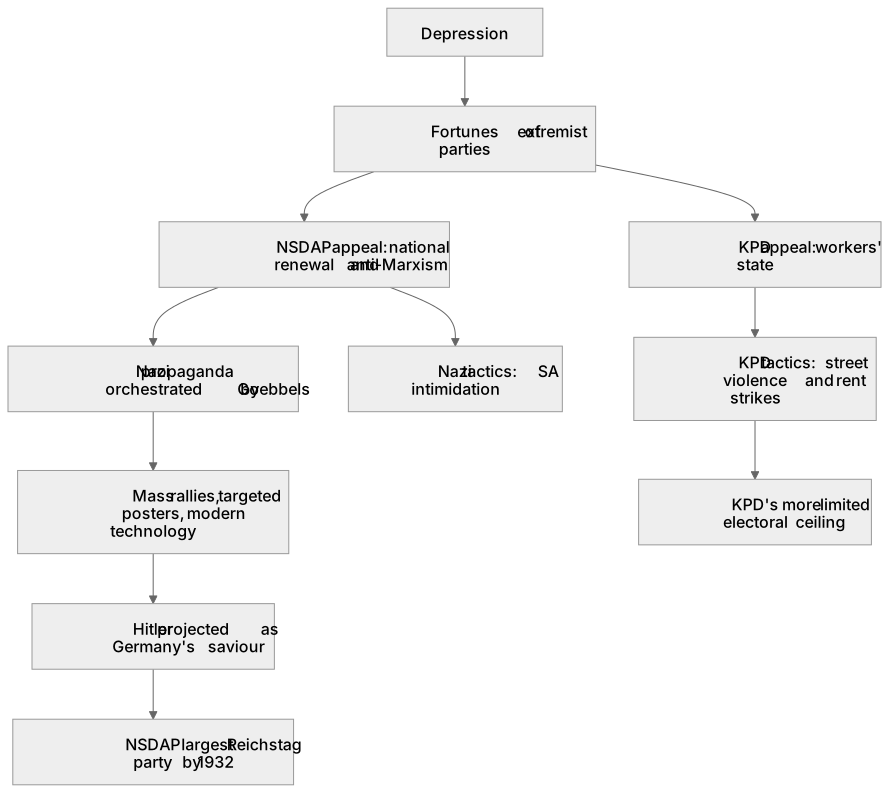
Label the diagram
Some boxes have lost their names. Pick the right name for each number.
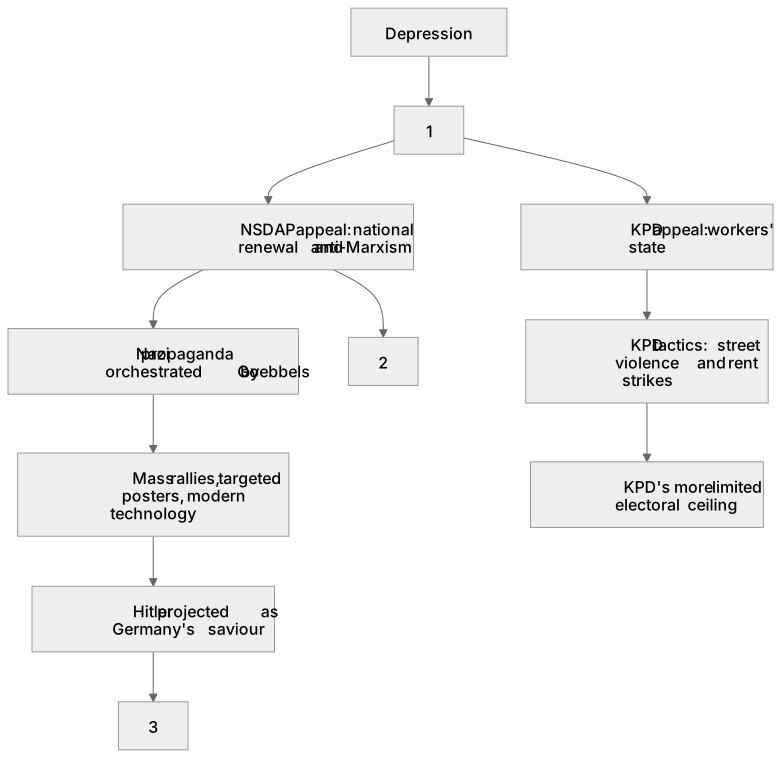
1Box 1
2Box 2
3Box 3
There is more to this lesson
The full lesson goes on to check your understanding and help you earn the marks. Create a free account to carry on, with your progress saved.
A week of Premium from your first lesson · Then the free plan continues · No card, no charge
Test your understanding of 2O Democracy and Nazism: Germany, 1918–1945 – The Collapse of Democracy, 1928–1933: The appeal of Nazism and Communism; the tactics and fortunes of the extremist parties, including the role of propaganda
Active recall beats re-reading. Take an instant quiz now to test what you’ve learned and lock it into long-term memory.
A week of Premium from your first lesson · Then the free plan continues · No card, no charge