AQA · A-Level · History
Course version: 7042 · Version from Sept 2017
Germany, 1918–1945 – The Collapse of Democracy, 1928–1933: The economic,…
Full specification wording
2O Democracy and Nazism: Germany, 1918–1945 – The Collapse of Democracy, 1928–1933: The economic, social and political impact of the Depression: elections; governments and policies
The Great Depression devastated Weimar Germany, triggering profound economic, social, and political crises.
Checked against the AQA 7042 specification (opens in a new tab) on .
- Point 1 of 4
- 4 key terms
Study notes
From the checked teaching notes for this specification point.
The idea
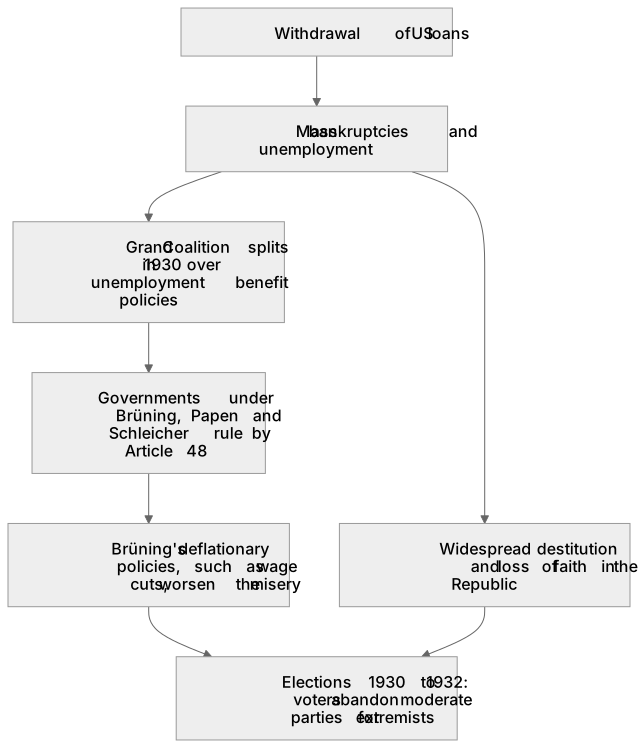
The Great Depression devastated Weimar Germany, triggering profound economic, social, and political crises. Economically, the withdrawal of US loans caused mass bankruptcies and unemployment, peaking at six million by 1932. Socially, this created widespread destitution and a psychological loss of faith in the Republic. Politically, the crisis shattered the Grand Coalition in 1930 over unemployment benefit policies. Subsequent governments under Brüning, Papen, and Schleicher relied on Article 48, ruling by presidential decree. Brüning’s deflationary policies, such as wage cuts, worsened the misery. Consequently, elections between 1930 and 1932 saw a dramatic polarisation, with voters abandoning moderate parties for extremists.
What earns the marks
- Identify the economic consequences of the Wall Street Crash on Germany, specifically the recall of short-term American loans and the resulting surge in unemployment.
- Explain the social impact of the Depression, including the rise in poverty, the strain on the welfare system, and the radicalisation of the working and middle classes.
- Analyse the political paralysis caused by the collapse of Müller's Grand Coalition and the subsequent reliance on Hindenburg's presidential decrees under Article 48.
- Evaluate the failure of government policies, particularly Brüning's deflationary measures, in addressing the economic crisis and their role in alienating the electorate.
- Assess the significance of the 1930 and 1932 Reichstag elections in demonstrating the collapse of the moderate democratic centre and the surge in extremist support.
Common mistakes and how to put them right
Claiming the Wall Street Crash was the sole cause of Germany's economic problems.
Put it right: Acknowledge that the German economy was already stagnating before 1929 and was structurally dependent on short-term foreign loans.
Stating that Brüning deliberately caused the Depression to end reparations.
Put it right: Explain that while Brüning used the crisis to argue against reparations, his deflationary policies were primarily driven by a fear of repeating the hyperinflation of 1923.
Assuming the working class universally abandoned the SPD for the Nazis.
Put it right: Note that the unemployed working class largely shifted towards the KPD, while the Nazis drew heavily from the lower-middle class and rural voters.
Exam tips
- Link economic statistics directly to political shifts; use the unemployment figure of six million in 1932 to explain the electoral breakthroughs of the KPD and NSDAP.
- When discussing government policies, contrast the inaction or deflationary measures of Brüning with the desperate need for state intervention demanded by the electorate.
- Use the collapse of Müller's government in 1930 as the definitive turning point marking the end of parliamentary democracy and the beginning of presidential rule.
Try the lesson
The start of the 2O Democracy and Nazism: Germany, 1918–1945 – The Collapse of Democracy, 1928–1933: The economic, social and political impact of the Depression: elections; governments and policies lesson, made from checked teaching notes for this specification point.
Have a go first
What was the primary economic policy pursued by Chancellor Heinrich Brüning in response to the Great Depression?
Listen
The Great Depression devastated Weimar Germany, triggering profound economic, social, and political crises. Economically, the withdrawal of US loans caused mass bankruptcies and unemployment, peaking at six million by 1932. Socially, this created widespread destitution and a psychological loss of faith in the Republic. Politically, the crisis shattered the Grand Coalition in 1930 over unemployment benefit policies. Subsequent governments under Brüning, Papen, and Schleicher relied on Article 48, ruling by presidential decree. Brüning’s deflationary policies, such as wage cuts, worsened the misery. Consequently, elections between 1930 and 1932 saw a dramatic polarisation, with voters abandoning moderate parties for extremists. A strong answer earns marks for these points. Identify the economic consequences of the Wall Street Crash on Germany, specifically the recall of short-term American loans and the resulting surge in unemployment. Explain the social impact of the Depression, including the rise in poverty, the strain on the welfare system, and the radicalisation of the working and middle classes. Analyse the political paralysis caused by the collapse of Müller's Grand Coalition and the subsequent reliance on Hindenburg's presidential decrees under Article 48. Evaluate the failure of government policies, particularly Brüning's deflationary measures, in addressing the economic crisis and their role in alienating the electorate. A common slip: Claiming the Wall Street Crash was the sole cause of Germany's economic problems. Instead, Acknowledge that the German economy was already stagnating before 1929 and was structurally dependent on short-term foreign loans. Exam tip: Link economic statistics directly to political shifts; use the unemployment figure of six million in 1932 to explain the electoral breakthroughs of the KPD and NSDAP.
See it
Key words
Say what each word means before you turn the card.
Economic instability
Try answering aloud or in your head before turning the card.
Political extremism
Try answering aloud or in your head before turning the card.
Failure of democracy
Try answering aloud or in your head before turning the card.
Social polarisation
Try answering aloud or in your head before turning the card.
See every definition
- Economic instability
- The withdrawal of US loans caused mass bankruptcies and unemployment, peaking at six million by 1932.
- Political extremism
- Elections between 1930 and 1932 saw voters abandoning moderate parties for extremists.
- Failure of democracy
- The crisis shattered the Grand Coalition in 1930, and subsequent governments relied on Article 48, ruling by presidential decree.
- Social polarisation
- Widespread destitution and a psychological loss of faith in the Republic accompanied the radicalisation of the working and middle classes.
Label the diagram
Some boxes have lost their names. Pick the right name for each number.
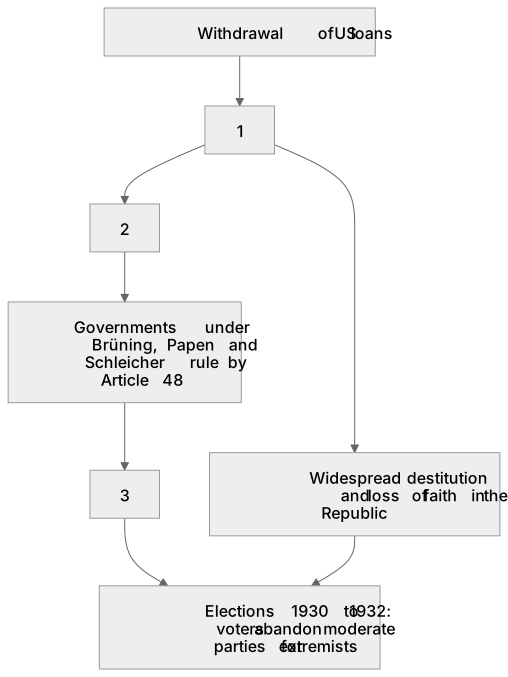
1Box 1
2Box 2
3Box 3
There is more to this lesson
The full lesson goes on to check your understanding and help you earn the marks. Create a free account to carry on, with your progress saved.
A week of Premium from your first lesson · Then the free plan continues · No card, no charge
Test your understanding of 2O Democracy and Nazism: Germany, 1918–1945 – The Collapse of Democracy, 1928–1933: The economic, social and political impact of the Depression: elections; governments and policies
Active recall beats re-reading. Take an instant quiz now to test what you’ve learned and lock it into long-term memory.
A week of Premium from your first lesson · Then the free plan continues · No card, no charge