AQA · A-Level · History
Course version: 7042 · Version from Sept 2017
Relations with and policies towards USA, particularly issue of Vietnam;…
Full specification wording
2S The Making of Modern Britain, 1951–2007 – The Sixties, 1964–1970: Relations with and policies towards USA, particularly issue of Vietnam; response to world affairs and relations with Europe; decolonisation including 'withdrawal East of Suez' and Rhodesia.
During the 1960s, Harold Wilson’s Labour government faced complex foreign policy challenges.
Checked against the AQA 7042 specification (opens in a new tab) on .
- Point 4 of 4
- 4 key terms
Study notes
From the checked teaching notes for this specification point.
The idea
During the 1960s, Harold Wilson’s Labour government faced complex foreign policy challenges. Relations with the USA were strained by the Vietnam War; Wilson offered moral support to President Johnson but refused to send British troops, balancing domestic anti-war sentiment with the need for American financial backing. In Europe, Britain’s changing global role prompted a second application to join the EEC in 1967, which was again vetoed by de Gaulle. Decolonisation accelerated due to economic pressures, culminating in the 1968 decision to withdraw British military forces 'East of Suez' by 1971. Concurrently, the government struggled with Rhodesia, where Ian Smith’s white minority regime declared Unilateral Declaration of Independence (UDI) in 1965, defying British attempts at negotiated settlement.
What earns the marks
- Explain Wilson's balancing act regarding the Vietnam War, maintaining the special relationship without committing British military forces.
- Analyse the economic and political motivations behind the 1967 EEC application and the impact of de Gaulle's veto on British foreign policy.
- Evaluate the financial pressures, particularly the 1967 devaluation crisis, that forced the accelerated 'withdrawal East of Suez'.
- Assess the failure of British diplomacy, including the Tiger and Fearless talks, to resolve the Rhodesian UDI crisis.
Common mistakes and how to put them right
Claiming Britain sent combat troops to Vietnam.
Put it right: Britain provided diplomatic support but Wilson explicitly refused to send military forces.
Confusing the 1961 and 1967 EEC applications.
Put it right: Macmillan made the first application in 1961, whereas Wilson made the second application in 1967.
Stating that the 'withdrawal East of Suez' was purely a strategic choice.
Put it right: The withdrawal was primarily driven by severe economic constraints and the need to reduce defence spending.
Exam tips
- Link foreign policy decisions directly to domestic economic issues, such as how the balance of payments deficit influenced the East of Suez withdrawal.
- Contrast Wilson's handling of the USA over Vietnam with previous Prime Ministers' approaches to the 'Special Relationship'.
- Use the Rhodesian crisis to illustrate the limits of British imperial power and influence in the post-war era.
Try the lesson
The start of the 2S The Making of Modern Britain, 1951–2007 – The Sixties, 1964–1970: Relations with and policies towards USA, particularly issue of Vietnam; response to world affairs and relations with Europe; decolonisation including 'withdrawal East of Suez' and Rhodesia. lesson, made from checked teaching notes for this specification point.
Have a go first
Which of the following best describes Harold Wilson's policy towards the United States' involvement in the Vietnam War during the 1960s?
Listen
During the 1960s, Harold Wilson’s Labour government faced complex foreign policy challenges. Relations with the USA were strained by the Vietnam War; Wilson offered moral support to President Johnson but refused to send British troops, balancing domestic anti-war sentiment with the need for American financial backing. In Europe, Britain’s changing global role prompted a second application to join the EEC in 1967, which was again vetoed by de Gaulle. Decolonisation accelerated due to economic pressures, culminating in the 1968 decision to withdraw British military forces 'East of Suez' by 1971. Concurrently, the government struggled with Rhodesia, where Ian Smith’s white minority regime declared Unilateral Declaration of Independence (UDI) in 1965, defying British attempts at negotiated settlement. A strong answer earns marks for these points. Explain Wilson's balancing act regarding the Vietnam War, maintaining the special relationship without committing British military forces. Analyse the economic and political motivations behind the 1967 EEC application and the impact of de Gaulle's veto on British foreign policy. Evaluate the financial pressures, particularly the 1967 devaluation crisis, that forced the accelerated 'withdrawal East of Suez'. Assess the failure of British diplomacy, including the Tiger and Fearless talks, to resolve the Rhodesian UDI crisis. A common slip: Claiming Britain sent combat troops to Vietnam. Instead, Britain provided diplomatic support but Wilson explicitly refused to send military forces. Exam tip: Link foreign policy decisions directly to domestic economic issues, such as how the balance of payments deficit influenced the East of Suez withdrawal.
See it
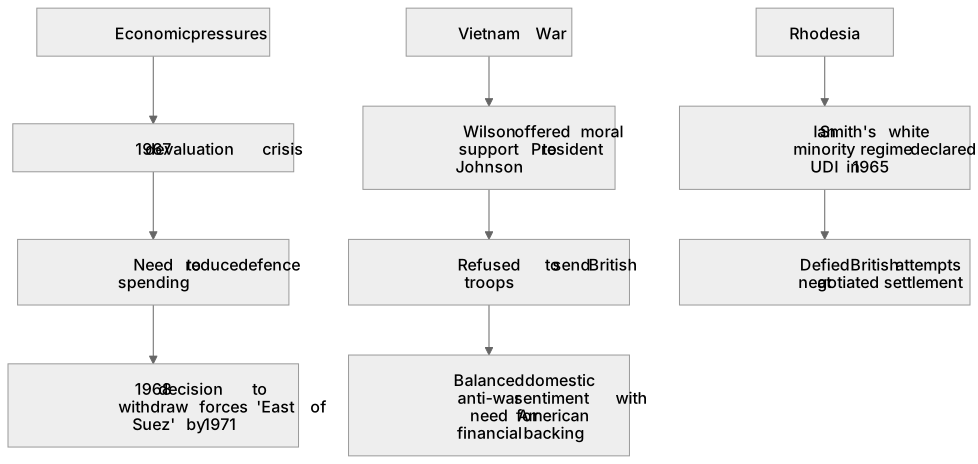
Put the events in order
Put these events in the order they happened, earliest first.
- 1. Ian Smith's white minority regime declared Unilateral Declaration of Independence in Rhodesia
- 2. Decision taken to withdraw British military forces East of Suez
- 3. Britain made a second application to join the EEC
Key words
Say what each word means before you turn the card.
The Special Relationship
Try answering aloud or in your head before turning the card.
European Integration
Try answering aloud or in your head before turning the card.
Decline of Empire
Try answering aloud or in your head before turning the card.
Economic Constraints on Foreign Policy
Try answering aloud or in your head before turning the card.
See every definition
- The Special Relationship
- Wilson maintained this with the USA by offering moral support to President Johnson while refusing to send British troops to Vietnam.
- European Integration
- Britain's changing global role prompted a second application to join the EEC in 1967, which was again vetoed by de Gaulle.
- Decline of Empire
- Decolonisation accelerated due to economic pressures, culminating in the 1968 decision to withdraw British military forces 'East of Suez' by 1971.
- Economic Constraints on Foreign Policy
- Severe economic constraints and the need to reduce defence spending primarily drove the withdrawal East of Suez.
Label the diagram
Some boxes have lost their names. Pick the right name for each number.
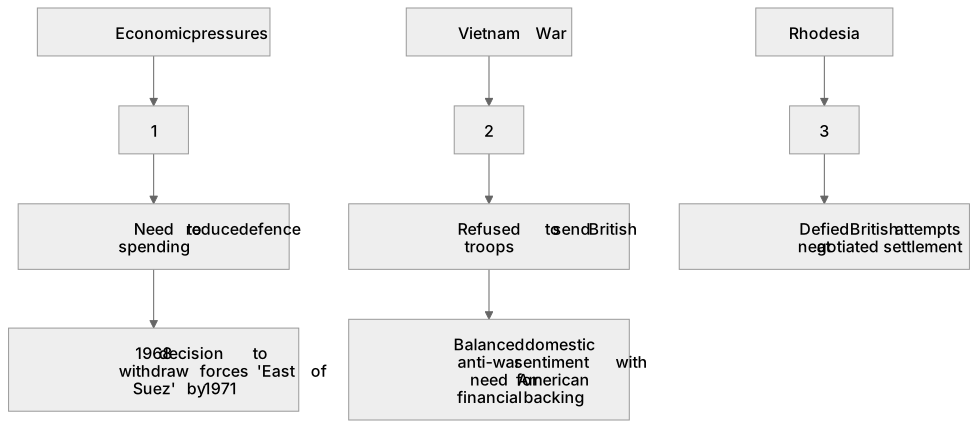
1Box 1
2Box 2
3Box 3
There is more to this lesson
The full lesson goes on to check your understanding and help you earn the marks. Create a free account to carry on, with your progress saved.
A week of Premium from your first lesson · Then the free plan continues · No card, no charge
Test your understanding of 2S The Making of Modern Britain, 1951–2007 – The Sixties, 1964–1970: Relations with and policies towards USA, particularly issue of Vietnam; response to world affairs and relations with Europe; decolonisation including 'withdrawal East of Suez' and Rhodesia.
Active recall beats re-reading. Take an instant quiz now to test what you’ve learned and lock it into long-term memory.
A week of Premium from your first lesson · Then the free plan continues · No card, no charge