AQA · A-Level · History
Course version: 7042 · Version from Sept 2017
Social and cultural change: the expansion of the mass media; growth in…
Full specification wording
2S The Making of Modern Britain, 1951–2007 – The Sixties, 1964–1970: Social and cultural change: the expansion of the mass media; growth in leisure activities; the impact of scientific developments; the reduction in censorship; progress towards female equality; changes in moral attitudes; youth culture and the 'permissive society'; anti-Vietnam war riots; issues of immigration and race
The 1960s saw rapid social and cultural change, driven by the expansion of mass media, notably television, and a growth in leisure activities like package holidays.
Checked against the AQA 7042 specification (opens in a new tab) on .
- Point 3 of 4
- 4 key terms
Study notes
From the checked teaching notes for this specification point.
The idea
The 1960s saw rapid social and cultural change, driven by the expansion of mass media, notably television, and a growth in leisure activities like package holidays. Scientific developments, particularly the contraceptive pill, impacted changes in moral attitudes and progress towards female equality. The reduction in censorship, highlighted by the 1968 Theatres Act, fostered a more open culture. Youth culture flourished, contributing to the idea of a 'permissive society'. Political activism surged, evidenced by the 1968 anti-Vietnam war riots in Grosvenor Square. Furthermore, issues of immigration and race became highly contentious, marked by Enoch Powell's 1968 'Rivers of Blood' speech and the restrictive Commonwealth Immigrants Act.
What earns the marks
- Assess the influence of television and print media in shaping public opinion and spreading new cultural trends.
- Evaluate the impact of the contraceptive pill on women's liberation, employment opportunities, and shifting moral attitudes.
- Analyse the tension between the emerging 'permissive society', characterised by youth culture and reduced censorship, and the conservative backlash.
- Examine the causes and consequences of racial tensions, including the impact of Enoch Powell's speech and the government's legislative responses to immigration.
- Discuss the significance of student protests and anti-Vietnam war riots as expressions of a newly politicised youth culture.
Common mistakes and how to put them right
Assuming the 'permissive society' affected all demographics equally.
Put it right: Acknowledge that changes in moral attitudes were largely concentrated among the youth and in urban areas, while many older or rural citizens remained conservative.
Stating that the 1960s achieved full female equality.
Put it right: Note that while progress was made, such as the introduction of the pill and the 1970 Equal Pay Act, significant inequalities in pay and societal expectations persisted.
Confusing the timeline of immigration legislation.
Put it right: Distinguish between the 1962 Commonwealth Immigrants Act passed by the Conservatives and the 1968 Act passed by Labour which tightened controls further.
Exam tips
- Use the concept of the 'permissive society' critically, debating whether it was a media construct or a genuine reflection of widespread social change.
- Connect scientific developments, like the contraceptive pill, directly to both demographic changes and the growth of second-wave feminism.
- When discussing immigration, balance the narrative of racial tension with the passing of the Race Relations Acts of 1965 and 1968 to show a nuanced understanding of government policy.
Try the lesson
The start of the 2S The Making of Modern Britain, 1951–2007 – The Sixties, 1964–1970: Social and cultural change: the expansion of the mass media; growth in leisure activities; the impact of scientific developments; the reduction in censorship; progress towards female equality; changes in moral attitudes; youth culture and the 'permissive society'; anti-Vietnam war riots; issues of immigration and race lesson, made from checked teaching notes for this specification point.
Have a go first
Which institution lost its historic power to censor and ban theatrical plays following the passage of the Theatres Act in 1968?
Listen
The 1960s saw rapid social and cultural change, driven by the expansion of mass media, notably television, and a growth in leisure activities like package holidays. Scientific developments, particularly the contraceptive pill, impacted changes in moral attitudes and progress towards female equality. The reduction in censorship, highlighted by the 1968 Theatres Act, fostered a more open culture. Youth culture flourished, contributing to the idea of a 'permissive society'. Political activism surged, evidenced by the 1968 anti-Vietnam war riots in Grosvenor Square. Furthermore, issues of immigration and race became highly contentious, marked by Enoch Powell's 1968 'Rivers of Blood' speech and the restrictive Commonwealth Immigrants Act. A strong answer earns marks for these points. Assess the influence of television and print media in shaping public opinion and spreading new cultural trends. Evaluate the impact of the contraceptive pill on women's liberation, employment opportunities, and shifting moral attitudes. Analyse the tension between the emerging 'permissive society', characterised by youth culture and reduced censorship, and the conservative backlash. Examine the causes and consequences of racial tensions, including the impact of Enoch Powell's speech and the government's legislative responses to immigration. A common slip: Assuming the 'permissive society' affected all demographics equally. Instead, acknowledge that changes in moral attitudes were largely concentrated among the youth and in urban areas, while many older or rural citizens remained conservative. Exam tip: Use the concept of the 'permissive society' critically, debating whether it was a media construct or a genuine reflection of widespread social change.
See it

Key words
Say what each word means before you turn the card.
The 'Permissive Society' and its critics
Try answering aloud or in your head before turning the card.
Racial tension and multiculturalism
Try answering aloud or in your head before turning the card.
The politicisation of youth
Try answering aloud or in your head before turning the card.
Technological and scientific catalysts for social change
Try answering aloud or in your head before turning the card.
See every definition
- The 'Permissive Society' and its critics
- A more open culture characterised by youth culture and reduced censorship, which met a conservative backlash.
- Racial tension and multiculturalism
- Issues of immigration and race that became highly contentious, marked by Enoch Powell's speech and restrictive legislation.
- The politicisation of youth
- Political activism that surged, evidenced by student protests and the anti-Vietnam war riots in Grosvenor Square.
- Technological and scientific catalysts for social change
- Scientific developments, particularly the contraceptive pill, which impacted moral attitudes and progress towards female equality.
Label the diagram
Some boxes have lost their names. Pick the right name for each number.
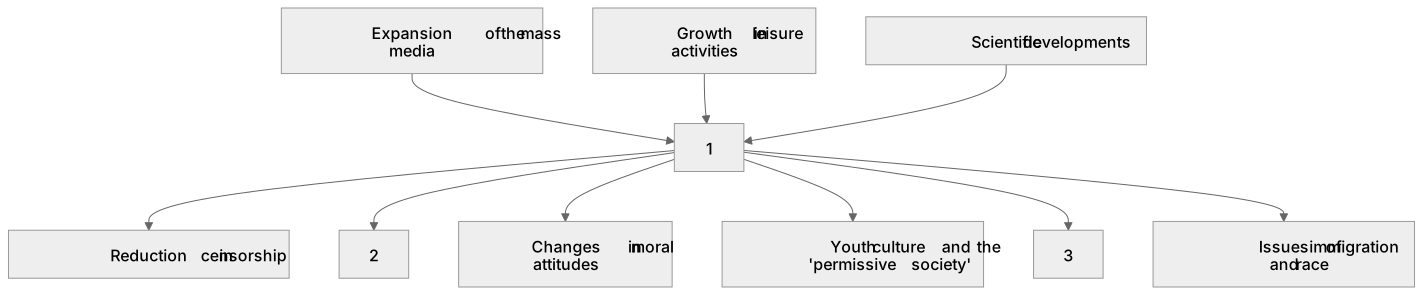
1Box 1
2Box 2
3Box 3
There is more to this lesson
The full lesson goes on to check your understanding and help you earn the marks. Create a free account to carry on, with your progress saved.
A week of Premium from your first lesson · Then the free plan continues · No card, no charge
Test your understanding of 2S The Making of Modern Britain, 1951–2007 – The Sixties, 1964–1970: Social and cultural change: the expansion of the mass media; growth in leisure activities; the impact of scientific developments; the reduction in censorship; progress towards female equality; changes in moral attitudes; youth culture and the 'permissive society'; anti-Vietnam war riots; issues of immigration and race
Active recall beats re-reading. Take an instant quiz now to test what you’ve learned and lock it into long-term memory.
A week of Premium from your first lesson · Then the free plan continues · No card, no charge