Pearson Edexcel · A-Level · History
Course version: 9HI0 · Version from Sept 2015
The British experience of warfare, c1790–1918 - 2 The Crimean War,…
Full specification wording
Paper 3, Option 35.2: The British experience of warfare, c1790–1918 - 2 The Crimean War, 1854–56: The problems of medical care; the work of Florence Nightingale and Mary Seacole in the Crimea.
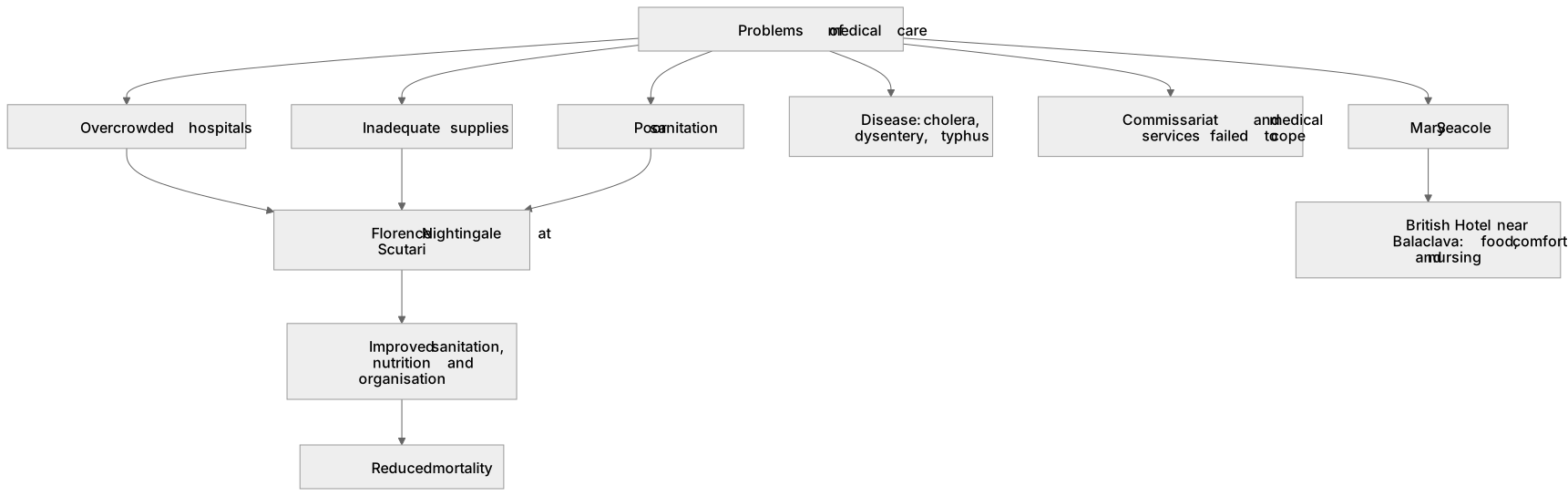
Medical care in the Crimea was initially chaotic: hospitals were overcrowded, supplies were inadequate, and diseases such as cholera, dysentery and typhus killed far more soldiers than battle wounds.
Checked against the Pearson Edexcel 9HI0 specification (opens in a new tab) on .
- Point 2 of 3
- 4 key terms
Study notes
From the checked teaching notes for this specification point.
The idea
Medical care in the Crimea was initially chaotic: hospitals were overcrowded, supplies were inadequate, and diseases such as cholera, dysentery and typhus killed far more soldiers than battle wounds. Florence Nightingale arrived at Scutari in November 1854 with a team of nurses, improving sanitation, nutrition and organisation, and reducing mortality. Mary Seacole, a Creole businesswoman, travelled independently to the Crimea, setting up the British Hotel near Balaclava to provide food, comfort and nursing to soldiers. Both women faced opposition and prejudice, but their work highlighted the need for reform. Their contributions are assessed in terms of their impact on soldiers' welfare and on the development of nursing.
What earns the marks
- Analyse the impact of Nightingale's work: the reduction in mortality rates at Scutari, her establishment of a nursing school after the war, and her influence on army medical reform.
- Describe Mary Seacole's work: her independent journey to the Crimea, the establishment of the British Hotel, her provision of food, clothing and nursing care to soldiers, and her presence at the front.
- Assess the significance of Seacole's work: her popularity among soldiers, her difficulties in gaining recognition from the authorities, and her later memoir 'Wonderful Adventures of Mrs Seacole in Many Lands'.
Common mistakes and how to put them right
Claiming that Florence Nightingale single-handedly reduced mortality.
Put it right: Acknowledge the wider efforts and the timing of the mortality decline.
Assuming Mary Seacole was a nurse in the same official capacity as Nightingale.
Put it right: Describe her role accurately as a sutler and nurse.
Overlooking the continued high death rates from disease even after Nightingale's arrival.
Put it right: Avoid exaggerating the speed and extent of improvement.
Ignoring the prejudice and obstacles both women faced.
Put it right: Include these challenges in assessments of their work.
Exam tips
- Use specific examples of Nightingale's reforms, such as the introduction of clean linen, better diets and ventilation, to show depth of knowledge.
- For Seacole, refer to her own writings and contemporary accounts to illustrate her impact and the obstacles she overcame.
- When discussing problems of medical care, link them to broader logistical failures of the British army in the Crimea.
- In comparative questions, avoid simply listing achievements; instead, analyse the relative significance and limitations of each woman's work.
Try the lesson
The start of the Paper 3, Option 35.2: The British experience of warfare, c1790–1918 - 2 The Crimean War, 1854–56: The problems of medical care; the work of Florence Nightingale and Mary Seacole in the Crimea. lesson, made from checked teaching notes for this specification point.
Have a go first
What was the primary focus of Mary Seacole's work during the Crimean War?
Listen
Medical care in the Crimea was initially chaotic: hospitals were overcrowded, supplies were inadequate, and diseases such as cholera, dysentery and typhus killed far more soldiers than battle wounds. Florence Nightingale arrived at Scutari in November 1854 with a team of nurses, improving sanitation, nutrition and organisation, and reducing mortality. Mary Seacole, a Creole businesswoman, travelled independently to the Crimea, setting up the British Hotel near Balaclava to provide food, comfort and nursing to soldiers. Both women faced opposition and prejudice, but their work highlighted the need for reform. Their contributions are assessed in terms of their impact on soldiers' welfare and on the development of nursing. A strong answer earns marks for these points. Explain the problems of medical care: inadequate hospitals, shortage of supplies, poor sanitation, and the prevalence of disease; the failure of the Commissariat and medical services to cope with the number of casualties. Describe Florence Nightingale's work: her arrival at Scutari with nurses, her emphasis on sanitation and hygiene, her use of statistics to demonstrate the link between dirt and disease, and her role in improving the hospital environment. Analyse the impact of Nightingale's work: the reduction in mortality rates at Scutari, her establishment of a nursing school after the war, and her influence on army medical reform. Describe Mary Seacole's work: her independent journey to the Crimea, the establishment of the British Hotel, her provision of food, clothing and nursing care to soldiers, and her presence at the front. A common slip: Claiming that Florence Nightingale single-handedly reduced mortality: the Sanitary Commission also played a major role. Instead, acknowledge the wider efforts and the timing of the mortality decline. Exam tip: Use specific examples of Nightingale's reforms, such as the introduction of clean linen, better diets and ventilation, to show depth of knowledge.
See it
Key words
Say what each word means before you turn the card.
Medical care and reform
Try answering aloud or in your head before turning the card.
Role of women in war
Try answering aloud or in your head before turning the card.
Public health and sanitation
Try answering aloud or in your head before turning the card.
Recognition and prejudice
Try answering aloud or in your head before turning the card.
See every definition
- Medical care and reform
- Hospitals were overcrowded with inadequate supplies and poor sanitation, and diseases such as cholera, dysentery and typhus killed far more soldiers than battle wounds.
- Role of women in war
- Florence Nightingale arrived at Scutari with a team of nurses, while Mary Seacole travelled independently and set up the British Hotel near Balaclava.
- Public health and sanitation
- Nightingale emphasised sanitation and hygiene, used statistics to demonstrate the link between dirt and disease, and improved the hospital environment.
- Recognition and prejudice
- Both women faced opposition and prejudice, and Seacole had difficulties in gaining recognition from the authorities.
Label the diagram
Some boxes have lost their names. Pick the right name for each number.
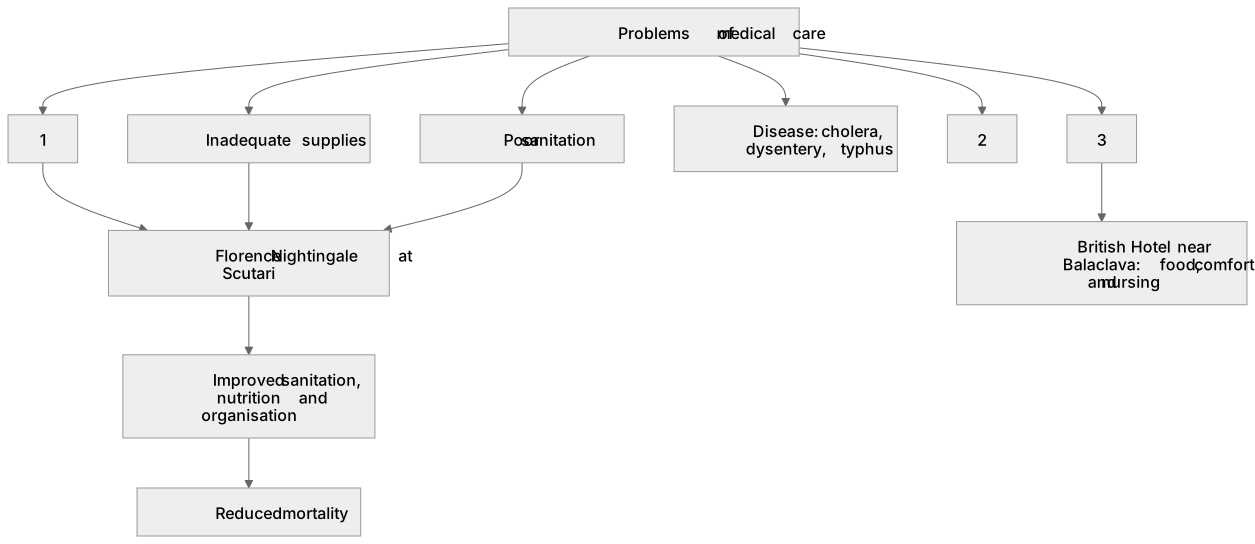
1Box 1
2Box 2
3Box 3
There is more to this lesson
The full lesson goes on to check your understanding and help you earn the marks. Create a free account to carry on, with your progress saved.
A week of Premium from your first lesson · Then the free plan continues · No card, no charge
Test your understanding of Paper 3, Option 35.2: The British experience of warfare, c1790–1918 - 2 The Crimean War, 1854–56: The problems of medical care; the work of Florence Nightingale and Mary Seacole in the Crimea.
Active recall beats re-reading. Take an instant quiz now to test what you’ve learned and lock it into long-term memory.
A week of Premium from your first lesson · Then the free plan continues · No card, no charge