AQA · GCSE · Mathematics
Course version: 8300 · Version from Sept 2015
Apply ideas of randomness, fairness and equally likely events to calculate…
Full specification wording
Probability: apply ideas of randomness, fairness and equally likely events to calculate expected outcomes of multiple future experiments
This skill connects three ideas.
Checked against the AQA 8300 specification (opens in a new tab) on .
- Point 2 of 10
- 4 key terms
Study notes
From the checked teaching notes for this specification point.
The idea
This skill connects three ideas. Randomness means each trial is unpredictable, yet over many trials a pattern emerges. Fairness means no outcome is favoured, so a fair six-sided die gives each face probability 1/6. Equally likely events have the same probability, which lets you calculate expected outcomes by multiplying the probability of an outcome by the number of trials. For example, if a fair coin is tossed 200 times, the expected number of heads is 200 × 1/2 = 100. For multiple future experiments, apply the same expected value to each experiment and combine the totals, for example 3 experiments of 50 spins each give 150 spins in total. Expected outcomes describe long-run averages, not guaranteed results in any single experiment.
What earns the marks
- Identifies whether outcomes are equally likely and states the probability of each outcome for a fair object.
- Calculates an expected frequency by multiplying the probability of an outcome by the number of trials.
- Applies the same expected-value calculation across multiple future experiments and combines the totals correctly.
- Interprets an expected outcome as a long-run average rather than a certain result.
- Explains how randomness and fairness justify using equal probabilities in the calculation.
- Recognises that observed results may differ from expected results, especially in small numbers of trials.
Common mistakes and how to put them right
Assuming an expected outcome must occur exactly.
Put it right: Describe it as the average result over many trials, with individual experiments varying around it.
Using unequal probabilities for a fair object, for example giving a fair die faces different probabilities.
Put it right: Assign probability 1/6 to each face.
Multiplying the number of trials by the number of outcomes instead of by the probability.
Put it right: Use expected frequency = probability × number of trials.
Forgetting to combine the trials when several future experiments are described.
Put it right: Find the total number of trials first, or to calculate each experiment separately and add the expected outcomes.
Exam tips
- Write down the probability of the outcome you are using before multiplying, so your expected-value calculation is clear.
- When several experiments are described, state the total number of trials or show each expected outcome separately and then add them.
- Use the words expected or average in your final answer to show you understand it is a long-run prediction, not a guaranteed result.
Try the lesson
The start of the Probability: apply ideas of randomness, fairness and equally likely events to calculate expected outcomes of multiple future experiments lesson, made from checked teaching notes for this specification point.
Have a go first
A fair coin is tossed 60 times. How many times would you expect it to land on heads?
Listen
This skill connects three ideas. Randomness means each trial is unpredictable, yet over many trials a pattern emerges. Fairness means no outcome is favoured, so a fair six-sided die gives each face probability 1/6. Equally likely events have the same probability, which lets you calculate expected outcomes by multiplying the probability of an outcome by the number of trials. For example, if a fair coin is tossed 200 times, the expected number of heads is 200 × 1/2 = 100. For multiple future experiments, apply the same expected value to each experiment and combine the totals, for example 3 experiments of 50 spins each give 150 spins in total. Expected outcomes describe long-run averages, not guaranteed results in any single experiment. A strong answer earns marks for these points. Identifies whether outcomes are equally likely and states the probability of each outcome for a fair object. Calculates an expected frequency by multiplying the probability of an outcome by the number of trials. Applies the same expected-value calculation across multiple future experiments and combines the totals correctly. Interprets an expected outcome as a long-run average rather than a certain result. A common slip: Assuming an expected outcome must occur exactly. Instead, describe it as the average result over many trials, with individual experiments varying around it. Exam tip: Write down the probability of the outcome you are using before multiplying, so your expected-value calculation is clear.
See it
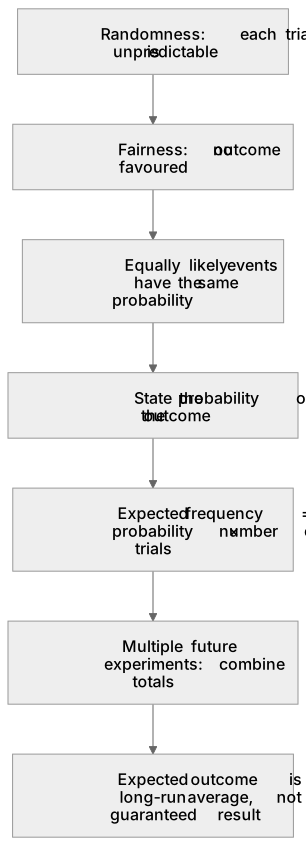
Put it in order
Put these steps in the order they happen.
- 1. Expected outcome is a long-run average, not a guaranteed result
- 2. Multiple future experiments: combine the totals
- 3. Equally likely events have the same probability
- 4. Expected frequency = probability × number of trials
- 5. Randomness: each trial is unpredictable
- 6. Fairness: no outcome is favoured
- 7. State the probability of the outcome
Key words
Say what each word means before you turn the card.
Randomness
Try answering aloud or in your head before turning the card.
Fairness
Try answering aloud or in your head before turning the card.
Equally likely events
Try answering aloud or in your head before turning the card.
Expected outcomes
Try answering aloud or in your head before turning the card.
See every definition
- Randomness
- Each trial is unpredictable, yet over many trials a pattern emerges.
- Fairness
- No outcome is favoured, so a fair six-sided die gives each face probability 1/6.
- Equally likely events
- Events that have the same probability, which lets you calculate expected outcomes by multiplying the probability of an outcome by the number of trials.
- Expected outcomes
- Long-run averages, not guaranteed results in any single experiment.
Label the diagram
Some boxes have lost their names. Pick the right name for each number.
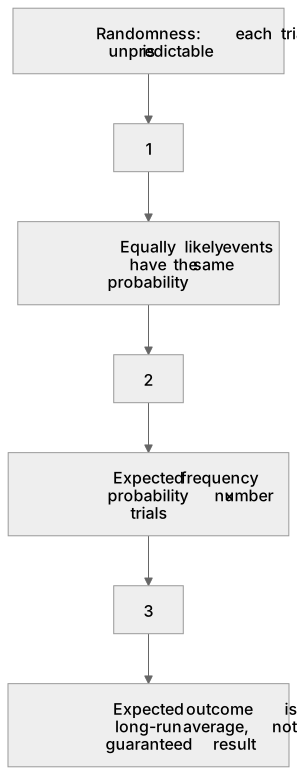
1Box 1
2Box 2
3Box 3
There is more to this lesson
The full lesson goes on to check your understanding and help you earn the marks. Create a free account to carry on, with your progress saved.
A week of Premium from your first lesson · Then the free plan continues · No card, no charge
Test your understanding of Probability: apply ideas of randomness, fairness and equally likely events to calculate expected outcomes of multiple future experiments
Active recall beats re-reading. Take an instant quiz now to test what you’ve learned and lock it into long-term memory.
A week of Premium from your first lesson · Then the free plan continues · No card, no charge