AQA · GCSE · Mathematics
Course version: 8300 · Version from Sept 2015
Relate relative expected frequencies to theoretical probability, using…
Full specification wording
Probability: relate relative expected frequencies to theoretical probability, using appropriate language and the 0 to 1 probability scale
Relative expected frequency is the expected proportion of times an outcome occurs over many trials, expressed on the 0 to 1 scale.
Checked against the AQA 8300 specification (opens in a new tab) on .
- Point 3 of 10
- 3 key terms
Study notes
From the checked teaching notes for this specification point.
The idea
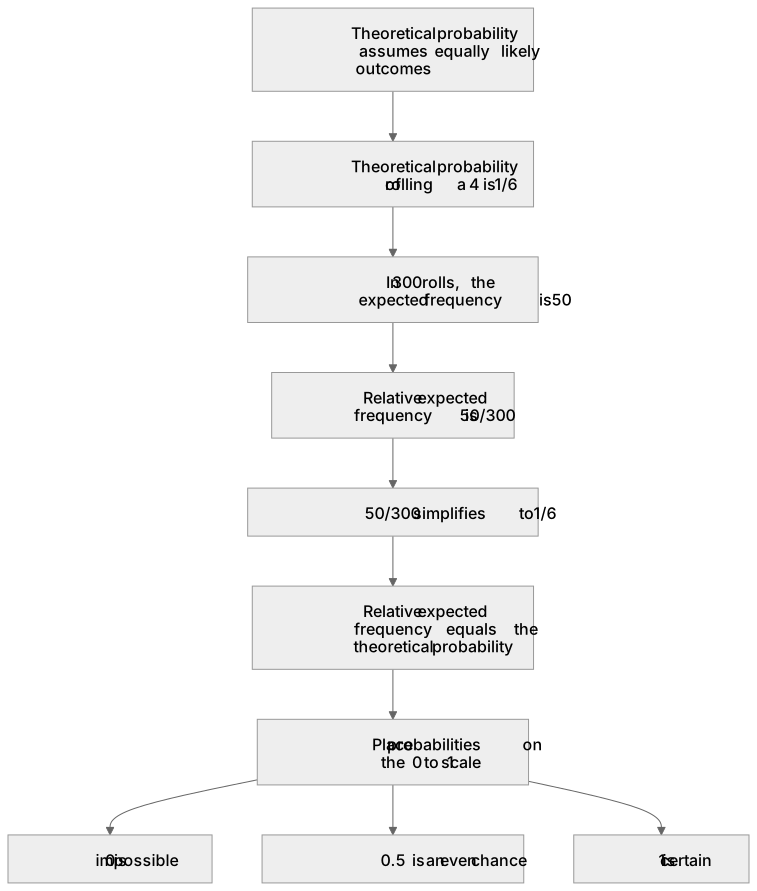
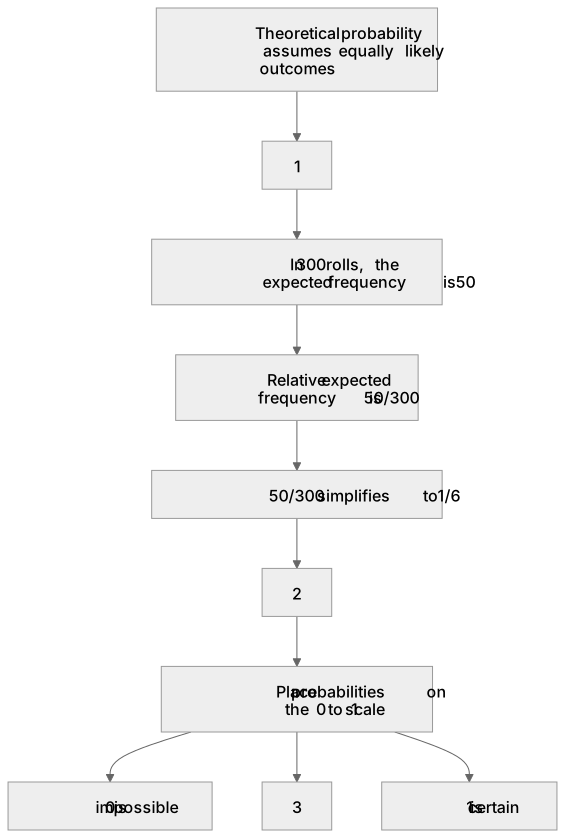
Relative expected frequency is the expected proportion of times an outcome occurs over many trials, expressed on the 0 to 1 scale. It is found by dividing the expected frequency count by the total number of trials, simplifying to the theoretical probability. For a fair six-sided die, the theoretical probability of rolling a 4 is 1/6. In 300 rolls, the expected frequency is 50, so the relative expected frequency is 50/300, which is 1/6. Theoretical probability assumes equally likely outcomes. Use precise language: 'expected frequency', 'theoretical probability', 'equally likely', and 'relative frequency'. Place probabilities on the 0 to 1 scale: 0 is impossible, 1 is certain, 0.5 is an even chance.
What earns the marks
- Defines relative expected frequency as a proportion on the 0 to 1 scale, equivalent to theoretical probability.
- Distinguishes expected frequency (a count) from relative expected frequency (a proportion).
- States theoretical probability as a fraction or decimal between 0 and 1 inclusive, or as a percentage between 0% and 100%.
- Uses correct language such as 'expected frequency', 'theoretical probability', 'equally likely' and 'relative frequency'.
- Places a given probability correctly on the 0 to 1 scale, recognising 0 as impossible and 1 as certain.
Common mistakes and how to put them right
Confusing relative expected frequency with expected frequency.
Put it right: The expected frequency is a count over trials, while relative expected frequency is a proportion from 0 to 1.
Writing a fractional or decimal probability greater than 1 or less than 0, for example 1.5 or -0.2.
Put it right by checking the value lies within the 0 to 1 scale.
Treating a relative frequency from a small sample as proof that a die is biased.
Put it right by explaining that random variation is larger in small samples.
Using vague language such as 'probably' without linking to the 0 to 1 scale.
Put it right by stating the numerical probability and its position on the scale.
Exam tips
- Read the question carefully to decide whether it asks for a probability/proportion (0 to 1) or an expected frequency (a count).
- When calculating relative expected frequency, show it as a fraction of the total trials, which simplifies to the theoretical probability.
- When comparing data with theory, refer to the number of trials and whether the observed relative frequency is close to the theoretical probability.
Try the lesson
The start of the Probability: relate relative expected frequencies to theoretical probability, using appropriate language and the 0 to 1 probability scale lesson, made from checked teaching notes for this specification point.
Have a go first
A fair six-sided dice is rolled 60 times. How many times would you expect it to land on a 4?
Listen
Relative expected frequency is the expected proportion of times an outcome occurs over many trials, expressed on the 0 to 1 scale. It is found by dividing the expected frequency count by the total number of trials, simplifying to the theoretical probability. For a fair six-sided die, the theoretical probability of rolling a 4 is 1/6. In 300 rolls, the expected frequency is 50, so the relative expected frequency is 50/300, which is 1/6. Theoretical probability assumes equally likely outcomes. Use precise language: 'expected frequency', 'theoretical probability', 'equally likely', and 'relative frequency'. Place probabilities on the 0 to 1 scale: 0 is impossible, 1 is certain, 0.5 is an even chance. A strong answer earns marks for these points. Defines relative expected frequency as a proportion on the 0 to 1 scale, equivalent to theoretical probability. Distinguishes expected frequency (a count) from relative expected frequency (a proportion). States theoretical probability as a fraction or decimal between 0 and 1 inclusive, or as a percentage between 0% and 100%. Uses correct language such as 'expected frequency', 'theoretical probability', 'equally likely' and 'relative frequency'. A common slip: Writing a fractional or decimal probability greater than 1 or less than 0, for example 1.5 or -0.2. Instead, checking the value lies within the 0 to 1 scale. Exam tip: Read the question carefully to decide whether it asks for a probability/proportion (0 to 1) or an expected frequency (a count).
See it
Key words
Say what each word means before you turn the card.
Relative expected frequency
Try answering aloud or in your head before turning the card.
Theoretical probability
Try answering aloud or in your head before turning the card.
The 0 to 1 probability scale
Try answering aloud or in your head before turning the card.
See every definition
- Relative expected frequency
- The expected proportion of times an outcome occurs over many trials, expressed on the 0 to 1 scale, found by dividing the expected frequency count by the total number of trials.
- Theoretical probability
- A probability that assumes equally likely outcomes, stated as a fraction or decimal between 0 and 1 inclusive, or as a percentage between 0% and 100%.
- The 0 to 1 probability scale
- A scale on which 0 is impossible, 1 is certain and 0.5 is an even chance.
Label the diagram
Some boxes have lost their names. Pick the right name for each number.
1Box 1
2Box 2
3Box 3
There is more to this lesson
The full lesson goes on to check your understanding and help you earn the marks. Create a free account to carry on, with your progress saved.
A week of Premium from your first lesson · Then the free plan continues · No card, no charge
Test your understanding of Probability: relate relative expected frequencies to theoretical probability, using appropriate language and the 0 to 1 probability scale
Active recall beats re-reading. Take an instant quiz now to test what you’ve learned and lock it into long-term memory.
A week of Premium from your first lesson · Then the free plan continues · No card, no charge