AQA · GCSE · Mathematics
Course version: 8300 · Version from Sept 2015
Apply the property that the probabilities of an exhaustive set of outcomes…
Full specification wording
Probability: apply the property that the probabilities of an exhaustive set of outcomes sum to 1 apply the property that the probabilities of an exhaustive set of mutually exclusive events sum to 1
An exhaustive set of outcomes covers every possible result of an experiment, so their probabilities sum to 1.
Checked against the AQA 8300 specification (opens in a new tab) on .
- Point 4 of 10
- 3 key terms
Study notes
From the checked teaching notes for this specification point.
The idea
An exhaustive set of outcomes covers every possible result of an experiment, so their probabilities sum to 1. Mutually exclusive events cannot happen at the same time, so their probabilities add without overlap. When a set is both exhaustive and mutually exclusive, the probabilities sum to exactly 1. For a fair six-sided die, the outcomes 1, 2, 3, 4, 5 and 6 are exhaustive and mutually exclusive, and 1/6 + 1/6 + 1/6 + 1/6 + 1/6 + 1/6 = 1. If P(rain) = 0.3, then P(no rain) = 1 − 0.3 = 0.7 because rain and no rain are exhaustive and mutually exclusive. Use this property to find a missing probability by subtracting known probabilities from 1.
What earns the marks
- States that the probabilities of an exhaustive set of outcomes sum to 1.
- States that the probabilities of mutually exclusive events sum to 1 when the events are exhaustive.
- Finds a missing probability by subtracting known probabilities from 1, e.g. 1 − 0.3 = 0.7.
- Checks that a set of probabilities is valid by confirming the total is 1 and no probability is negative or greater than 1.
- Explains why events must be mutually exclusive for their probabilities to be added directly.
Common mistakes and how to put them right
Adding probabilities of events that are not mutually exclusive, which double-counts overlap.
Put it right by identifying whether events can occur together before adding.
Forgetting to subtract from 1 when finding a complementary probability, for example giving 0.3 instead of 0.7 for the probability of no rain.
Put it right by using 1 minus the known probability.
Assuming a set is exhaustive when some outcomes are missing.
Put it right by listing all possible outcomes and checking that every one is included.
Writing a total probability greater than 1 for an exhaustive set.
Put it right by rechecking each probability and the sum.
Exam tips
- List all outcomes first to check whether the set is exhaustive and mutually exclusive.
- Use the sum-to-1 property to find a missing probability quickly, showing the subtraction.
- Check your answer is between 0 and 1 and that the total of all probabilities is exactly 1.
Try the lesson
The start of the Probability: apply the property that the probabilities of an exhaustive set of outcomes sum to 1 apply the property that the probabilities of an exhaustive set of mutually exclusive events sum to 1 lesson, made from checked teaching notes for this specification point.
Have a go first
A bag contains only red, blue and green counters. The probability of picking a red counter is 0.4 and the probability of picking a blue counter is 0.35. Work out the probability of picking a green counter.
Listen
An exhaustive set of outcomes covers every possible result of an experiment, so their probabilities sum to 1. Mutually exclusive events cannot happen at the same time, so their probabilities add without overlap. When a set is both exhaustive and mutually exclusive, the probabilities sum to exactly 1. For a fair six-sided die, the outcomes 1, 2, 3, 4, 5 and 6 are exhaustive and mutually exclusive, and 1/6 + 1/6 + 1/6 + 1/6 + 1/6 + 1/6 = 1. If P(rain) = 0.3, then P(no rain) = 1 − 0.3 = 0.7 because rain and no rain are exhaustive and mutually exclusive. Use this property to find a missing probability by subtracting known probabilities from 1. A strong answer earns marks for these points. States that the probabilities of an exhaustive set of outcomes sum to 1. States that the probabilities of mutually exclusive events sum to 1 when the events are exhaustive. Finds a missing probability by subtracting known probabilities from 1, e.g. 1 − 0.3 = 0.7. Checks that a set of probabilities is valid by confirming the total is 1 and no probability is negative or greater than 1. A common slip: Adding probabilities of events that are not mutually exclusive, which double-counts overlap. Instead, identifying whether events can occur together before adding. Exam tip: List all outcomes first to check whether the set is exhaustive and mutually exclusive.
See it
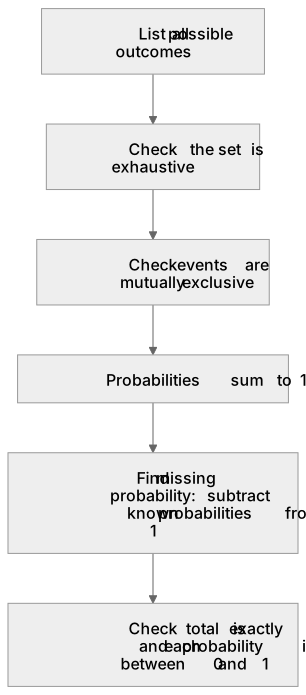
Put it in order
Put these steps in the order they happen.
- 1. Check events are mutually exclusive
- 2. Check the set is exhaustive
- 3. List all possible outcomes
- 4. Check total is exactly 1 and each probability is between 0 and 1
- 5. Find missing probability: subtract known probabilities from 1
- 6. Probabilities sum to 1
Key words
Say what each word means before you turn the card.
Exhaustive sets of outcomes
Try answering aloud or in your head before turning the card.
Mutually exclusive events
Try answering aloud or in your head before turning the card.
Probabilities summing to 1
Try answering aloud or in your head before turning the card.
See every definition
- Exhaustive sets of outcomes
- A set of outcomes that covers every possible result of an experiment, so their probabilities sum to 1.
- Mutually exclusive events
- Events that cannot happen at the same time, so their probabilities add without overlap.
- Probabilities summing to 1
- When a set is both exhaustive and mutually exclusive, the probabilities sum to exactly 1.
Label the diagram
Some boxes have lost their names. Pick the right name for each number.
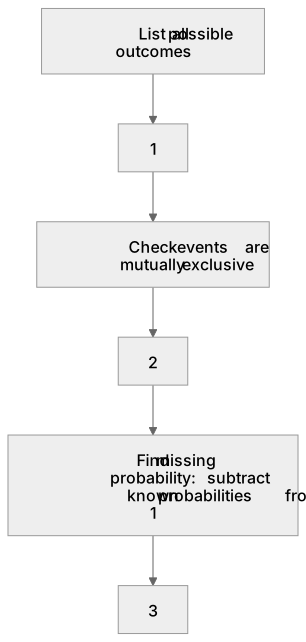
1Box 1
2Box 2
3Box 3
There is more to this lesson
The full lesson goes on to check your understanding and help you earn the marks. Create a free account to carry on, with your progress saved.
A week of Premium from your first lesson · Then the free plan continues · No card, no charge
Test your understanding of Probability: apply the property that the probabilities of an exhaustive set of outcomes sum to 1 apply the property that the probabilities of an exhaustive set of mutually exclusive events sum to 1
Active recall beats re-reading. Take an instant quiz now to test what you’ve learned and lock it into long-term memory.
A week of Premium from your first lesson · Then the free plan continues · No card, no charge