AQA · GCSE · Mathematics
Course version: 8300 · Version from Sept 2015
Construct and interpret equations that describe direct and inverse…
Full specification wording
Ratio, proportion and rates of change: construct and interpret equations that describe direct and inverse proportion (Higher tier only)
Direct proportion means two quantities increase together at a constant ratio, so y = kx, where k is the constant of proportionality.
Checked against the AQA 8300 specification (opens in a new tab) on .
- Point 17 of 21
- 4 key terms
Study notes
From the checked teaching notes for this specification point.
The idea
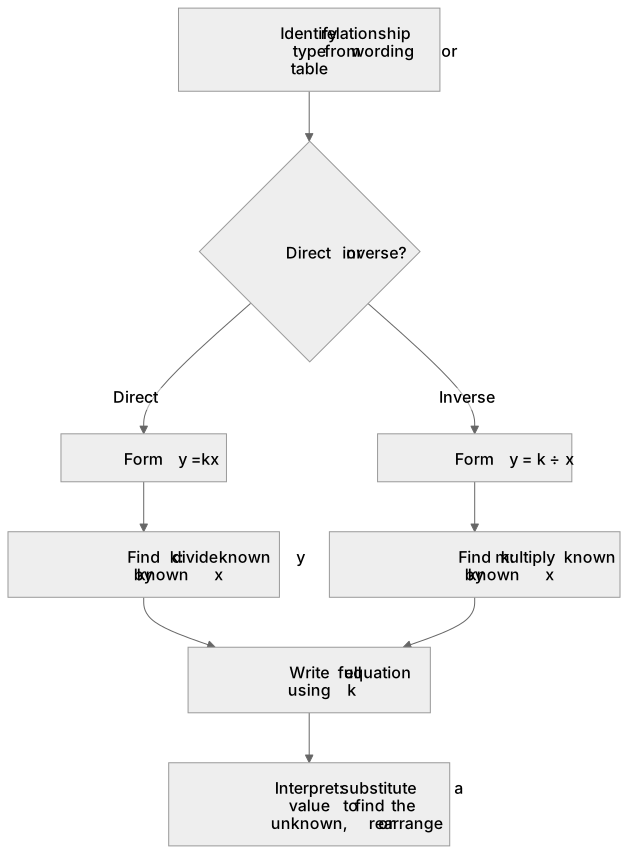
Direct proportion means two quantities increase together at a constant ratio, so y = kx, where k is the constant of proportionality. Inverse proportion means one quantity decreases as the other increases so their product stays fixed, giving y = k ÷ x, often written y = k/x. To construct an equation, first identify the relationship type from the wording or table, then substitute a known pair of values to find k. For example, if y is directly proportional to x and y = 12 when x = 3, then k = 12 ÷ 3 = 4, so y = 4x. If y is inversely proportional to x and y = 12 when x = 3, then k = 12 × 3 = 36, so y = 36 ÷ x. Interpreting an equation means using it to predict a value, such as finding y when x = 5, or rearranging to find x when y is known. Higher tier only.
What earns the marks
- Recognises that direct proportion has the form y = kx and inverse proportion has the form y = k ÷ x, where k is constant.
- Finds k by substituting a known pair of values: divide for direct proportion, multiply for inverse proportion.
- Constructs the full equation, for example y = 4x or y = 36 ÷ x, using the calculated value of k.
- Interprets the equation by substituting a given value to calculate the unknown quantity, or by rearranging to make the other variable the subject.
- Distinguishes direct from inverse proportion using the context, a table of values or the shape of the relationship.
Common mistakes and how to put them right
Confusing the two forms and writing y = k ÷ x for a directly proportional relationship.
Put it right: Direct proportion multiplies, y = kx, while inverse proportion divides.
Finding k by the wrong operation, such as multiplying when the relationship is direct.
Put it right: Divide the known y by the known x for direct proportion.
Treating k as the answer rather than part of the equation.
Put it right: Substitute k back to give the full relationship, such as y = 4x.
Assuming every proportional relationship passes through the origin with gradient 1.
Put it right: The gradient or constant is k, which must be calculated from the data.
Exam tips
- Underline the words directly proportional or inversely proportional before choosing the equation form.
- Show the substitution that gives k, because method marks are available even if the final value is wrong.
- Check the equation by substituting the original pair of values back in to confirm both sides match.
- When a table is given, test whether y ÷ x is constant (direct) or x × y is constant (inverse) before writing anything.
Try the lesson
The start of the Ratio, proportion and rates of change: construct and interpret equations that describe direct and inverse proportion (Higher tier only) lesson, made from checked teaching notes for this specification point.
Have a go first
y is directly proportional to the square of x. When x = 3, y = 36. Which equation gives y in terms of x?
Listen
Direct proportion means two quantities increase together at a constant ratio, so y = kx, where k is the constant of proportionality. Inverse proportion means one quantity decreases as the other increases so their product stays fixed, giving y = k ÷ x, often written y = k/x. To construct an equation, first identify the relationship type from the wording or table, then substitute a known pair of values to find k. For example, if y is directly proportional to x and y = 12 when x = 3, then k = 12 ÷ 3 = 4, so y = 4x. If y is inversely proportional to x and y = 12 when x = 3, then k = 12 × 3 = 36, so y = 36 ÷ x. Interpreting an equation means using it to predict a value, such as finding y when x = 5, or rearranging to find x when y is known. Higher tier only. A strong answer earns marks for these points. Recognises that direct proportion has the form y = kx and inverse proportion has the form y = k ÷ x, where k is constant. Finds k by substituting a known pair of values: divide for direct proportion, multiply for inverse proportion. Constructs the full equation, for example y = 4x or y = 36 ÷ x, using the calculated value of k. Interprets the equation by substituting a given value to calculate the unknown quantity, or by rearranging to make the other variable the subject. A common slip: Confusing the two forms and writing y = k ÷ x for a directly proportional relationship. Instead, direct proportion multiplies, y = kx, while inverse proportion divides. Exam tip: Underline the words directly proportional or inversely proportional before choosing the equation form.
See it
Watch it explained
What is the one idea the video explains? Say it in a sentence.
Read the described scene instead
Some quantities rise together, while others trade off against each other. In this lesson we look at direct proportion and inverse proportion, both Higher tier only, and see how each one becomes an equation you can use. Direct proportion means two quantities increase together at a constant ratio, so y equals k x, where k is the constant of proportionality. Inverse proportion means their product stays fixed, giving y equals k divided by x, often written y equals k over x. To construct an equation, first identify the relationship type from the wording or from a table. Then substitute a known pair of values to find k. For direct proportion you divide y by x to find k. For inverse proportion you multiply y by x to find k. Suppose y is directly proportional to x, and y equals twelve when x equals three. Pause here and think which operation finds k. Because the relationship is direct, k is twelve divided by three, which is four. So the full equation is y equals four x. Now suppose y is inversely proportional to x, again with y equals twelve when x equals three. Pause and think how this differs. Here the product is constant, so k is twelve times three, which is thirty six. The equation is y equals thirty six divided by x. Interpreting an equation means using it to predict a value, such as finding y when x equals five, or rearranging to find x when y is known. Check the equation by substituting the original pair of values back in to confirm both sides match. The most common slip is writing y equals k divided by x for a directly proportional relationship. Remember that direct proportion multiplies, while inverse proportion divides. Another slip is finding k by the wrong operation, so divide for direct and multiply for inverse. Direct proportion has the form y equals k x, and inverse proportion has the form y equals k divided by x. Find k by dividing for direct proportion and multiplying for inverse proportion, then write the full equation. Use that equation to calculate unknown values or rearrange it to find the other variable.
Key words
Say what each word means before you turn the card.
Direct proportion
Try answering aloud or in your head before turning the card.
Inverse proportion
Try answering aloud or in your head before turning the card.
Constant of proportionality
Try answering aloud or in your head before turning the card.
Interpreting an equation
Try answering aloud or in your head before turning the card.
See every definition
- Direct proportion
- Two quantities increase together at a constant ratio, so y = kx, where k is the constant of proportionality.
- Inverse proportion
- One quantity decreases as the other increases so their product stays fixed, giving y = k ÷ x, often written y = k/x.
- Constant of proportionality
- The constant k in y = kx or y = k ÷ x, found by substituting a known pair of values.
- Interpreting an equation
- Using the equation to predict a value, such as finding y when x = 5, or rearranging to find x when y is known.
There is more to this lesson
The full lesson goes on to check your understanding and help you earn the marks. Create a free account to carry on, with your progress saved.
A week of Premium from your first lesson · Then the free plan continues · No card, no charge
Test your understanding of Ratio, proportion and rates of change: construct and interpret equations that describe direct and inverse proportion (Higher tier only)
Active recall beats re-reading. Take an instant quiz now to test what you’ve learned and lock it into long-term memory.
A week of Premium from your first lesson · Then the free plan continues · No card, no charge