AQA · GCSE · Mathematics
Course version: 8300 · Version from Sept 2015
Relate ratios to fractions and to linear functions
Full specification wording
Ratio, proportion and rates of change: relate ratios to fractions and to linear functions
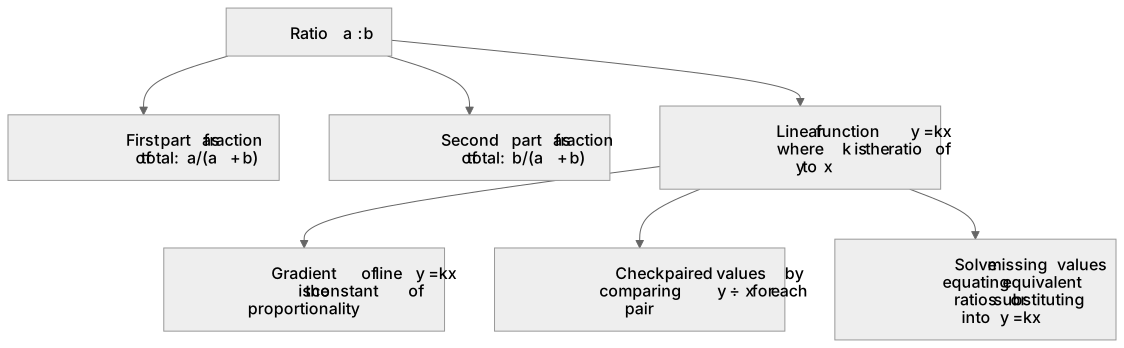
A ratio compares quantities in a fixed order, so the ratio a : b can be written as the fraction a/(a + b) for the first part and b/(a + b) for the second.
Checked against the AQA 8300 specification (opens in a new tab) on .
- Point 9 of 21
- 4 key terms
Study notes
From the checked teaching notes for this specification point.
The idea
A ratio compares quantities in a fixed order, so the ratio a : b can be written as the fraction a/(a + b) for the first part and b/(a + b) for the second. For example, in 3 : 5 the first share is 3/8 of the total and the second is 5/8. A ratio also describes a linear function: if y is proportional to x with y : x = 3 : 5, then y = (3/5)x, a straight-line graph through the origin with gradient 3/5. Equivalently x = (5/3)y. Recognising this link lets you move between a ratio, a fraction of a total, and an equation or graph of the form y = kx, and to check whether a table of paired values is in a constant ratio.
What earns the marks
- Convert a two-part ratio a : b to fractions of the total as a/(a + b) and b/(a + b).
- Use a ratio to form a linear equation y = kx where k is the ratio of y to x.
- Identify the gradient of the line y = kx as the constant of proportionality from the ratio.
- Check whether paired values are in a constant ratio by comparing y ÷ x for each pair.
- Solve a missing-value problem by equating two equivalent ratios or by substituting into y = kx.
Common mistakes and how to put them right
Writing the ratio a : b directly as the fraction a/b of the total; the correct fraction of the total is a/(a + b).
Reversing the constant when forming the equation, for example using y = (5/3)x for the ratio y.
Put it right: x = 3 : 5; the correct equation is y = (3/5)x.
Treating a ratio as an additive difference rather than a multiplicative comparison, so that 3.
Put it right: 5 is read as '5 is 2 more than 3' instead of 'the second is 5/3 of the first'.
Assuming every straight-line graph represents a ratio relationship.
Put it right: Only lines through the origin, y = kx, do.
Exam tips
- Write the ratio as a fraction of the total before doing any calculation, and label which quantity each fraction represents.
- When a question gives a ratio and asks for an equation, state clearly which variable is proportional to which before writing y = kx.
- Check your answer by substituting one pair of values back into the ratio or equation to confirm it is satisfied.
Try the lesson
The start of the Ratio, proportion and rates of change: relate ratios to fractions and to linear functions lesson, made from checked teaching notes for this specification point.
Have a go first
A bag contains red and blue counters in the ratio 3 : 5. What fraction of the counters are red?
Listen
A ratio compares quantities in a fixed order, so the ratio a : b can be written as the fraction a/(a + b) for the first part and b/(a + b) for the second. For example, in 3 : 5 the first share is 3/8 of the total and the second is 5/8. A ratio also describes a linear function: if y is proportional to x with y : x = 3 : 5, then y = (3/5)x, a straight-line graph through the origin with gradient 3/5. Equivalently x = (5/3)y. Recognising this link lets you move between a ratio, a fraction of a total, and an equation or graph of the form y = kx, and to check whether a table of paired values is in a constant ratio. A strong answer earns marks for these points. Convert a two-part ratio a : b to fractions of the total as a/(a + b) and b/(a + b). Use a ratio to form a linear equation y = kx where k is the ratio of y to x. Identify the gradient of the line y = kx as the constant of proportionality from the ratio. Check whether paired values are in a constant ratio by comparing y ÷ x for each pair. Exam tip: Write the ratio as a fraction of the total before doing any calculation, and label which quantity each fraction represents.
See it
Watch it explained
What is the one idea the video explains? Say it in a sentence.
Read the described scene instead
A ratio compares quantities in a fixed order. In the ratio three to five, the first share is three eighths of the total and the second is five eighths. Notice we divide by the sum, three plus five, which is eight. Three ideas are linked here: a ratio, a fraction of a total, and a linear function. A ratio describes a linear function when y is proportional to x. Recognising this link lets you move between a ratio, a fraction of a total, and an equation or graph of the form y equals k x. Write a two-part ratio a to b as fractions of the total: a over a plus b, and b over a plus b. A common slip is writing a over b instead. The ratio a to b is not a fraction of the total, because the denominator must be the sum of both parts. Pause and think: if y to x is three to five, what equation links them? Because y is proportional to x, y equals k x with k equal to three fifths. The graph is a straight line through the origin with gradient three fifths. Equivalently, x equals five thirds of y. How do you check a table of paired values? Compare y divided by x for each pair. If every pair gives the same value, the values are in a constant ratio, and that value is k. To solve a missing-value problem, equate two equivalent ratios or substitute into y equals k x. Watch for these. Writing a to b as a over b of the total; reversing the constant, using five thirds x when y to x is three to five; treating a ratio as an additive difference, so three to five means the second is five thirds of the first, not two more; and assuming every straight line is a ratio relationship, when only lines through the origin are. To recap: convert a ratio a to b into fractions of the total, a over a plus b and b over a plus b. Use the ratio to form y equals k x, with gradient k. Check paired values by comparing y divided by x, and remember only lines through the origin represent a ratio relationship.
Key words
Say what each word means before you turn the card.
Ratio notation and equivalent ratios
Try answering aloud or in your head before turning the card.
Fractions of a total
Try answering aloud or in your head before turning the card.
Direct proportion and the constant of proportionality
Try answering aloud or in your head before turning the card.
Linear functions and gradient
Try answering aloud or in your head before turning the card.
See every definition
- Ratio notation and equivalent ratios
- A ratio compares quantities in a fixed order, and two equivalent ratios can be equated to solve a missing-value problem.
- Fractions of a total
- The ratio a : b gives the first part as a/(a + b) of the total and the second part as b/(a + b).
- Direct proportion and the constant of proportionality
- If y is proportional to x with y : x = 3 : 5, then y = (3/5)x, where the constant of proportionality is the gradient of the line.
- Linear functions and gradient
- A ratio describes a linear function y = kx, a straight-line graph through the origin whose gradient is the constant of proportionality.
Label the diagram
Some boxes have lost their names. Pick the right name for each number.
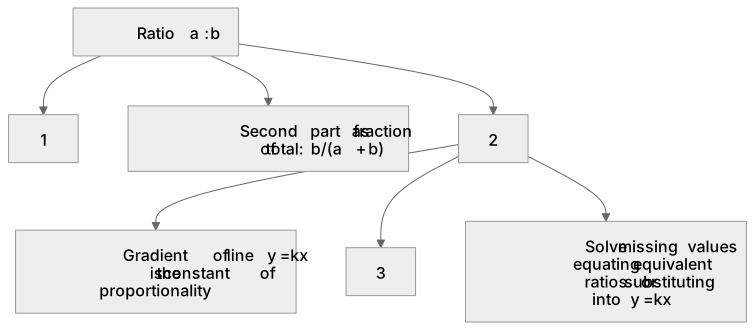
1Box 1
2Box 2
3Box 3
There is more to this lesson
The full lesson goes on to check your understanding and help you earn the marks. Create a free account to carry on, with your progress saved.
A week of Premium from your first lesson · Then the free plan continues · No card, no charge
Test your understanding of Ratio, proportion and rates of change: relate ratios to fractions and to linear functions
Active recall beats re-reading. Take an instant quiz now to test what you’ve learned and lock it into long-term memory.
A week of Premium from your first lesson · Then the free plan continues · No card, no charge