AQA · GCSE · Mathematics
Course version: 8300 · Version from Sept 2015
Interpret the gradient at a point on a curve as the instantaneous rate of…
Full specification wording
Ratio, proportion and rates of change: interpret the gradient at a point on a curve as the instantaneous rate of change apply the concepts of average and instantaneous rate of change (gradients of chords and tangents) in numerical, algebraic and graphical contexts (Higher tier only)
This Higher tier topic links gradients to rates of change.
Checked against the AQA 8300 specification (opens in a new tab) on .
- Point 19 of 21
- 4 key terms
Study notes
From the checked teaching notes for this specification point.
The idea
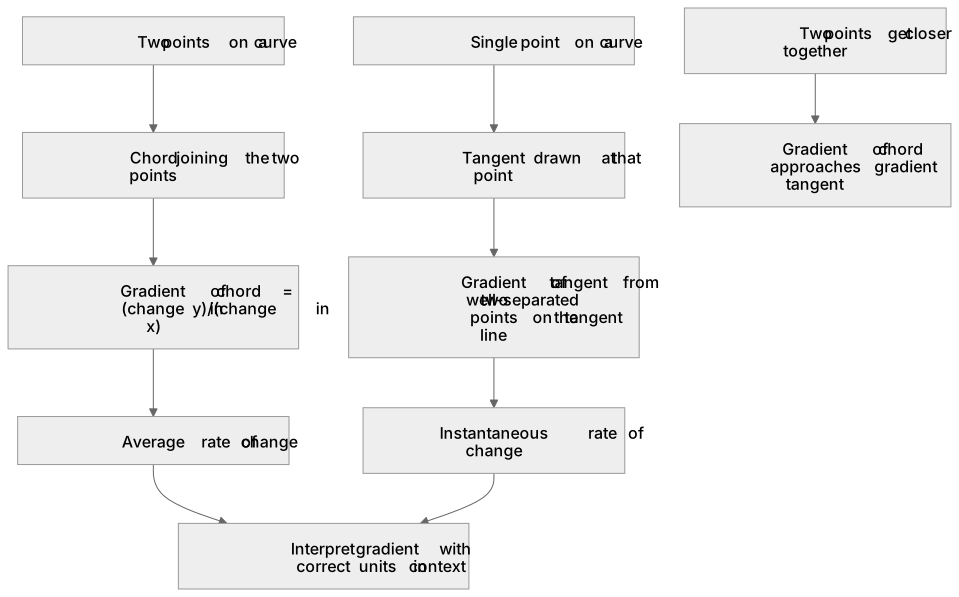
This Higher tier topic links gradients to rates of change. The average rate of change between two points on a curve is the gradient of the chord joining them: divide the change in the dependent variable by the change in the independent variable. The instantaneous rate of change at a single point is the gradient of the tangent at that point, found graphically by drawing a tangent and reading its gradient. For example, for y = x², the chord from x = 1 to x = 3 has gradient (9 − 1)/(3 − 1) = 4, an average rate. You must interpret these gradients in context, including units such as m/s or £/year, and work numerically, algebraically (using equations to find coordinates) and graphically.
What earns the marks
- Average rate of change between two points equals the gradient of the chord: (change in y)/(change in x).
- Instantaneous rate of change at a point equals the gradient of the tangent at that point.
- On a graph, a tangent is drawn at the required point and its gradient is calculated from two well-separated points on the tangent line.
- In algebraic contexts, substitute x-values into the given equation to find the corresponding y-coordinates before calculating the gradient of a chord.
- Interpret the numerical gradient with correct units and in the context of the problem, distinguishing average from instantaneous.
- Recognise that the gradient of a chord approaches the tangent gradient as the two points get closer together.
Common mistakes and how to put them right
Confusing average and instantaneous rate.
Put it right by labelling which two points or which single point is being used.
Reading the tangent gradient from the curve itself rather than from the straight tangent line.
Put it right by drawing a straight line that touches the curve at the point and extends clearly on both sides.
Forgetting to divide by the change in x, or reversing the subtraction order between the two points.
Put it right by writing (y₂ − y₁)/(x₂ − x₁) consistently.
Omitting units or attaching the wrong units to a rate.
Put it right by dividing the units of the y-axis by the units of the x-axis.
Exam tips
- When a question says 'estimate', draw the tangent as accurately as you can and choose two points on the tangent that are far apart to reduce reading error.
- Show the substitution into (y₂ − y₁)/(x₂ − x₁) so method marks are visible.
- State the meaning of the gradient in the context of the question, including units, rather than giving a bare number.
Try the lesson
The start of the Ratio, proportion and rates of change: interpret the gradient at a point on a curve as the instantaneous rate of change apply the concepts of average and instantaneous rate of change (gradients of chords and tangents) in numerical, algebraic and graphical contexts (Higher tier only) lesson, made from checked teaching notes for this specification point.
Have a go first
A curve shows the distance s, in metres, travelled by a toy car against time t, in seconds. The points (1, 4) and (5, 36) lie on the curve. What is the average rate of change of distance with respect to time between t = 1 and t = 5?
Listen
This Higher tier topic links gradients to rates of change. The average rate of change between two points on a curve is the gradient of the chord joining them: divide the change in the dependent variable by the change in the independent variable. The instantaneous rate of change at a single point is the gradient of the tangent at that point, found graphically by drawing a tangent and reading its gradient. For example, for y = x², the chord from x = 1 to x = 3 has gradient (9 − 1)/(3 − 1) = 4, an average rate. You must interpret these gradients in context, including units such as m/s or £/year, and work numerically, algebraically (using equations to find coordinates) and graphically. A strong answer earns marks for these points. Average rate of change between two points equals the gradient of the chord: (change in y)/(change in x). Instantaneous rate of change at a point equals the gradient of the tangent at that point. On a graph, a tangent is drawn at the required point and its gradient is calculated from two well-separated points on the tangent line. In algebraic contexts, substitute x-values into the given equation to find the corresponding y-coordinates before calculating the gradient of a chord. A common slip: Confusing average and instantaneous rate: the average uses two points and a chord, while the instantaneous uses one point and a tangent. Instead, labelling which two points or which single point is being used. Exam tip: When a question says 'estimate', draw the tangent as accurately as you can and choose two points on the tangent that are far apart to reduce reading error.
See it
Watch it explained
What is the one idea the video explains? Say it in a sentence.
Read the described scene instead
In Higher tier maths, gradients describe rates of change. A rate compares how a dependent variable changes as an independent variable changes. We will look at average and instantaneous rates using chords and tangents. The average rate of change between two points is the gradient of the chord joining them. The instantaneous rate of change at one point is the gradient of the tangent there. As the two points get closer, the chord gradient approaches the tangent gradient. On a graph, draw the tangent at the point and read its gradient. To calculate an average rate, use change in y divided by change in x. In algebraic contexts, substitute x-values into the given equation to find the corresponding y-coordinates. Then calculate the gradient of the chord. Keep the subtraction order consistent: y two minus y one over x two minus x one. To estimate an instantaneous rate, draw a straight tangent touching the curve at the point and extending on both sides. Choose two well-separated points on the tangent line. Calculate the gradient from those points using change in y over change in x. This reduces reading error. Here is a worked example. For y equals x squared, find the average rate of change from x equals one to x equals three. Pause to think: what are the y-values? Substitute x equals one and x equals three into the equation. The y-values are one and nine. The chord gradient is nine minus one over three minus one, which equals four. This is an average rate of change. A common mistake is confusing average and instantaneous rates. Average uses two points and a chord; instantaneous uses one point and a tangent. Another mistake is reading the gradient from the curve rather than the tangent line. Also remember to divide by the change in x and keep units such as metres per second or pounds per year. Remember: average rate of change is the gradient of a chord between two points. Instantaneous rate is the gradient of the tangent at one point. Work numerically, algebraically or graphically, and state the meaning with units. Show your substitution into change in y over change in x.
Key words
Say what each word means before you turn the card.
Gradient as a rate of change
Try answering aloud or in your head before turning the card.
Chord versus tangent
Try answering aloud or in your head before turning the card.
Numerical, algebraic and graphical representation
Try answering aloud or in your head before turning the card.
Interpretation in context with units
Try answering aloud or in your head before turning the card.
See every definition
- Gradient as a rate of change
- The gradient at a point on a curve is the instantaneous rate of change, and the gradient of a chord is the average rate of change between two points.
- Chord versus tangent
- A chord joins two points on a curve, while a tangent is a straight line that touches the curve at the required point and extends clearly on both sides.
- Numerical, algebraic and graphical representation
- Rates of change are worked numerically, algebraically using equations to find coordinates, and graphically by drawing a tangent and reading its gradient.
- Interpretation in context with units
- The numerical gradient is interpreted with correct units, such as m/s or £/year, and in the context of the problem, distinguishing average from instantaneous.
Label the diagram
Some boxes have lost their names. Pick the right name for each number.
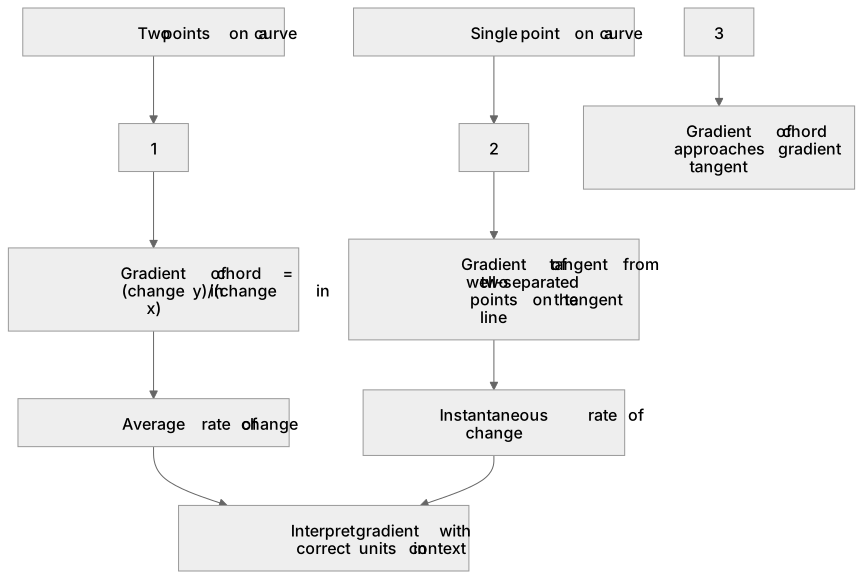
1Box 1
2Box 2
3Box 3
There is more to this lesson
The full lesson goes on to check your understanding and help you earn the marks. Create a free account to carry on, with your progress saved.
A week of Premium from your first lesson · Then the free plan continues · No card, no charge
Test your understanding of Ratio, proportion and rates of change: interpret the gradient at a point on a curve as the instantaneous rate of change apply the concepts of average and instantaneous rate of change (gradients of chords and tangents) in numerical, algebraic and graphical contexts (Higher tier only)
Active recall beats re-reading. Take an instant quiz now to test what you’ve learned and lock it into long-term memory.
A week of Premium from your first lesson · Then the free plan continues · No card, no charge