Pearson Edexcel · A-Level · Mathematics
Course version: 9MA0 · Version from Mar 2026
Apply differentiation to find gradients, tangents and normals, maxima and…
Full specification wording
Differentiation: 7.3 Apply differentiation to find gradients, tangents and normals, maxima and minima and stationary points, points of inflection. Identify where functions are increasing or decreasing.
Differentiation gives the gradient function, which you use to describe curve behaviour.
Checked against the Pearson Edexcel 9MA0 specification (opens in a new tab) on .
- Point 3 of 6
- 4 key terms
Study notes
From the checked teaching notes for this specification point.
The idea
Differentiation gives the gradient function, which you use to describe curve behaviour. To find the gradient at a point, substitute the x-coordinate into dy/dx. The tangent at that point has gradient m = dy/dx, and its equation follows from y − y₁ = m(x − x₁). The normal is perpendicular, so its gradient is −1/m when m ≠ 0. Stationary points occur where dy/dx = 0; classify them by the sign of the second derivative: d²y/dx² > 0 gives a minimum, d²y/dx² < 0 gives a maximum, and d²y/dx² = 0 requires further checking because it may be a point of inflection. A point of inflection is where the curve changes concavity, often with d²y/dx² = 0 and a change in sign of d²y/dx². A function is increasing where dy/dx > 0 and decreasing where dy/dx < 0, so solve the resulting inequality to identify intervals.
What earns the marks
- Substitutes a given x-value into dy/dx to obtain the gradient at a point and uses it in the tangent equation.
- Finds the normal gradient as the negative reciprocal of the tangent gradient and forms the correct line equation.
- Solves dy/dx = 0 to locate stationary points and gives both coordinates.
- Uses the second derivative, or a sign test on dy/dx, to classify maxima, minima and points of inflection.
- Determines intervals where dy/dx > 0 or dy/dx < 0 to state where the function is increasing or decreasing.
Common mistakes and how to put them right
Using the tangent gradient directly for the normal.
Put it right by taking the negative reciprocal, so a tangent gradient of 3 gives a normal gradient of −1/3.
Assuming every point with d²y/dx² = 0 is a point of inflection.
Put it right by checking that concavity actually changes sign.
Giving only the x-coordinate of a stationary point.
Put it right by substituting back into the original equation to find the y-coordinate.
Exam tips
- Write the gradient function clearly before substituting values, so arithmetic errors are easier to spot.
- For increasing or decreasing intervals, solve the inequality and express the answer as a range of x-values rather than a single point.
- When classifying a stationary point, show the second derivative value or a sign table to justify the conclusion.
Try the lesson
The start of the Differentiation: 7.3 Apply differentiation to find gradients, tangents and normals, maxima and minima and stationary points, points of inflection. Identify where functions are increasing or decreasing. lesson, made from checked teaching notes for this specification point.
Have a go first
A curve has equation y = x² − 6x + 5. Find the gradient of the curve at the point where x = 4.
Listen
Differentiation gives the gradient function, which you use to describe curve behaviour. To find the gradient at a point, substitute the x-coordinate into dy/dx. The tangent at that point has gradient m = dy/dx, and its equation follows from y − y₁ = m(x − x₁). The normal is perpendicular, so its gradient is −1/m when m ≠ 0. Stationary points occur where dy/dx = 0; classify them by the sign of the second derivative: d²y/dx² > 0 gives a minimum, d²y/dx² < 0 gives a maximum, and d²y/dx² = 0 requires further checking because it may be a point of inflection. A point of inflection is where the curve changes concavity, often with d²y/dx² = 0 and a change in sign of d²y/dx². A function is increasing where dy/dx > 0 and decreasing where dy/dx < 0, so solve the resulting inequality to identify intervals. A strong answer earns marks for these points. Substitutes a given x-value into dy/dx to obtain the gradient at a point and uses it in the tangent equation. Finds the normal gradient as the negative reciprocal of the tangent gradient and forms the correct line equation. Solves dy/dx = 0 to locate stationary points and gives both coordinates. Uses the second derivative, or a sign test on dy/dx, to classify maxima, minima and points of inflection. A common slip: Using the tangent gradient directly for the normal. Instead, taking the negative reciprocal, so a tangent gradient of 3 gives a normal gradient of −1/3. Exam tip: Write the gradient function clearly before substituting values, so arithmetic errors are easier to spot.
See it
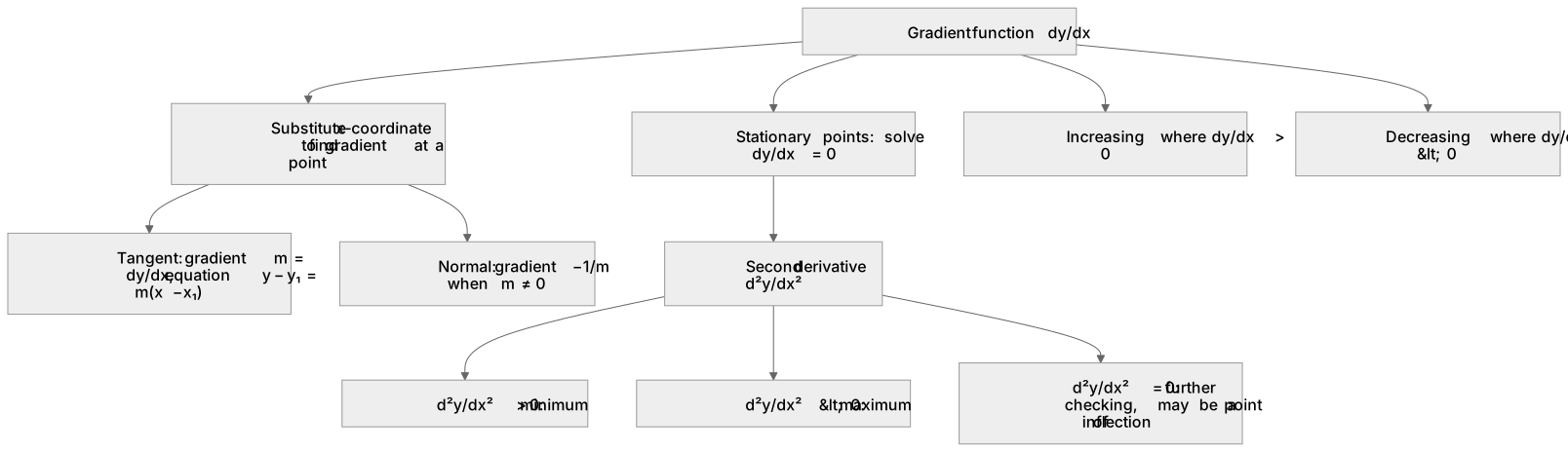
Key words
Say what each word means before you turn the card.
Gradient at a point
Try answering aloud or in your head before turning the card.
Tangent and normal lines
Try answering aloud or in your head before turning the card.
Stationary points and their classification
Try answering aloud or in your head before turning the card.
Increasing and decreasing functions and points of inflection
Try answering aloud or in your head before turning the card.
See every definition
- Gradient at a point
- Found by substituting the x-coordinate into dy/dx.
- Tangent and normal lines
- The tangent has gradient m = dy/dx and equation y − y₁ = m(x − x₁); the normal is perpendicular with gradient −1/m when m ≠ 0.
- Stationary points and their classification
- Occur where dy/dx = 0; d²y/dx² > 0 gives a minimum, d²y/dx² < 0 gives a maximum, and d²y/dx² = 0 requires further checking.
- Increasing and decreasing functions and points of inflection
- A function is increasing where dy/dx > 0 and decreasing where dy/dx < 0; a point of inflection is where the curve changes concavity.
Label the diagram
Some boxes have lost their names. Pick the right name for each number.
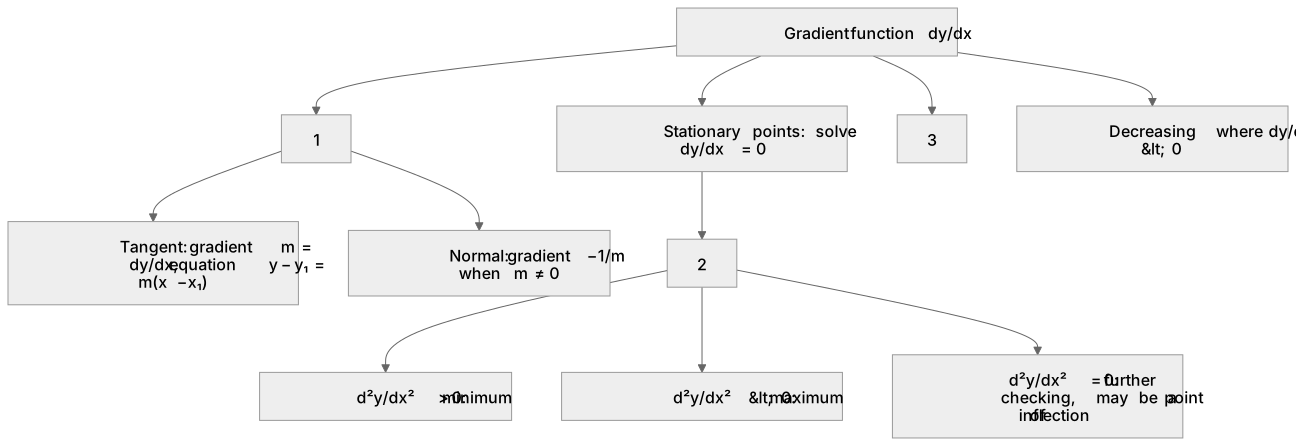
1Box 1
2Box 2
3Box 3
There is more to this lesson
The full lesson goes on to check your understanding and help you earn the marks. Create a free account to carry on, with your progress saved.
A week of Premium from your first lesson · Then the free plan continues · No card, no charge
Test your understanding of Differentiation: 7.3 Apply differentiation to find gradients, tangents and normals, maxima and minima and stationary points, points of inflection. Identify where functions are increasing or decreasing.
Active recall beats re-reading. Take an instant quiz now to test what you’ve learned and lock it into long-term memory.
A week of Premium from your first lesson · Then the free plan continues · No card, no charge