Pearson Edexcel · A-Level · Mathematics
Course version: 9MA0 · Version from Mar 2026
Mathematical problem solving: Evaluate, including by making reasoned…
Full specification wording
Overarching theme 2: Mathematical problem solving: Evaluate, including by making reasoned estimates, the accuracy or limitations of solutions, including those obtained using numerical methods.
Evaluating a solution means judging how trustworthy it is, not merely calculating it.
Checked against the Pearson Edexcel 9MA0 specification (opens in a new tab) on .
- Point 5 of 7
- 3 key terms
Study notes
From the checked teaching notes for this specification point.
The idea
Evaluating a solution means judging how trustworthy it is, not merely calculating it. For a numerical root, you can bound the error: after n bisection steps on [a, b], the absolute error is at most (b − a) / 2ⁿ. For Newton–Raphson, convergence may be rapid near a simple root but can fail if the derivative is small or the starting value is poor. Reasoned estimates include checking the sign and size of the answer, comparing with a graph, or using a simpler model. Limitations may arise from rounding, iteration count, model assumptions or sensitivity to initial data. You should state what the solution does and does not tell you, and whether the accuracy is sufficient for the context.
What earns the marks
- States a numerical bound or estimate for the error in a solution, such as an interval width or a function-value tolerance.
- Compares an approximate solution with an independent check, for example a graph, a sign change or a simpler estimate.
- Identifies limitations of a method, including slow convergence, failure near a zero derivative or sensitivity to the starting value.
- Distinguishes between error from the numerical method and error from rounding or from the mathematical model itself.
- Judges whether the achieved accuracy is adequate for the stated purpose and communicates that judgement clearly.
Common mistakes and how to put them right
Claiming an answer is exact when it is numerical.
Put it right: Quote the tolerance and describe the result as accurate to that tolerance.
Ignoring rounding error accumulated over many iterations.
Put it right: Consider how rounding affects the final accuracy.
Assuming a method always converges.
Put it right: Check conditions such as a sign change or a non-zero derivative before relying on the result.
Exam tips
- Give a numerical bound on the error rather than a vague statement that the answer is close.
- Use a graph or a sign check to support your evaluation of accuracy.
- Comment explicitly on whether the accuracy is sufficient for the problem context.
Try the lesson
The start of the Overarching theme 2: Mathematical problem solving: Evaluate, including by making reasoned estimates, the accuracy or limitations of solutions, including those obtained using numerical methods. lesson, made from checked teaching notes for this specification point.
Have a go first
A numerical method gives the root of an equation as 3.1416, correct to 4 decimal places. Which statement best describes the accuracy of this value?
Listen
Evaluating a solution means judging how trustworthy it is, not merely calculating it. For a numerical root, you can bound the error: after n bisection steps on [a, b], the absolute error is at most (b − a) / 2ⁿ. For Newton–Raphson, convergence may be rapid near a simple root but can fail if the derivative is small or the starting value is poor. Reasoned estimates include checking the sign and size of the answer, comparing with a graph, or using a simpler model. Limitations may arise from rounding, iteration count, model assumptions or sensitivity to initial data. You should state what the solution does and does not tell you, and whether the accuracy is sufficient for the context. A strong answer earns marks for these points. States a numerical bound or estimate for the error in a solution, such as an interval width or a function-value tolerance. Compares an approximate solution with an independent check, for example a graph, a sign change or a simpler estimate. Identifies limitations of a method, including slow convergence, failure near a zero derivative or sensitivity to the starting value. Distinguishes between error from the numerical method and error from rounding or from the mathematical model itself. A common slip: Claiming an answer is exact when it is numerical. Instead, quote the tolerance and describe the result as accurate to that tolerance. Exam tip: Give a numerical bound on the error rather than a vague statement that the answer is close.
See it
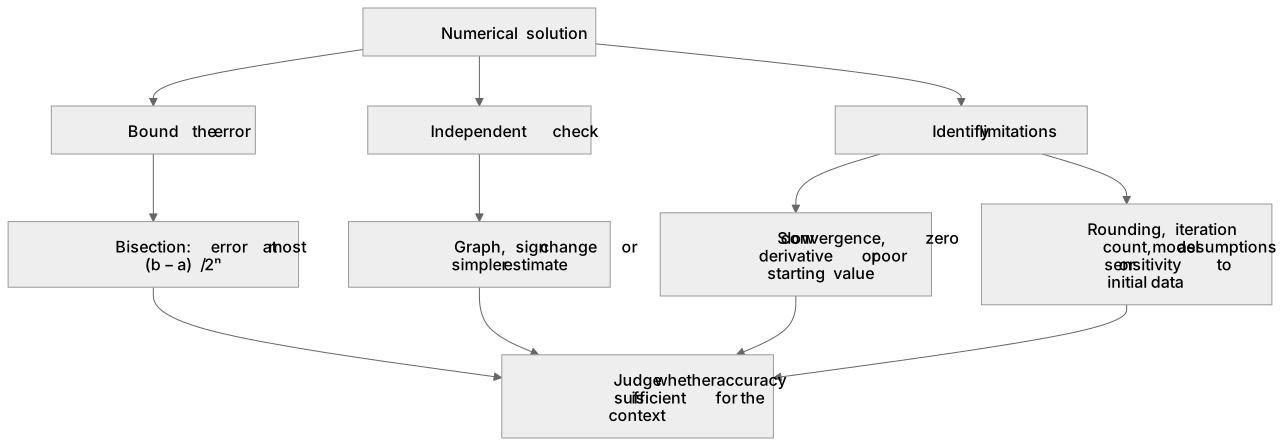
Key words
Say what each word means before you turn the card.
Error bounds
Try answering aloud or in your head before turning the card.
Reasoned estimation
Try answering aloud or in your head before turning the card.
Limitations of numerical methods
Try answering aloud or in your head before turning the card.
See every definition
- Error bounds
- A numerical limit on how far a solution may be from the true value, such as an interval width or a function-value tolerance.
- Reasoned estimation
- Judging accuracy by checking the sign and size of the answer, comparing with a graph, or using a simpler model.
- Limitations of numerical methods
- Drawbacks such as slow convergence, failure near a zero derivative or sensitivity to the starting value.
Label the diagram
Some boxes have lost their names. Pick the right name for each number.
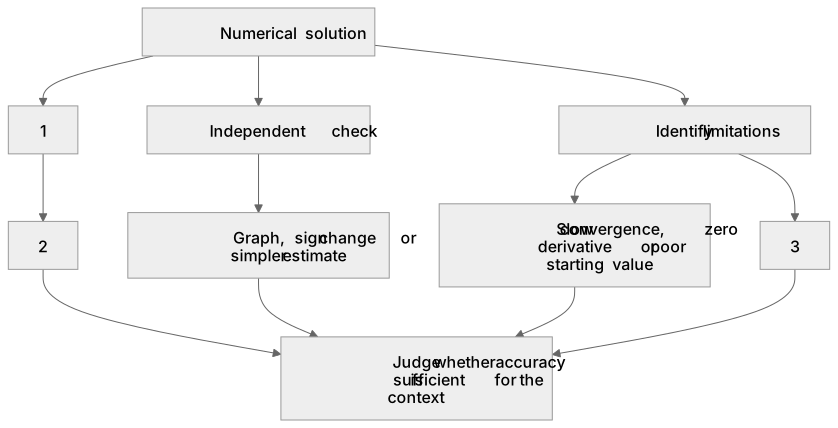
1Box 1
2Box 2
3Box 3
There is more to this lesson
The full lesson goes on to check your understanding and help you earn the marks. Create a free account to carry on, with your progress saved.
A week of Premium from your first lesson · Then the free plan continues · No card, no charge
Test your understanding of Overarching theme 2: Mathematical problem solving: Evaluate, including by making reasoned estimates, the accuracy or limitations of solutions, including those obtained using numerical methods.
Active recall beats re-reading. Take an instant quiz now to test what you’ve learned and lock it into long-term memory.
A week of Premium from your first lesson · Then the free plan continues · No card, no charge