Pearson Edexcel · A-Level · Mathematics
Course version: 9MA0 · Version from Mar 2026
Mathematical problem solving: Understand that many mathematical problems…
Full specification wording
Overarching theme 2: Mathematical problem solving: Understand that many mathematical problems cannot be solved analytically, but numerical methods permit solution to a required level of accuracy.
Some equations, such as x = cos x or e^x = 3x, have no closed-form solution using elementary functions, so an analytical approach fails.
Checked against the Pearson Edexcel 9MA0 specification (opens in a new tab) on .
- Point 4 of 7
- 4 key terms
Study notes
From the checked teaching notes for this specification point.
The idea
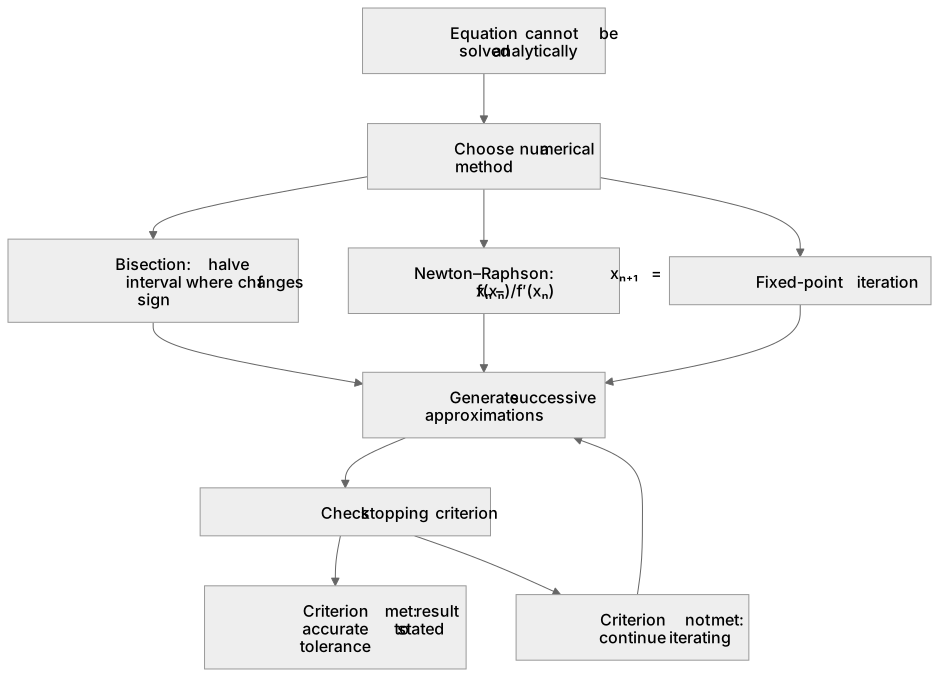
Some equations, such as x = cos x or e^x = 3x, have no closed-form solution using elementary functions, so an analytical approach fails. Numerical methods instead generate a sequence of approximations that converges towards the root. For example, the bisection method repeatedly halves an interval where f changes sign; after n iterations the error is at most (b − a) / 2ⁿ. You control accuracy by choosing a stopping criterion, such as |f(xₙ)| < 0.001 or an interval width below 10⁻⁴. Newton–Raphson uses xₙ₊₁ = xₙ − f(xₙ)/f′(xₙ) and often converges faster, but can fail if f′(xₙ) is zero or the starting value is poor. The solution is therefore not exact but is accurate to a stated tolerance, and you must justify that tolerance.
What earns the marks
- Recognises that an analytical solution means expressing the answer exactly in terms of known functions, and that some equations cannot be rearranged this way.
- Selects a suitable numerical method, such as bisection, Newton–Raphson or fixed-point iteration, for a given equation.
- Applies the chosen method correctly, showing successive approximations and maintaining consistent accuracy throughout.
- States and applies a stopping criterion, for example an interval width or a function-value tolerance, to decide when the required accuracy is reached.
- Interprets the final approximation in the context of the problem, including the meaning of the stated level of accuracy.
Common mistakes and how to put them right
Treating a numerical approximation as if it were an exact analytical solution.
Put it right: State the tolerance and present the result as accurate to that tolerance.
Stopping after one iteration without checking the required accuracy.
Put it right: Continue iterating until the stated stopping criterion is met.
Using degrees instead of radians in trigonometric equations.
Put it right: Work in radians unless the problem explicitly states otherwise.
Exam tips
- Show enough iterations to demonstrate convergence and to justify that your stopping criterion has been satisfied.
- State the equation you are solving in the form f(x) = 0 before applying a numerical method.
- When a required accuracy is given, quote your final answer to that accuracy and make clear how you know it is valid.
Try the lesson
The start of the Overarching theme 2: Mathematical problem solving: Understand that many mathematical problems cannot be solved analytically, but numerical methods permit solution to a required level of accuracy. lesson, made from checked teaching notes for this specification point.
Have a go first
The equation x³ + x − 5 = 0 has one real root. A student evaluates f(x) = x³ + x − 5 and finds f(1) = −3 and f(2) = 5. What does the change of sign tell the student about the root?
Listen
Some equations, such as x = cos x or e^x = 3x, have no closed-form solution using elementary functions, so an analytical approach fails. Numerical methods instead generate a sequence of approximations that converges towards the root. For example, the bisection method repeatedly halves an interval where f changes sign; after n iterations the error is at most (b − a) / 2ⁿ. You control accuracy by choosing a stopping criterion, such as |f(xₙ)| < 0.001 or an interval width below 10⁻⁴. Newton–Raphson uses xₙ₊₁ = xₙ − f(xₙ)/f′(xₙ) and often converges faster, but can fail if f′(xₙ) is zero or the starting value is poor. The solution is therefore not exact but is accurate to a stated tolerance, and you must justify that tolerance. A strong answer earns marks for these points. Recognises that an analytical solution means expressing the answer exactly in terms of known functions, and that some equations cannot be rearranged this way. Selects a suitable numerical method, such as bisection, Newton–Raphson or fixed-point iteration, for a given equation. Applies the chosen method correctly, showing successive approximations and maintaining consistent accuracy throughout. States and applies a stopping criterion, for example an interval width or a function-value tolerance, to decide when the required accuracy is reached. A common slip: Treating a numerical approximation as if it were an exact analytical solution. Instead, state the tolerance and present the result as accurate to that tolerance. Exam tip: Show enough iterations to demonstrate convergence and to justify that your stopping criterion has been satisfied.
See it
Key words
Say what each word means before you turn the card.
Analytical solution
Try answering aloud or in your head before turning the card.
Numerical methods
Try answering aloud or in your head before turning the card.
Stopping criterion
Try answering aloud or in your head before turning the card.
Tolerance
Try answering aloud or in your head before turning the card.
See every definition
- Analytical solution
- Expressing the answer exactly in terms of known functions, which some equations cannot be rearranged into.
- Numerical methods
- Methods that generate a sequence of approximations converging towards the root when an analytical approach fails.
- Stopping criterion
- A condition such as an interval width or a function-value tolerance used to decide when the required accuracy is reached.
- Tolerance
- The stated level of accuracy to which the solution is accurate, which you must justify.
Label the diagram
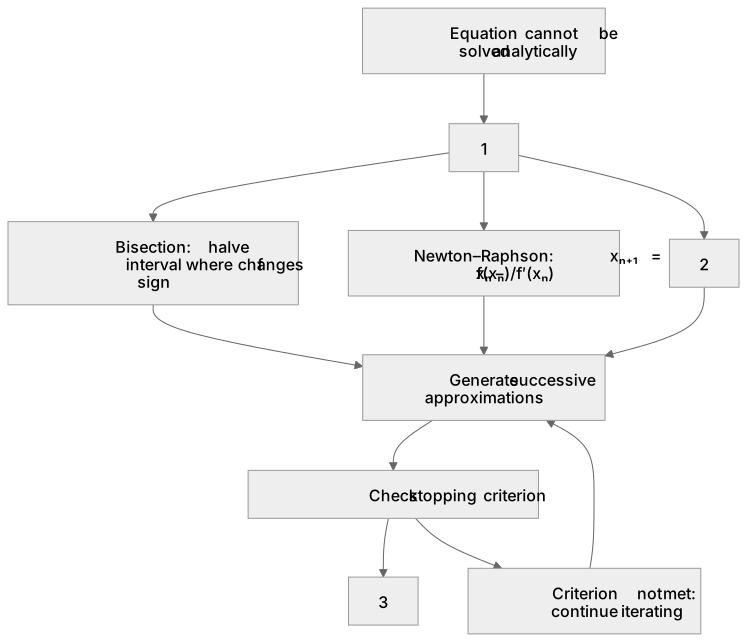
Some boxes have lost their names. Pick the right name for each number.
1Box 1
2Box 2
3Box 3
There is more to this lesson
The full lesson goes on to check your understanding and help you earn the marks. Create a free account to carry on, with your progress saved.
A week of Premium from your first lesson · Then the free plan continues · No card, no charge
Test your understanding of Overarching theme 2: Mathematical problem solving: Understand that many mathematical problems cannot be solved analytically, but numerical methods permit solution to a required level of accuracy.
Active recall beats re-reading. Take an instant quiz now to test what you’ve learned and lock it into long-term memory.
A week of Premium from your first lesson · Then the free plan continues · No card, no charge