Pearson Edexcel · A-Level · Mathematics
Course version: 9MA0 · Version from Mar 2026
Mathematical modelling: Interpret the outputs of a mathematical model in…
Full specification wording
Overarching theme 3: Mathematical modelling: Interpret the outputs of a mathematical model in the context of the original situation (for a given model or a model constructed or selected by the student).
Interpreting outputs means translating mathematical results back into the original context.
Checked against the Pearson Edexcel 9MA0 specification (opens in a new tab) on .
- Point 3 of 5
- 4 key terms
Study notes
From the checked teaching notes for this specification point.
The idea
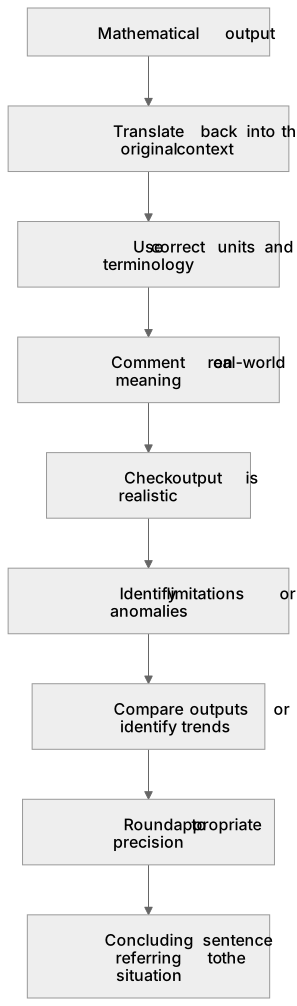
Interpreting outputs means translating mathematical results back into the original context. For example, if a model gives h = 15.1 m at t = 1 s, you state that after 1 second the object is 15.1 metres above the ground. You must consider whether the output is realistic: a negative height might indicate the object has passed ground level, or a non-integer time might need rounding to a sensible precision. Interpretation includes commenting on trends, comparing outputs, and explaining what the numbers mean in real terms. You should also check that the output's units match the context and that any rounding is appropriate. This step connects the mathematics back to the situation and prepares for evaluation.
What earns the marks
- Translates numerical outputs back into the context using correct units and terminology.
- Comments on the meaning of the output in real-world terms, not just restating the number.
- Checks whether the output is realistic and identifies any limitations or anomalies.
- Compares outputs or identifies trends where multiple values are calculated.
- Rounds or presents results at a level of precision appropriate to the context.
Common mistakes and how to put them right
Restating the numerical answer without contextual meaning.
Put it right by writing a sentence that explains what the number represents.
Ignoring unrealistic outputs such as negative lengths or probabilities greater than 1.
Put it right by commenting on the model's limitations.
Using inappropriate precision, such as quoting 15.123456 m for a rough model.
Put it right by rounding to a sensible number of significant figures.
Exam tips
- Always write a concluding sentence that refers back to the original situation.
- Check units and magnitudes for plausibility before writing your interpretation.
- If an output seems impossible, say so and suggest why the model might be limited.
Try the lesson
The start of the Overarching theme 3: Mathematical modelling: Interpret the outputs of a mathematical model in the context of the original situation (for a given model or a model constructed or selected by the student). lesson, made from checked teaching notes for this specification point.
Have a go first
A model gives the number of bacteria N in a dish after t hours as N = 500 × 2^t. The model predicts N = 4000 after 3 hours. Interpret this output in the context of the bacteria.
Listen
Interpreting outputs means translating mathematical results back into the original context. For example, if a model gives h = 15.1 m at t = 1 s, you state that after 1 second the object is 15.1 metres above the ground. You must consider whether the output is realistic: a negative height might indicate the object has passed ground level, or a non-integer time might need rounding to a sensible precision. Interpretation includes commenting on trends, comparing outputs, and explaining what the numbers mean in real terms. You should also check that the output's units match the context and that any rounding is appropriate. This step connects the mathematics back to the situation and prepares for evaluation. A strong answer earns marks for these points. Translates numerical outputs back into the context using correct units and terminology. Comments on the meaning of the output in real-world terms, not just restating the number. Checks whether the output is realistic and identifies any limitations or anomalies. Compares outputs or identifies trends where multiple values are calculated. A common slip: Restating the numerical answer without contextual meaning. Instead, writing a sentence that explains what the number represents. Exam tip: Always write a concluding sentence that refers back to the original situation.
See it
Key words
Say what each word means before you turn the card.
Contextual meaning
Try answering aloud or in your head before turning the card.
Realism checking
Try answering aloud or in your head before turning the card.
Trend description
Try answering aloud or in your head before turning the card.
Appropriate precision
Try answering aloud or in your head before turning the card.
See every definition
- Contextual meaning
- Translating mathematical results back into the original situation, explaining what the numbers mean in real terms rather than just restating the number.
- Realism checking
- Considering whether the output is realistic and identifying any limitations or anomalies, such as a negative height or a probability greater than 1.
- Trend description
- Commenting on trends or comparing outputs where multiple values are calculated as part of interpreting the model.
- Appropriate precision
- Rounding or presenting results at a level of precision appropriate to the context, rather than quoting an excessive number of significant figures.
Label the diagram
Some boxes have lost their names. Pick the right name for each number.
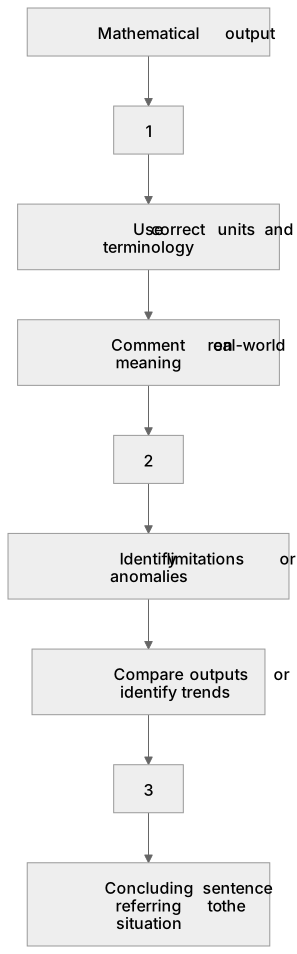
1Box 1
2Box 2
3Box 3
There is more to this lesson
The full lesson goes on to check your understanding and help you earn the marks. Create a free account to carry on, with your progress saved.
A week of Premium from your first lesson · Then the free plan continues · No card, no charge
Test your understanding of Overarching theme 3: Mathematical modelling: Interpret the outputs of a mathematical model in the context of the original situation (for a given model or a model constructed or selected by the student).
Active recall beats re-reading. Take an instant quiz now to test what you’ve learned and lock it into long-term memory.
A week of Premium from your first lesson · Then the free plan continues · No card, no charge