Pearson Edexcel · GCSE · Mathematics
Course version: 1MA1 · Version from Mar 2026
Construct theoretical possibility spaces for single and combined…
Full specification wording
Probability: construct theoretical possibility spaces for single and combined experiments with equally likely outcomes and use these to calculate theoretical probabilities
A possibility space lists every equally likely outcome.
Checked against the Pearson Edexcel 1MA1 specification (opens in a new tab) on .
- Point 7 of 9
Study notes
From the checked teaching notes for this specification point.
The idea
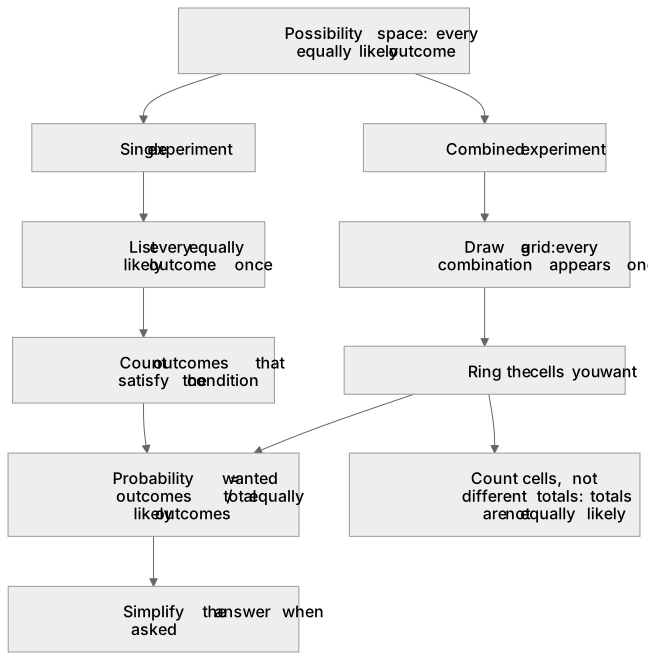
A possibility space lists every equally likely outcome. For a single experiment, such as rolling one fair six-sided die, the space is simply 1, 2, 3, 4, 5, 6, so the probability of an even number is 3/6 = 1/2. For two combined experiments, draw a grid: put one die down the side and the other along the top, then write the total in each of the 36 cells. Every cell is equally likely, so a probability is the number of cells you want divided by 36. Four cells hold a total of nine, so P(total 9) = 4/36 = 1/9. This method depends on the cells being equally likely. The totals themselves are not equally likely, which is exactly why you count cells rather than count the different totals available.
What earns the marks
- A correctly built possibility space for a single experiment, listing every equally likely outcome once.
- A correctly built grid for a combined experiment, with every combination appearing once.
- Identifying the outcomes that satisfy the condition, shown by ringing or listing them.
- A probability whose denominator is the total number of equally likely outcomes.
- The answer in its simplest form when the question asks for it.
Common mistakes and how to put them right
Using the number of different totals as the denominator, for example 11 rather than 36 for two dice.
Counting a pair such as one and three only once when the two dice are distinguishable, so the count comes out short.
Adding two probabilities when the question needs both events to happen together.
Writing the answer as a ratio of wanted cells to unwanted cells instead of as a probability.
Exam tips
- Draw the grid even when the question does not ask for one. The probability marks come faster off a grid than off a written list.
- Ring the cells you are counting rather than counting them in your head, so you can recount them if the number looks wrong.
Try the lesson
The start of the Probability: construct theoretical possibility spaces for single and combined experiments with equally likely outcomes and use these to calculate theoretical probabilities lesson, made from checked teaching notes for this specification point.
Have a go first
A fair six-sided dice is rolled once. Using a possibility space listing the outcomes 1, 2, 3, 4, 5 and 6, what is the theoretical probability of rolling a number greater than 4?
Listen
A possibility space lists every equally likely outcome. For a single experiment, such as rolling one fair six-sided die, the space is simply 1, 2, 3, 4, 5, 6, so the probability of an even number is 3/6 = 1/2. For two combined experiments, draw a grid: put one die down the side and the other along the top, then write the total in each of the 36 cells. Every cell is equally likely, so a probability is the number of cells you want divided by 36. Four cells hold a total of nine, so P(total 9) = 4/36 = 1/9. This method depends on the cells being equally likely. The totals themselves are not equally likely, which is exactly why you count cells rather than count the different totals available. A strong answer earns marks for these points. a correctly built possibility space for a single experiment, listing every equally likely outcome once. a correctly built grid for a combined experiment, with every combination appearing once. identifying the outcomes that satisfy the condition, shown by ringing or listing them. a probability whose denominator is the total number of equally likely outcomes. Exam tip: Draw the grid even when the question does not ask for one. The probability marks come faster off a grid than off a written list.
See it
Label the diagram
Some boxes have lost their names. Pick the right name for each number.
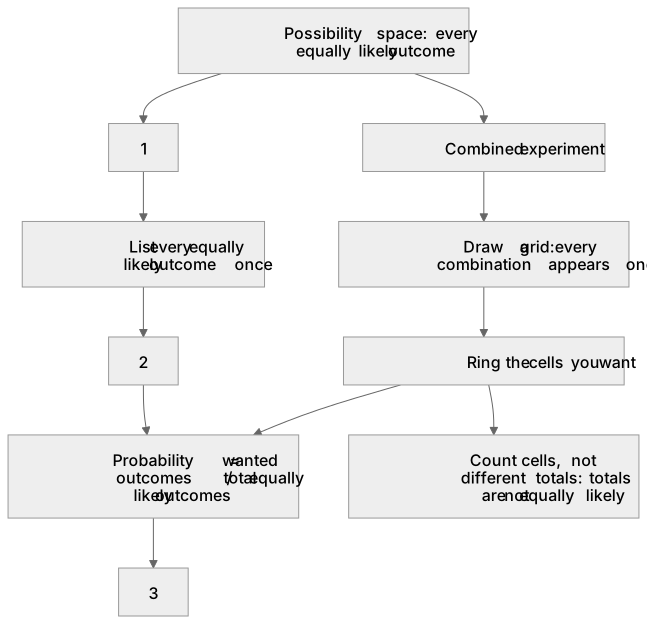
1Box 1
2Box 2
3Box 3
There is more to this lesson
The full lesson goes on to check your understanding and help you earn the marks. Create a free account to carry on, with your progress saved.
A week of Premium from your first lesson · Then the free plan continues · No card, no charge
Test your understanding of Probability: construct theoretical possibility spaces for single and combined experiments with equally likely outcomes and use these to calculate theoretical probabilities
Active recall beats re-reading. Take an instant quiz now to test what you’ve learned and lock it into long-term memory.
A week of Premium from your first lesson · Then the free plan continues · No card, no charge