WJEC · A-Level · Mathematics
Course version: 603/1977/X · Version from Sept 2017
Pure Mathematics B): Understand the effect of combinations of…
Full specification wording
Algebra and Functions (A2 Unit 3: Pure Mathematics B): Understand the effect of combinations of transformations on the graph of y = f (x), as represented by y = af (x), y = f (x) + a, y = f (x + a) and y = f (ax).
Combined transformations must be applied in a precise order, because order matters.
- Point 4 of 6
- 4 key terms
Study notes
From the teaching notes for this specification point.
The idea
Combined transformations must be applied in a precise order, because order matters. For y = af(x) + b, follow normal order of operations: stretch vertically by scale factor a parallel to the y-axis, then translate by vector (0, b). Writing y = a(f(x) + b) reverses this: translate up b first, then stretch. For y = f(ax + b), factorise as f(a(x + b/a)). The bracket x + b/a indicates a horizontal translation by −b/a, while the multiplier a indicates a horizontal stretch by scale factor 1/a. Crucially, the stretch must be applied before the translation: stretch by 1/a, then translate by −b/a. Reversing the order gives f(ax + b/a), not f(ax + b). Example: f(2x + 4) = f(2(x + 2)) is a stretch by 1/2 followed by a translation of −2. Track landmarks (intercepts, turning points, asymptotes) through each step to confirm the result.
What earns the marks
- Identifying each distinct transformation within a combined expression, including its type, direction and scale factor.
- Stating transformations in a mathematically correct sequential order, distinguishing vertical from horizontal cases.
- Calculating transformed coordinates of stationary points, intercepts and asymptotes after a combination of transformations.
- Explaining why horizontal order matters, using factorisation such as f(ax + b) = f(a(x + b/a)) to justify the sequence.
- Sketching the resulting curve and labelling key features to verify the transformation sequence.
Common mistakes and how to put them right
Applying horizontal transformations in the wrong order, or using scale factor a instead of 1/a for the horizontal stretch.
Translating in the wrong direction for horizontal shifts, moving right instead of left for x + b.
Assuming the order for vertical combinations carries over unchanged to horizontal combinations, when the horizontal case is reversed.
Exam tips
- Factorise horizontal terms first: write f(2x + 4) as f(2(x + 2)) to reveal a stretch by 1/2 followed by a translation of −2.
- Track one coordinate point (x, y) through each transformation step by step, and check the final image satisfies the original equation.
Try the lesson
The start of the Algebra and Functions (A2 Unit 3: Pure Mathematics B): Understand the effect of combinations of transformations on the graph of y = f (x), as represented by y = af (x), y = f (x) + a, y = f (x + a) and y = f (ax). lesson, made from teaching notes for this specification point.
Have a go first
The graph of y = f(x) is translated by the vector (0, 4). Write down the equation of the translated graph.
Listen
Combined transformations must be applied in a precise order, because order matters. For y = af(x) + b, follow normal order of operations: stretch vertically by scale factor a parallel to the y-axis, then translate by vector (0, b). Writing y = a(f(x) + b) reverses this: translate up b first, then stretch. For y = f(ax + b), factorise as f(a(x + b/a)). The bracket x + b/a indicates a horizontal translation by −b/a, while the multiplier a indicates a horizontal stretch by scale factor 1/a. Crucially, the stretch must be applied before the translation: stretch by 1/a, then translate by −b/a. Reversing the order gives f(ax + b/a), not f(ax + b). Example: f(2x + 4) = f(2(x + 2)) is a stretch by 1/2 followed by a translation of −2. Track landmarks (intercepts, turning points, asymptotes) through each step to confirm the result. A strong answer earns marks for these points. identifying each distinct transformation within a combined expression, including its type, direction and scale factor. stating transformations in a mathematically correct sequential order, distinguishing vertical from horizontal cases. calculating transformed coordinates of stationary points, intercepts and asymptotes after a combination of transformations. explaining why horizontal order matters, using factorisation such as f(ax + b) = f(a(x + b/a)) to justify the sequence. Exam tip: Factorise horizontal terms first: write f(2x + 4) as f(2(x + 2)) to reveal a stretch by 1/2 followed by a translation of −2.
See it
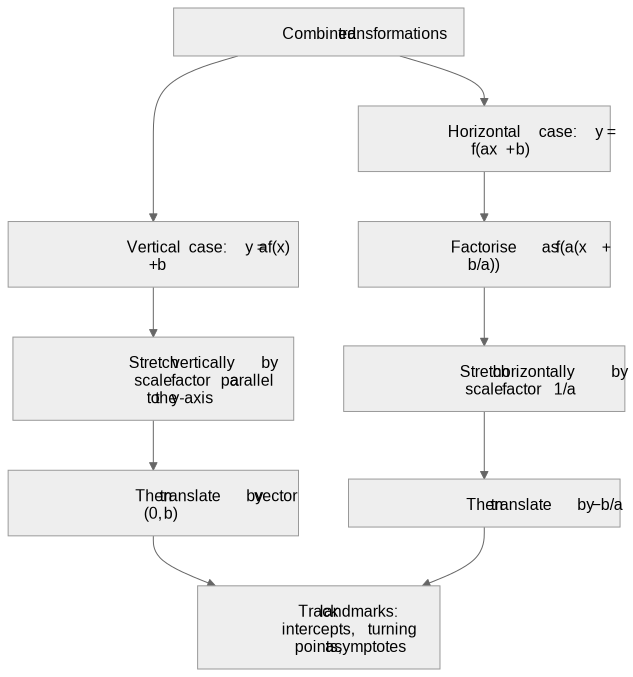
Key words
Say what each word means before you turn the card.
combined transformations
Try answering aloud or in your head before turning the card.
order of operations
Try answering aloud or in your head before turning the card.
horizontal and vertical scaling
Try answering aloud or in your head before turning the card.
transformed asymptotes
Try answering aloud or in your head before turning the card.
See every definition
- combined transformations
- Must be applied in a precise order, because order matters, as with y = af(x) + b and y = f(ax + b).
- order of operations
- For y = af(x) + b, stretch vertically by scale factor a parallel to the y-axis, then translate by vector (0, b).
- horizontal and vertical scaling
- The multiplier a indicates a horizontal stretch by scale factor 1/a, while a stretch vertically by scale factor a is parallel to the y-axis.
- transformed asymptotes
- Landmarks such as asymptotes are tracked through each step to confirm the result.
Label the diagram
Some boxes have lost their names. Pick the right name for each number.
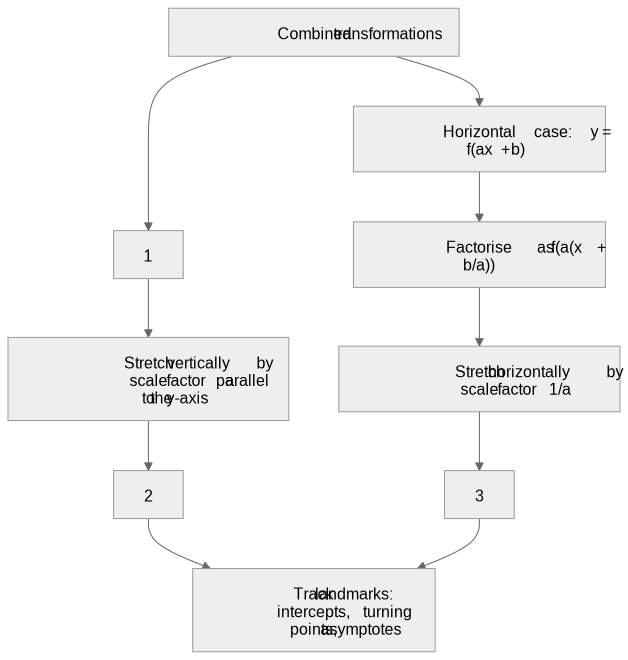
1Box 1
2Box 2
3Box 3
There is more to this lesson
The full lesson goes on to check your understanding and help you earn the marks. Create a free account to carry on, with your progress saved.
A week of Premium from your first lesson · Then the free plan continues · No card, no charge
Test your understanding of Algebra and Functions (A2 Unit 3: Pure Mathematics B): Understand the effect of combinations of transformations on the graph of y = f (x), as represented by y = af (x), y = f (x) + a, y = f (x + a) and y = f (ax).
Active recall beats re-reading. Take an instant quiz now to test what you’ve learned and lock it into long-term memory.
A week of Premium from your first lesson · Then the free plan continues · No card, no charge