WJEC · A-Level · Mathematics
Course version: 603/1977/X · Version from Sept 2017
Pure Mathematics A): Completing the square.
Full specification wording
Algebra and Functions (AS Unit 1: Pure Mathematics A): Completing the square.
Completing the square rewrites a quadratic expression ax² + bx + c into the canonical form a(x + p)² + q.
- Point 5 of 17
- 3 key terms
Study notes
From the teaching notes for this specification point.
The idea
Completing the square rewrites a quadratic expression ax² + bx + c into the canonical form a(x + p)² + q. For a monic quadratic x² + bx + c, halving the linear coefficient gives (x + b/2)² − (b/2)² + c. When a ≠ 1, the leading coefficient a must be factored out of the variable terms first: a[x² + (b/a)x] + c = a[(x + b/(2a))² − b²/(4a²)] + c = a(x + b/(2a))² + (4ac − b²)/(4a). This algebraic identity immediately locates the stationary vertex of the parabola at (−b/(2a), c − b²/(4a)). It also enables solving ax² + bx + c = 0 by taking square roots directly, proves whether a quadratic is positive definite, and provides the standard algebraic technique for rewriting the equations of circles.
What earns the marks
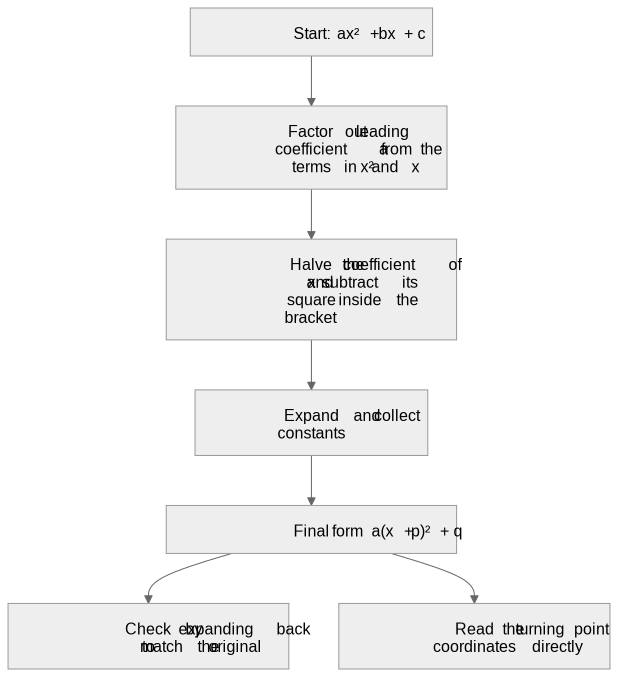
- Factorising out the leading coefficient a from the terms in x² and x.
- Halving the coefficient of x and subtracting its square inside the bracket.
- Expanding and collecting constants to obtain the final form a(x + p)² + q.
Common mistakes and how to put them right
Failing to multiply the subtracted squared term by the leading coefficient a when expanding.
Halving the coefficient of x incorrectly or making sign errors when b is negative.
Exam tips
- Double-check your completed square form by expanding it back to ensure it matches the original.
- Read the coordinates of the turning point directly from the completed square form.
Try the lesson
The start of the Algebra and Functions (AS Unit 1: Pure Mathematics A): Completing the square. lesson, made from teaching notes for this specification point.
Have a go first
Write x² + 6x + 5 in the form (x + p)² + q. What is the value of q?
Listen
Completing the square rewrites a quadratic expression ax² + bx + c into the canonical form a(x + p)² + q. For a monic quadratic x² + bx + c, halving the linear coefficient gives (x + b/2)² − (b/2)² + c. When a ≠ 1, the leading coefficient a must be factored out of the variable terms first: a[x² + (b/a)x] + c = a[(x + b/(2a))² − b²/(4a²)] + c = a(x + b/(2a))² + (4ac − b²)/(4a). This algebraic identity immediately locates the stationary vertex of the parabola at (−b/(2a), c − b²/(4a)). It also enables solving ax² + bx + c = 0 by taking square roots directly, proves whether a quadratic is positive definite, and provides the standard algebraic technique for rewriting the equations of circles. A strong answer earns marks for these points. factorising out the leading coefficient a from the terms in x² and x. halving the coefficient of x and subtracting its square inside the bracket. expanding and collecting constants to obtain the final form a(x + p)² + q. Exam tip: Double-check your completed square form by expanding it back to ensure it matches the original.
See it
Watch it explained
What is the one idea the video explains? Say it in a sentence.
Read the described scene instead
Completing the square rewrites a quadratic expression into a single squared bracket plus a constant. This canonical form reveals structure that the expanded form hides, including the vertex of the parabola. Before we begin, pause and think: what does the squared bracket tell you about the shape of the graph? Start with a monic quadratic, x squared plus bx plus c. Halving the coefficient of x gives b over two, and squaring that gives b over two all squared. So the expression becomes x plus b over two, all squared, minus b over two squared, plus c. The subtraction corrects for the extra term introduced by squaring the bracket. When a is not one, factor the leading coefficient out of the variable terms only. Factorising a from x squared plus b over a times x gives a times the bracket x plus b over 2a squared, minus b squared over 4a squared, and then plus c outside. Expanding and collecting the constants yields a times x plus b over 2a all squared, plus 4ac minus b squared, all over 4a. The identity immediately locates the stationary vertex of the parabola. From the completed square form, the turning point sits at x equals minus b over 2a, and y equals c minus b squared over 4a. Read those coordinates directly rather than differentiating. Pause here and check: do you agree the minus b over 2a comes from the bracket vanishing? The same form does more than locate a vertex. It lets you solve ax squared plus bx plus c equals zero by taking square roots directly. It also proves whether a quadratic is positive definite. And it is the standard algebraic technique for rewriting the equations of circles into a form you can read a centre and radius from. One common mistake is failing to multiply the subtracted squared term by the leading coefficient a when expanding. The other is halving the coefficient of x incorrectly, or making a sign error when b is negative. To guard against both, expand your completed square form back and check it matches the original expression exactly. To recap: factor out a, halve the coefficient of x, subtract its square inside the bracket, then expand and collect constants to reach a times x plus p squared plus q. Double-check by expanding back. Read the turning point straight from that form.
Key words
Say what each word means before you turn the card.
completing the square
Try answering aloud or in your head before turning the card.
turning points
Try answering aloud or in your head before turning the card.
quadratic expressions
Try answering aloud or in your head before turning the card.
See every definition
- completing the square
- Rewrites a quadratic expression ax² + bx + c into the canonical form a(x + p)² + q.
- turning points
- The stationary vertex of the parabola, located at (−b/(2a), c − b²/(4a)) from the completed square form.
- quadratic expressions
- Expressions of the form ax² + bx + c, rewritten by factoring out the leading coefficient a from the terms in x² and x.
Label the diagram
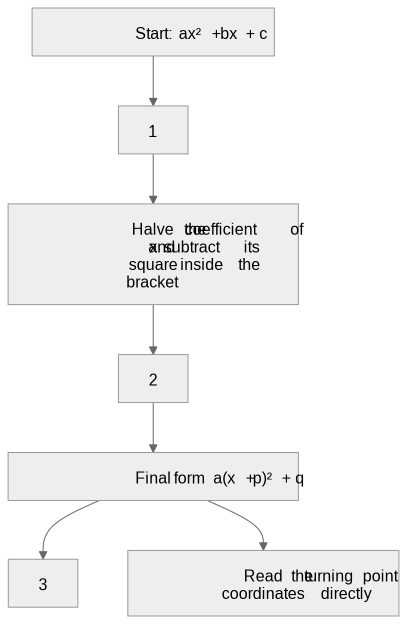
Some boxes have lost their names. Pick the right name for each number.
1Box 1
2Box 2
3Box 3
There is more to this lesson
The full lesson goes on to check your understanding and help you earn the marks. Create a free account to carry on, with your progress saved.
A week of Premium from your first lesson · Then the free plan continues · No card, no charge
Test your understanding of Algebra and Functions (AS Unit 1: Pure Mathematics A): Completing the square.
Active recall beats re-reading. Take an instant quiz now to test what you’ve learned and lock it into long-term memory.
A week of Premium from your first lesson · Then the free plan continues · No card, no charge