WJEC · A-Level · Mathematics
Course version: 603/1977/X · Version from Sept 2017
Pure Mathematics B): Use of functions in modelling
Full specification wording
Algebra and Functions (A2 Unit 3: Pure Mathematics B): Use of functions in modelling, including consideration of limitations and refinements of the models.
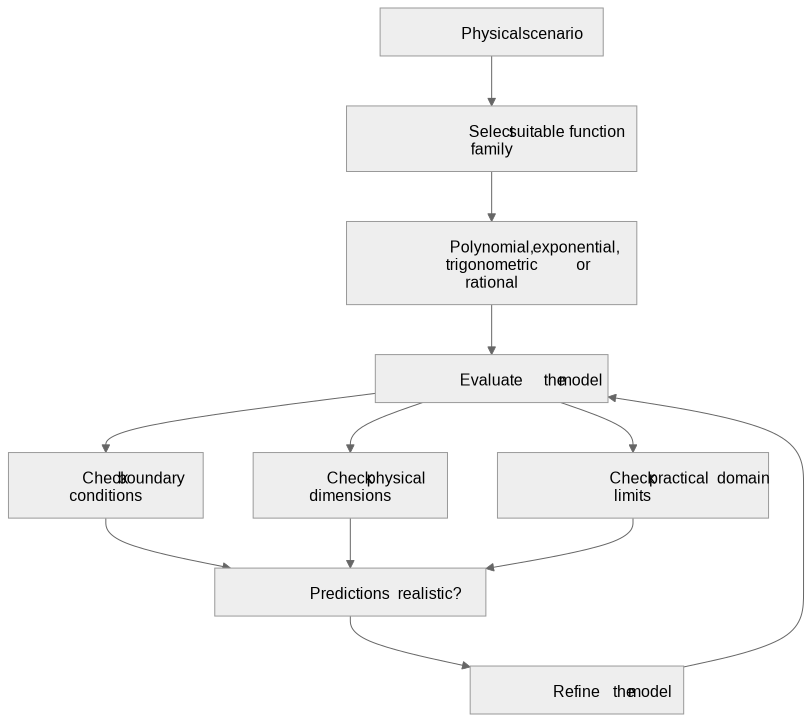
Mathematical modelling selects suitable function families—polynomial, exponential, trigonometric, or rational—to represent physical scenarios.
- Point 6 of 6
- 4 key terms
Study notes
From the teaching notes for this specification point.
The idea
Mathematical modelling selects suitable function families—polynomial, exponential, trigonometric, or rational—to represent physical scenarios. A quadratic function models projectile trajectories under gravity; trigonometric functions model cyclical waves such as tides; rational functions model saturation rates with asymptotic ceilings. Evaluating a model requires checking boundary conditions, physical dimensions, and practical domain limits. For instance, a quadratic trajectory h(t) = ut − ½gt² is valid only for h ≥ 0 and t ≥ 0, terminating when the object strikes the ground. If predictions become unrealistic—such as negative concentrations or unbounded velocities—the model is refined by introducing resistance terms or restricting domains.
What earns the marks
- Selecting or formulating an appropriate function family matching contextual behavior.
- Interpreting stationary points, intercepts, or asymptotes in the physical context.
- Evaluating model limitations and proposing realistic domain restrictions or refinements.
Common mistakes and how to put them right
Applying models outside their physical domains, such as allowing time or height to take negative values.
Failing to connect mathematical features like asymptotes to real-world limiting capacities.
Exam tips
- Always state the physical domain explicitly (e.g. 0 ≤ t ≤ 5 seconds) when working with models.
- Interpret the maximum of a function as the highest point or peak capacity in context.
Try the lesson
The start of the Algebra and Functions (A2 Unit 3: Pure Mathematics B): Use of functions in modelling, including consideration of limitations and refinements of the models. lesson, made from teaching notes for this specification point.
Have a go first
A model for the height h metres of a plant after t weeks is h(t) = 0.5t + 2 for 0 ≤ t ≤ 10. State the height predicted by the model after 6 weeks.
Listen
Mathematical modelling selects suitable function families—polynomial, exponential, trigonometric, or rational—to represent physical scenarios. A quadratic function models projectile trajectories under gravity; trigonometric functions model cyclical waves such as tides; rational functions model saturation rates with asymptotic ceilings. Evaluating a model requires checking boundary conditions, physical dimensions, and practical domain limits. For instance, a quadratic trajectory h(t) = ut − ½gt² is valid only for h ≥ 0 and t ≥ 0, terminating when the object strikes the ground. If predictions become unrealistic—such as negative concentrations or unbounded velocities—the model is refined by introducing resistance terms or restricting domains. A strong answer earns marks for these points. selecting or formulating an appropriate function family matching contextual behavior. interpreting stationary points, intercepts, or asymptotes in the physical context. evaluating model limitations and proposing realistic domain restrictions or refinements. Exam tip: Always state the physical domain explicitly (e.g. 0 ≤ t ≤ 5 seconds) when working with models.
See it
Key words
Say what each word means before you turn the card.
function modelling
Try answering aloud or in your head before turning the card.
domain restrictions
Try answering aloud or in your head before turning the card.
model evaluation
Try answering aloud or in your head before turning the card.
physical asymptotes
Try answering aloud or in your head before turning the card.
See every definition
- function modelling
- Selecting suitable function families, such as polynomial, exponential, trigonometric or rational, to represent physical scenarios.
- domain restrictions
- Practical domain limits based on physical constraints, such as time or height not taking negative values.
- model evaluation
- Checking boundary conditions, physical dimensions and practical domain limits to assess a model.
- physical asymptotes
- Mathematical features connected to real-world limiting capacities, such as asymptotic ceilings in rational functions.
Label the diagram
Some boxes have lost their names. Pick the right name for each number.
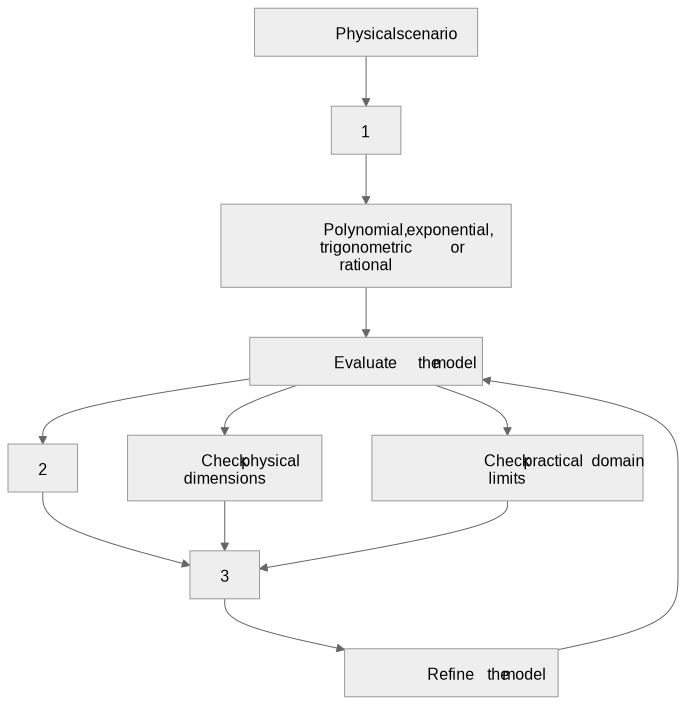
1Box 1
2Box 2
3Box 3
There is more to this lesson
The full lesson goes on to check your understanding and help you earn the marks. Create a free account to carry on, with your progress saved.
A week of Premium from your first lesson · Then the free plan continues · No card, no charge
Test your understanding of Algebra and Functions (A2 Unit 3: Pure Mathematics B): Use of functions in modelling, including consideration of limitations and refinements of the models.
Active recall beats re-reading. Take an instant quiz now to test what you’ve learned and lock it into long-term memory.
A week of Premium from your first lesson · Then the free plan continues · No card, no charge