WJEC · A-Level · Mathematics
Course version: 603/1977/X · Version from Sept 2017
Pure Mathematics A): Understand the effect of simple transformations on…
Full specification wording
Algebra and Functions (AS Unit 1: Pure Mathematics A): Understand the effect of simple transformations on the graph of y = f (x) including sketching associated graphs: y = af (x), y = f (x) + a, y = f (x + a ), y = f (ax).
Transformations alter the position and shape of the graph of y = f(x) in predictable ways.
- Point 17 of 17
- 4 key terms
Study notes
From the teaching notes for this specification point.
The idea
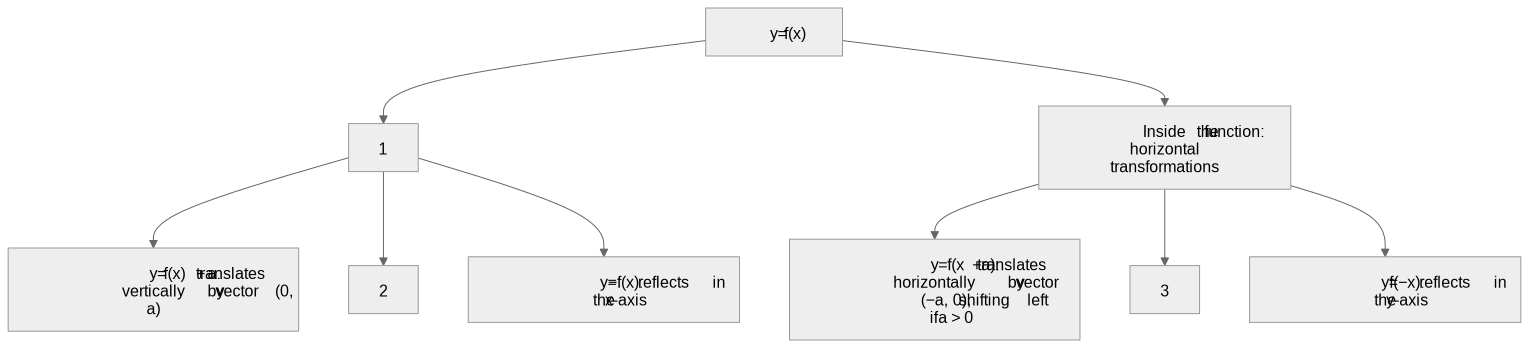
Transformations alter the position and shape of the graph of y = f(x) in predictable ways. Vertical transformations operate outside the function: y = f(x) + a translates the graph vertically by vector (0, a); y = af(x) stretches the graph vertically by scale factor a parallel to the y-axis, multiplying all y-coordinates by a while invariant points lie on the x-axis (y = −f(x) reflects in the x-axis). Horizontal transformations operate inside the function: y = f(x + a) translates the graph horizontally by vector (−a, 0), shifting left if a > 0; y = f(ax) stretches the graph horizontally by scale factor 1/a parallel to the x-axis, dividing all x-coordinates by a (y = f(−x) reflects in the y-axis). Label transformed intercepts and asymptotes explicitly.
What earns the marks
- Applying horizontal or vertical translations with correct direction and vector notation.
- Applying horizontal or vertical stretches with correct scale factor (e.g. 1/a for f(ax)).
- Sketching the transformed curve and labelling new coordinates of intercepts and asymptotes.
Common mistakes and how to put them right
Translating in the wrong horizontal direction, shifting right instead of left for f(x + a).
Stretching horizontally by scale factor a instead of 1/a for f(ax).
Exam tips
- Remember: changes inside the brackets f(...) affect x in the opposite way to what you might expect.
- State the new coordinates of maximums, minimums, and axis intercepts on your transformed sketch.
Try the lesson
The start of the Algebra and Functions (AS Unit 1: Pure Mathematics A): Understand the effect of simple transformations on the graph of y = f (x) including sketching associated graphs: y = af (x), y = f (x) + a, y = f (x + a ), y = f (ax). lesson, made from teaching notes for this specification point.
Have a go first
The graph of y = f(x) passes through the point (2, 5). Find the coordinates of the corresponding point on the graph of y = f(x) + 3.
Listen
Transformations alter the position and shape of the graph of y = f(x) in predictable ways. Vertical transformations operate outside the function: y = f(x) + a translates the graph vertically by vector (0, a); y = af(x) stretches the graph vertically by scale factor a parallel to the y-axis, multiplying all y-coordinates by a while invariant points lie on the x-axis (y = −f(x) reflects in the x-axis). Horizontal transformations operate inside the function: y = f(x + a) translates the graph horizontally by vector (−a, 0), shifting left if a > 0; y = f(ax) stretches the graph horizontally by scale factor 1/a parallel to the x-axis, dividing all x-coordinates by a (y = f(−x) reflects in the y-axis). Label transformed intercepts and asymptotes explicitly. A strong answer earns marks for these points. applying horizontal or vertical translations with correct direction and vector notation. applying horizontal or vertical stretches with correct scale factor (e.g. 1/a for f(ax)). sketching the transformed curve and labelling new coordinates of intercepts and asymptotes. Exam tip: Remember: changes inside the brackets f(...) affect x in the opposite way to what you might expect.
See it

Key words
Say what each word means before you turn the card.
translations
Try answering aloud or in your head before turning the card.
stretches and reflections
Try answering aloud or in your head before turning the card.
invariant points
Try answering aloud or in your head before turning the card.
graph transformations
Try answering aloud or in your head before turning the card.
See every definition
- translations
- Vertical transformations operate outside the function: y = f(x) + a translates the graph vertically by vector (0, a); y = f(x + a) translates the graph horizontally by vector (−a, 0).
- stretches and reflections
- y = af(x) stretches the graph vertically by scale factor a parallel to the y-axis; y = f(ax) stretches it horizontally by scale factor 1/a parallel to the x-axis.
- invariant points
- Points that stay fixed under a transformation, such as points lying on the x-axis when the graph is stretched vertically by scale factor a.
- graph transformations
- Changes that alter the position and shape of the graph of y = f(x) in predictable ways, operating either outside or inside the function.
Label the diagram
Some boxes have lost their names. Pick the right name for each number.
1Box 1
2Box 2
3Box 3
There is more to this lesson
The full lesson goes on to check your understanding and help you earn the marks. Create a free account to carry on, with your progress saved.
A week of Premium from your first lesson · Then the free plan continues · No card, no charge
Test your understanding of Algebra and Functions (AS Unit 1: Pure Mathematics A): Understand the effect of simple transformations on the graph of y = f (x) including sketching associated graphs: y = af (x), y = f (x) + a, y = f (x + a ), y = f (ax).
Active recall beats re-reading. Take an instant quiz now to test what you’ve learned and lock it into long-term memory.
A week of Premium from your first lesson · Then the free plan continues · No card, no charge