Pearson Edexcel · GCSE · Music
Course version: 1MU0 · Version from Sept 2016
Musical vocabulary - Dynamics and performance matters: The Wah wah (or…
Full specification wording
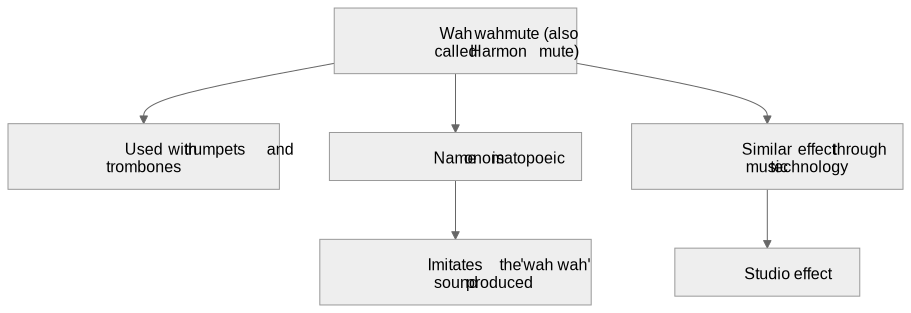
Appendix 3: Musical vocabulary - Dynamics and performance matters: The Wah wah (or Harmon) mute, as used with trumpets and trombones. The name is onomatopoeic – the resulting sound can be rather like ‘wah wah’. The same result can be obtained via music technology as a studio effect
A wah wah mute, also called a Harmon mute, is a metal device fitted into the bell of a trumpet or trombone.
- Point 16 of 25
- 3 key terms
Study notes
From the teaching notes for this specification point.
The idea
A wah wah mute, also called a Harmon mute, is a metal device fitted into the bell of a trumpet or trombone. It narrows and colours the airflow so the instrument produces a nasal, buzzing, vocal-like tone. Players often move the hand or a stem to open and close the sound, creating a shifting vowel colour. The label is onomatopoeic: the word imitates the sound itself, which listeners hear as a wavering 'wah wah'. In a studio, an engineer can recreate a similar sweeping, filtered tone electronically, for example with a wah pedal or an automated filter, so the effect need not come from a physical mute. When answering, link the device to the instruments named, explain the onomatopoeic naming, and recognise the technology alternative.
What earns the marks
- Identifies the wah wah mute as also known as the Harmon mute.
- States that it is used with trumpets and trombones, fitted into the bell.
- Explains that the name is onomatopoeic, imitating the 'wah wah' sound produced.
- Recognises that a similar effect can be created through music technology as a studio effect.
Common mistakes and how to put them right
Confusing the Harmon mute with a straight mute.
Put it right by noting the Harmon mute gives a distinctive nasal, vocal colour rather than a simple brightening.
Assuming the effect can only be produced acoustically.
Put it right by remembering a studio filter or wah pedal can imitate it electronically.
Treating 'wah wah' as a technical acoustic term.
Put it right by explaining it is onomatopoeic, imitating the sound.
Exam tips
- Read the question carefully to see whether it asks about the instrument, the naming or the technology route.
- Link the mute to the specific instruments named, trumpet and trombone, rather than any brass instrument.
- If an option mentions a studio effect, check it describes an electronic imitation of the same sound.
Try the lesson
The start of the Appendix 3: Musical vocabulary - Dynamics and performance matters: The Wah wah (or Harmon) mute, as used with trumpets and trombones. The name is onomatopoeic – the resulting sound can be rather like ‘wah wah’. The same result can be obtained via music technology as a studio effect lesson, made from teaching notes for this specification point.
Have a go first
Which aspect of the sound does a Harmon mute mainly change when fitted to a brass instrument?
Listen
A wah wah mute, also called a Harmon mute, is a metal device fitted into the bell of a trumpet or trombone. It narrows and colours the airflow so the instrument produces a nasal, buzzing, vocal-like tone. Players often move the hand or a stem to open and close the sound, creating a shifting vowel colour. The label is onomatopoeic: the word imitates the sound itself, which listeners hear as a wavering 'wah wah'. In a studio, an engineer can recreate a similar sweeping, filtered tone electronically, for example with a wah pedal or an automated filter, so the effect need not come from a physical mute. When answering, link the device to the instruments named, explain the onomatopoeic naming, and recognise the technology alternative. A strong answer earns marks for these points. Identifies the wah wah mute as also known as the Harmon mute. States that it is used with trumpets and trombones, fitted into the bell. Explains that the name is onomatopoeic, imitating the 'wah wah' sound produced. Recognises that a similar effect can be created through music technology as a studio effect. A common slip: Confusing the Harmon mute with a straight mute. Instead, noting the Harmon mute gives a distinctive nasal, vocal colour rather than a simple brightening. Exam tip: Read the question carefully to see whether it asks about the instrument, the naming or the technology route.
See it
Key words
Say what each word means before you turn the card.
Wah wah (Harmon) mute
Try answering aloud or in your head before turning the card.
Onomatopoeia
Try answering aloud or in your head before turning the card.
Music technology
Try answering aloud or in your head before turning the card.
See every definition
- Wah wah (Harmon) mute
- A mute used with trumpets and trombones, also called a Harmon mute.
- Onomatopoeia
- A name that is onomatopoeic imitates the sound itself, here rather like ‘wah wah’.
- Music technology
- The same result as the mute can be obtained via music technology as a studio effect.
Label the diagram
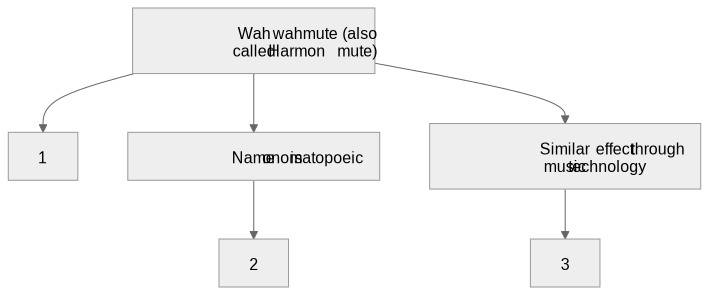
Some boxes have lost their names. Pick the right name for each number.
1Box 1
2Box 2
3Box 3
There is more to this lesson
The full lesson goes on to check your understanding and help you earn the marks. Create a free account to carry on, with your progress saved.
A week of Premium from your first lesson · Then the free plan continues · No card, no charge
Test your understanding of Appendix 3: Musical vocabulary - Dynamics and performance matters: The Wah wah (or Harmon) mute, as used with trumpets and trombones. The name is onomatopoeic – the resulting sound can be rather like ‘wah wah’. The same result can be obtained via music technology as a studio effect
Active recall beats re-reading. Take an instant quiz now to test what you’ve learned and lock it into long-term memory.
A week of Premium from your first lesson · Then the free plan continues · No card, no charge