Pearson Edexcel · GCSE · Music
Course version: 1MU0 · Version from Sept 2016
Appraising - Musical elements: texture, how musical lines (parts) fit…
Full specification wording
Component 3: Appraising - Musical elements: texture, how musical lines (parts) fit together, including simple textural combinations, for example unison, chordal and solo
Texture describes how musical lines, or parts, fit together at any moment.
- Point 5 of 7
- 4 key terms
Study notes
From the teaching notes for this specification point.
The idea
Texture describes how musical lines, or parts, fit together at any moment. Listen vertically: are the parts moving as one line, as a block of chords, or is one line alone? Unison means all parts sound the same pitch or the same melodic line together, so the texture is one line in effect. Chordal (homophonic) texture stacks parts that move together in chords, giving a clear melody with block accompaniment. Solo means a single line or single performer, so the texture is thin and exposed. To answer, count the distinct lines you hear, then judge whether they move together or independently, and use the correct term rather than describing loudness or speed.
What earns the marks
- Identifies texture as the relationship between musical lines or parts sounding together.
- Recognises unison as parts sharing the same pitch or melodic line.
- Recognises chordal (homophonic) texture as parts moving together in chords.
- Recognises solo as a single line or single performer, giving a thin texture.
- Distinguishes texture from unrelated elements such as dynamics or tempo.
Common mistakes and how to put them right
Confusing texture with dynamics.
Put it right by explaining that texture concerns how parts combine, not how loud they are.
Calling any loud passage 'chordal'.
Put it right by checking whether the parts actually move together as chords.
Treating unison as harmony.
Put it right by noting that unison parts share the same pitch, so there is no harmony between them.
Exam tips
- Count the distinct parts you hear before choosing a textural term.
- Ask whether the parts move together or independently to separate chordal from unison.
- Eliminate options that describe dynamics, tempo or instrumentation rather than texture.
Try the lesson
The start of the Component 3: Appraising - Musical elements: texture, how musical lines (parts) fit together, including simple textural combinations, for example unison, chordal and solo lesson, made from teaching notes for this specification point.
Have a go first
A choir sings a hymn. All sopranos and altos sing the same melody at the same pitch, while tenors and basses sing the same melody an octave lower. Which term best describes this texture?
Listen
Texture describes how musical lines, or parts, fit together at any moment. Listen vertically: are the parts moving as one line, as a block of chords, or is one line alone? Unison means all parts sound the same pitch or the same melodic line together, so the texture is one line in effect. Chordal (homophonic) texture stacks parts that move together in chords, giving a clear melody with block accompaniment. Solo means a single line or single performer, so the texture is thin and exposed. To answer, count the distinct lines you hear, then judge whether they move together or independently, and use the correct term rather than describing loudness or speed. A strong answer earns marks for these points. Identifies texture as the relationship between musical lines or parts sounding together. Recognises unison as parts sharing the same pitch or melodic line. Recognises chordal (homophonic) texture as parts moving together in chords. Recognises solo as a single line or single performer, giving a thin texture. A common slip: Confusing texture with dynamics. Instead, explaining that texture concerns how parts combine, not how loud they are. Exam tip: Count the distinct parts you hear before choosing a textural term.
See it
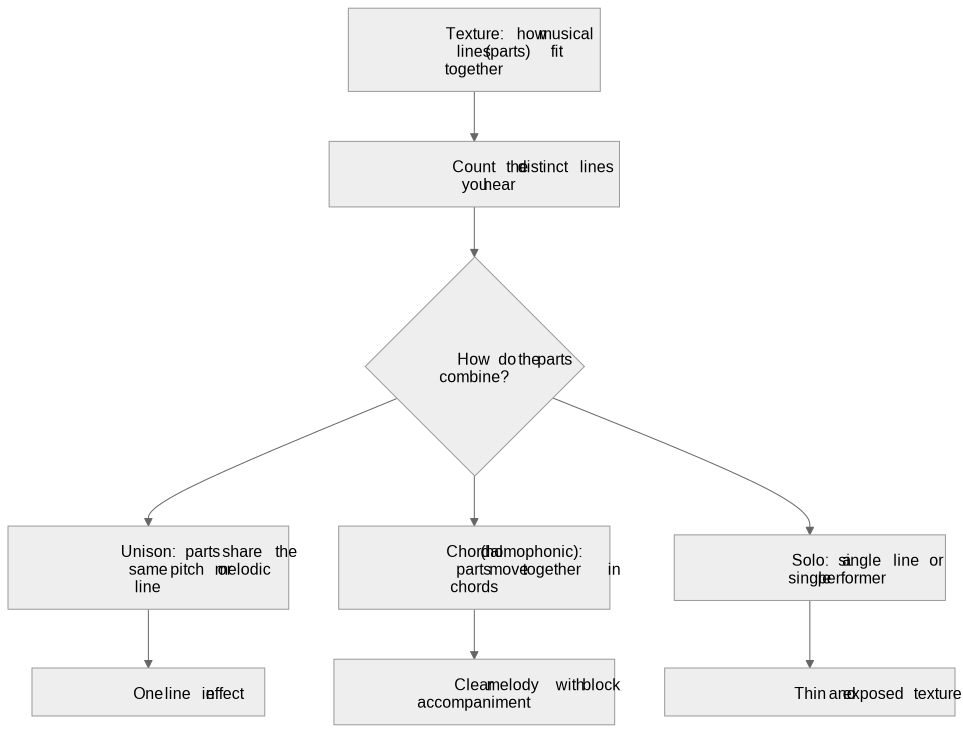
Key words
Say what each word means before you turn the card.
Texture
Try answering aloud or in your head before turning the card.
Unison
Try answering aloud or in your head before turning the card.
Chordal (homophonic) texture
Try answering aloud or in your head before turning the card.
Solo
Try answering aloud or in your head before turning the card.
See every definition
- Texture
- How musical lines, or parts, fit together at any moment.
- Unison
- All parts sound the same pitch or the same melodic line together, so the texture is one line in effect.
- Chordal (homophonic) texture
- Parts are stacked and move together in chords, giving a clear melody with block accompaniment.
- Solo
- A single line or single performer, so the texture is thin and exposed.
Label the diagram
Some boxes have lost their names. Pick the right name for each number.
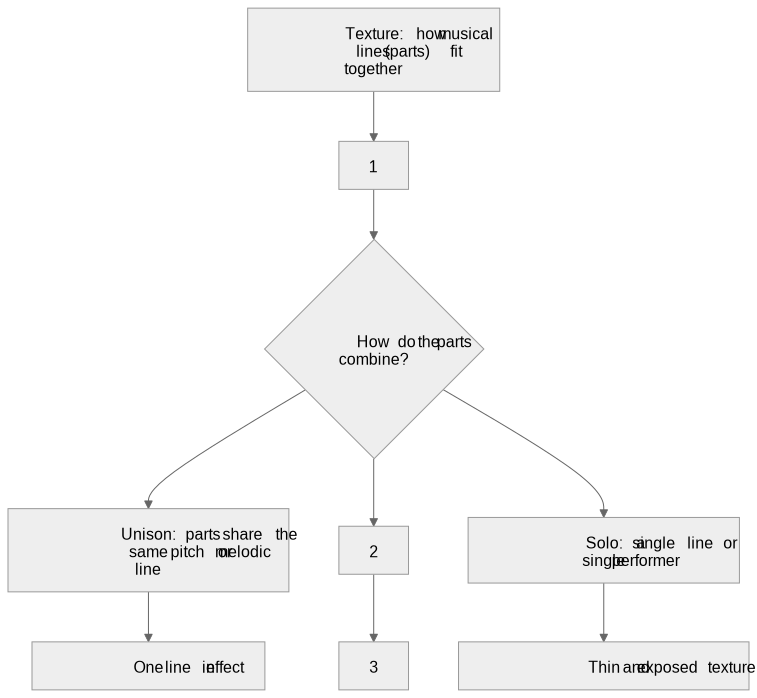
1Box 1
2Box 2
3Box 3
There is more to this lesson
The full lesson goes on to check your understanding and help you earn the marks. Create a free account to carry on, with your progress saved.
A week of Premium from your first lesson · Then the free plan continues · No card, no charge
Test your understanding of Component 3: Appraising - Musical elements: texture, how musical lines (parts) fit together, including simple textural combinations, for example unison, chordal and solo
Active recall beats re-reading. Take an instant quiz now to test what you’ve learned and lock it into long-term memory.
A week of Premium from your first lesson · Then the free plan continues · No card, no charge