AQA · A-Level · Physical Education
Course version: 7582 · Version from Sept 2016
Attribution theory: Self-serving bias.
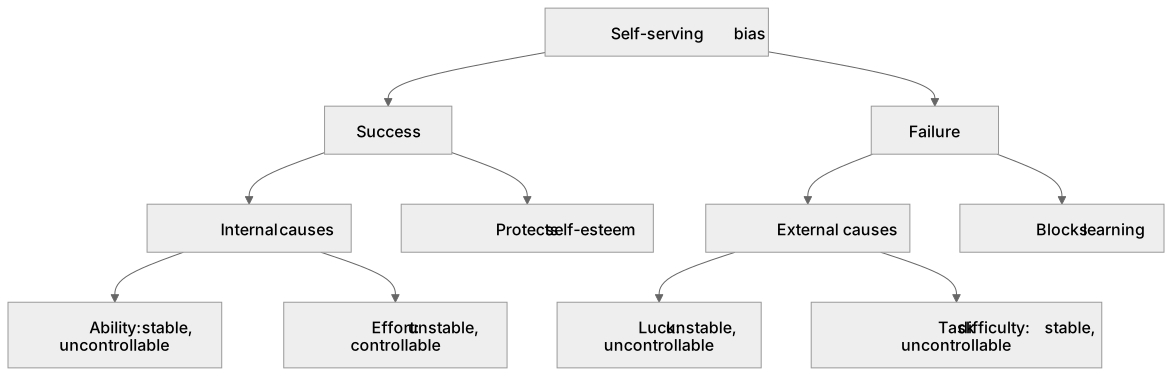
Self-serving bias is the tendency to attribute success to internal causes and failure to external causes, protecting self-esteem.
Checked against the AQA 7582 specification (opens in a new tab) on .
- Point 4 of 8
- 2 key terms
Study notes
From the checked teaching notes for this specification point.
The idea
Self-serving bias is the tendency to attribute success to internal causes and failure to external causes, protecting self-esteem. A netball shooter who scores attributes it to internal, stable, uncontrollable ability or internal, unstable, controllable effort; when she misses, she blames external, unstable, uncontrollable luck or task difficulty. The bias raises confidence after wins but can block learning after defeats, because the performer never accepts responsibility for weaknesses. Coaches counter it by reviewing performance evidence, praising effort, and asking performers to identify one controllable cause of failure. It differs from attribution generally: attribution is any perceived cause, whereas self-serving bias favours the self.
What earns the marks
- Self-serving bias is attributing success internally and failure externally.
- Success is typically credited to internal causes such as ability (stable, uncontrollable) or effort (unstable, controllable).
- Failure is typically blamed on external causes such as luck (unstable, uncontrollable) or task difficulty (stable, uncontrollable).
- Its function is to protect self-esteem and maintain confidence and motivation.
- A limitation is reduced learning after failure because responsibility is not accepted.
- Coaches can reduce it by using evidence, effort feedback and controllable-cause review.
Common mistakes and how to put them right
Incorrectly classifying Weiner's dimensions.
Put it right: Ability is internal, stable and uncontrollable, whereas effort is internal, unstable and controllable.
Defining self-serving bias as always blaming others.
Put it right: It also covers crediting the self for success, so both directions are needed.
Confusing it with learned helplessness, which is attributing failure to internal, stable, uncontrollable causes and expecting continued failure.
Thinking the bias always helps performance.
Put it right: It protects self-esteem but can prevent a performer from correcting genuine weaknesses.
Exam tips
- State both halves of the pattern: internal credit for success and external blame for failure.
- Give one concrete sport example showing the same performer in both outcomes, correctly applying Weiner's dimensions.
- Evaluate the bias by naming one benefit (self-esteem) and one cost (blocked learning).
Try the lesson
The start of the Attribution theory: Self-serving bias. lesson, made from checked teaching notes for this specification point.
Have a go first
A hockey player attributes her team's win to the squad's hard training but blames the referee for the team's defeat. Which attribution pattern does this illustrate?
Listen
Self-serving bias is the tendency to attribute success to internal causes and failure to external causes, protecting self-esteem. A netball shooter who scores attributes it to internal, stable, uncontrollable ability or internal, unstable, controllable effort; when she misses, she blames external, unstable, uncontrollable luck or task difficulty. The bias raises confidence after wins but can block learning after defeats, because the performer never accepts responsibility for weaknesses. Coaches counter it by reviewing performance evidence, praising effort, and asking performers to identify one controllable cause of failure. It differs from attribution generally: attribution is any perceived cause, whereas self-serving bias favours the self. A strong answer earns marks for these points. Self-serving bias is attributing success internally and failure externally. Success is typically credited to internal causes such as ability (stable, uncontrollable) or effort (unstable, controllable). Failure is typically blamed on external causes such as luck (unstable, uncontrollable) or task difficulty (stable, uncontrollable). Its function is to protect self-esteem and maintain confidence and motivation. A common slip: Incorrectly classifying Weiner's dimensions. Instead, ability is internal, stable and uncontrollable, whereas effort is internal, unstable and controllable. Exam tip: State both halves of the pattern: internal credit for success and external blame for failure.
See it
Key words
Say what each word means before you turn the card.
Self-serving bias
Try answering aloud or in your head before turning the card.
Attribution
Try answering aloud or in your head before turning the card.
See every definition
- Self-serving bias
- The tendency to attribute success to internal causes and failure to external causes, protecting self-esteem.
- Attribution
- Any perceived cause, whereas self-serving bias favours the self.
Label the diagram
Some boxes have lost their names. Pick the right name for each number.
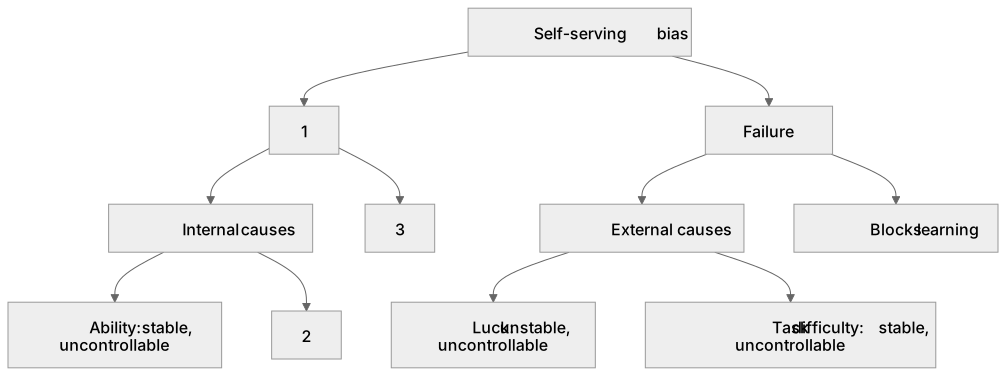
1Box 1
2Box 2
3Box 3
There is more to this lesson
The full lesson goes on to check your understanding and help you earn the marks. Create a free account to carry on, with your progress saved.
A week of Premium from your first lesson · Then the free plan continues · No card, no charge
Test your understanding of Attribution theory: Self-serving bias.
Active recall beats re-reading. Take an instant quiz now to test what you’ve learned and lock it into long-term memory.
A week of Premium from your first lesson · Then the free plan continues · No card, no charge