AQA · A-Level · Physical Education
Course version: 7582 · Version from Sept 2016
Link between attribution, task persistence and motivation.
Full specification wording
Attribution theory: Link between attribution, task persistence and motivation.
Attribution theory explains how a performer explains a result, and those explanations shape what happens next.
Checked against the AQA 7582 specification (opens in a new tab) on .
- Point 3 of 8
- 4 key terms
Study notes
From the checked teaching notes for this specification point.
The idea
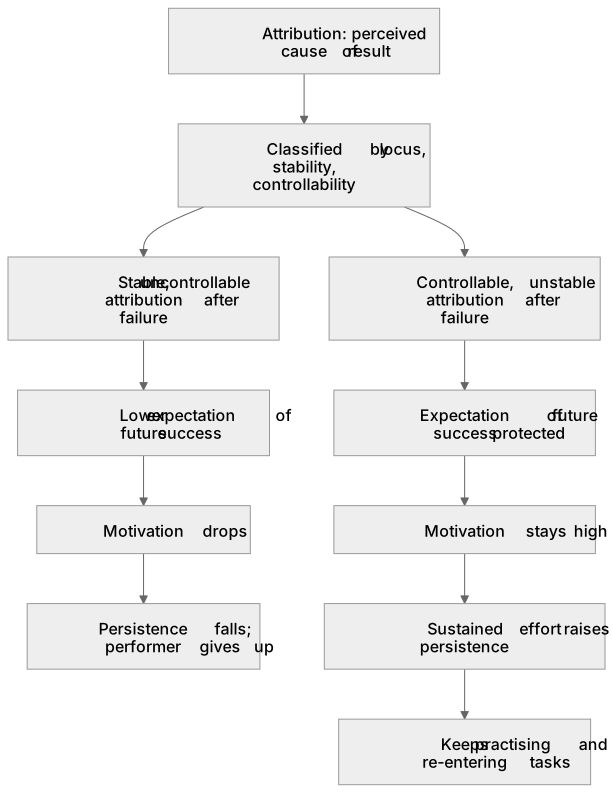
Attribution theory explains how a performer explains a result, and those explanations shape what happens next. Weiner's model classifies causes by locus (internal or external), stability (stable or unstable) and controllability. A footballer who attributes a missed penalty to lack of ability (internal, stable, uncontrollable) expects failure again, so motivation drops and persistence ends. The same miss attributed to a poor pitch (external, unstable, uncontrollable) or insufficient practice (internal, unstable, controllable) protects expectation of future success. High motivation sustains effort; sustained effort raises persistence, so the performer keeps practising and re-entering tasks. Coaches therefore guide attributions towards controllable, unstable causes after failure and internal causes after success.
What earns the marks
- Attribution is the perceived cause a performer gives for success or failure.
- Weiner classifies causes by locus, stability and controllability.
- Stable and uncontrollable attributions after failure lower expectation of future success.
- Reduced expectation lowers motivation, so the performer gives up and persistence falls.
- Controllable, unstable attributions such as effort or strategy keep motivation and persistence high.
- Coaches can shape attributions through feedback to protect motivation and persistence.
Common mistakes and how to put them right
Treating attribution as the objective cause of the result.
Put it right: It is the performer's perceived cause, so two athletes can explain one result differently.
Assuming any external cause protects motivation.
Put it right: A stable external cause such as a permanently weak squad still lowers expectation and persistence.
Believing high ability alone guarantees persistence.
Put it right: Motivation depends on the attribution made, not only on actual ability.
Confusing motivation with persistence.
Put it right: Motivation is the drive to act, while persistence is continuing that action over time.
Exam tips
- Name the three dimensions (locus, stability, controllability) before applying them to a sporting example.
- Chain the logic explicitly: attribution, then expectation, then motivation, then persistence.
- Use one named sport example and vary only the attribution to show the effect on persistence.
Try the lesson
The start of the Attribution theory: Link between attribution, task persistence and motivation. lesson, made from checked teaching notes for this specification point.
Have a go first
A badminton player loses a close game and says afterwards that she simply lacks the talent to compete at this level. According to the link between attribution, persistence and motivation, what is the most likely effect on her future effort?
Listen
Attribution theory explains how a performer explains a result, and those explanations shape what happens next. Weiner's model classifies causes by locus (internal or external), stability (stable or unstable) and controllability. A footballer who attributes a missed penalty to lack of ability (internal, stable, uncontrollable) expects failure again, so motivation drops and persistence ends. The same miss attributed to a poor pitch (external, unstable, uncontrollable) or insufficient practice (internal, unstable, controllable) protects expectation of future success. High motivation sustains effort; sustained effort raises persistence, so the performer keeps practising and re-entering tasks. Coaches therefore guide attributions towards controllable, unstable causes after failure and internal causes after success. A strong answer earns marks for these points. Attribution is the perceived cause a performer gives for success or failure. Weiner classifies causes by locus, stability and controllability. Stable and uncontrollable attributions after failure lower expectation of future success. Reduced expectation lowers motivation, so the performer gives up and persistence falls. Exam tip: Name the three dimensions (locus, stability, controllability) before applying them to a sporting example.
See it
Key words
Say what each word means before you turn the card.
Attribution
Try answering aloud or in your head before turning the card.
Weiner's dimensions
Try answering aloud or in your head before turning the card.
Motivation
Try answering aloud or in your head before turning the card.
Persistence
Try answering aloud or in your head before turning the card.
See every definition
- Attribution
- The perceived cause a performer gives for success or failure.
- Weiner's dimensions
- Classification of causes by locus, stability and controllability.
- Motivation
- The drive to act, which drops when stable and uncontrollable attributions after failure lower expectation of future success.
- Persistence
- Continuing an action over time, which falls when reduced expectation lowers motivation so the performer gives up.
Label the diagram
Some boxes have lost their names. Pick the right name for each number.
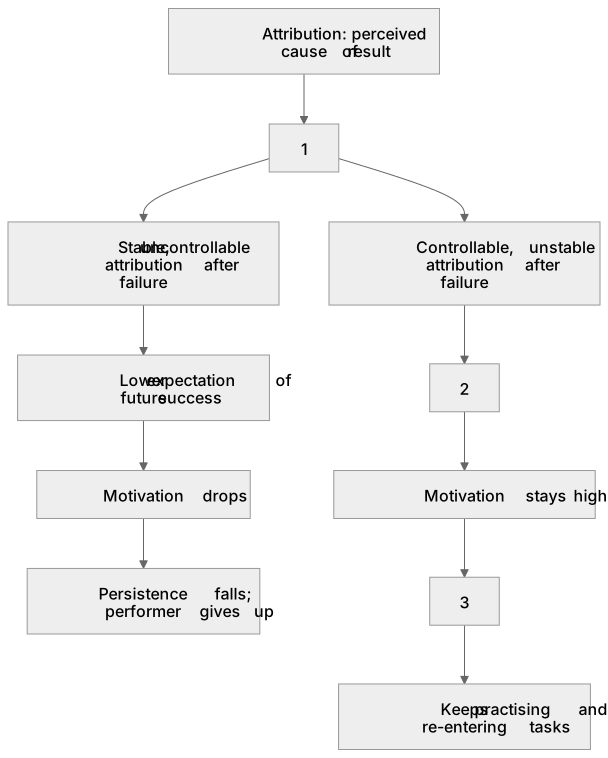
1Box 1
2Box 2
3Box 3
There is more to this lesson
The full lesson goes on to check your understanding and help you earn the marks. Create a free account to carry on, with your progress saved.
A week of Premium from your first lesson · Then the free plan continues · No card, no charge
Test your understanding of Attribution theory: Link between attribution, task persistence and motivation.
Active recall beats re-reading. Take an instant quiz now to test what you’ve learned and lock it into long-term memory.
A week of Premium from your first lesson · Then the free plan continues · No card, no charge