AQA · A-Level · Physical Education
Course version: 7582 · Version from Sept 2016
Cardiovascular system: Bohr shift.
The Bohr shift describes how a rise in carbon dioxide concentration, and the accompanying fall in pH, reduces haemoglobin's affinity for oxygen so that oxygen dissociates more readily from…
Checked against the AQA 7582 specification (opens in a new tab) on .
- Point 16 of 25
Study notes
From the checked teaching notes for this specification point.
The idea
The Bohr shift describes how a rise in carbon dioxide concentration, and the accompanying fall in pH, reduces haemoglobin's affinity for oxygen so that oxygen dissociates more readily from oxyhaemoglobin. During vigorous exercise, respiring muscle produces extra carbon dioxide, which forms carbonic acid and lowers blood pH; this shifts the oxyhaemoglobin dissociation curve to the right at any given partial pressure of oxygen. The same percentage saturation therefore releases more oxygen to the active tissues. A useful method is to compare two curves on one graph: at a fixed oxygen partial pressure, read across to each curve and note that the right-hand curve gives the lower saturation.
What earns the marks
- Carbon dioxide concentration increases during exercise because respiring muscles produce more carbon dioxide.
- Increased carbon dioxide lowers blood pH, making the blood more acidic.
- Lower pH reduces haemoglobin's affinity for oxygen.
- The oxyhaemoglobin dissociation curve shifts to the right.
- At a given partial pressure of oxygen, haemoglobin saturation is lower, so more oxygen dissociates.
- More oxygen is therefore delivered to the active muscles.
Common mistakes and how to put them right
Thinking the Bohr shift means haemoglobin carries more oxygen.
Put it right: It actually means haemoglobin releases oxygen more readily at the tissues.
Confusing a rightward shift with a leftward shift.
Put it right: A rightward shift shows reduced affinity and easier unloading.
Believing carbon dioxide directly displaces oxygen.
Put it right: The effect works mainly through the fall in pH caused by carbon dioxide.
Assuming the shift changes the maximum saturation of haemoglobin.
Put it right: It changes the position of the curve, not the maximum achievable saturation.
Exam tips
- Link the shift explicitly to exercise so the answer explains why more oxygen reaches active muscle.
- Use the phrase 'reduced affinity of haemoglobin for oxygen' rather than saying haemoglobin 'holds less oxygen'.
- When a graph is given, quote the partial pressure of oxygen and compare the two saturation values at that point.
- State the causal chain in order: more carbon dioxide, lower pH, reduced affinity, rightward shift, greater dissociation.
Try the lesson
The start of the Cardiovascular system: Bohr shift. lesson, made from checked teaching notes for this specification point.
Have a go first
The Bohr shift describes the effect of which change on the oxyhaemoglobin disassociation curve?
Listen
The Bohr shift describes how a rise in carbon dioxide concentration, and the accompanying fall in pH, reduces haemoglobin's affinity for oxygen so that oxygen dissociates more readily from oxyhaemoglobin. During vigorous exercise, respiring muscle produces extra carbon dioxide, which forms carbonic acid and lowers blood pH; this shifts the oxyhaemoglobin dissociation curve to the right at any given partial pressure of oxygen. The same percentage saturation therefore releases more oxygen to the active tissues. A useful method is to compare two curves on one graph: at a fixed oxygen partial pressure, read across to each curve and note that the right-hand curve gives the lower saturation. A strong answer earns marks for these points. Carbon dioxide concentration increases during exercise because respiring muscles produce more carbon dioxide. Increased carbon dioxide lowers blood pH, making the blood more acidic. Lower pH reduces haemoglobin's affinity for oxygen. The oxyhaemoglobin dissociation curve shifts to the right. Exam tip: Link the shift explicitly to exercise so the answer explains why more oxygen reaches active muscle.
See it
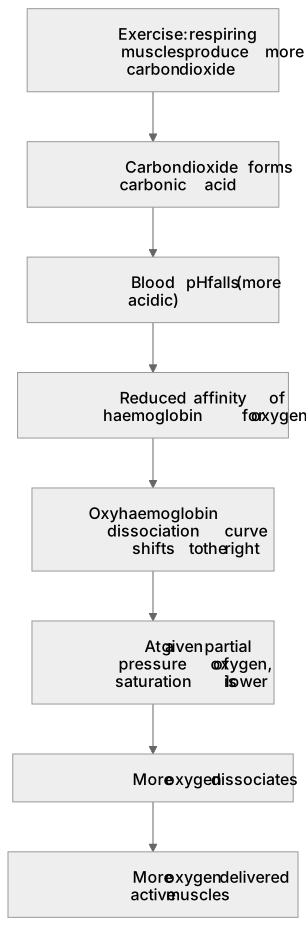
Put it in order
Put these steps in the order they happen.
- 1. Oxyhaemoglobin dissociation curve shifts to the right
- 2. More oxygen delivered to active muscles
- 3. At a given partial pressure of oxygen, saturation is lower
- 4. Exercise: respiring muscles produce more carbon dioxide
- 5. Carbon dioxide forms carbonic acid
- 6. More oxygen dissociates
- 7. Blood pH falls (more acidic)
- 8. Reduced affinity of haemoglobin for oxygen
Label the diagram
Some boxes have lost their names. Pick the right name for each number.
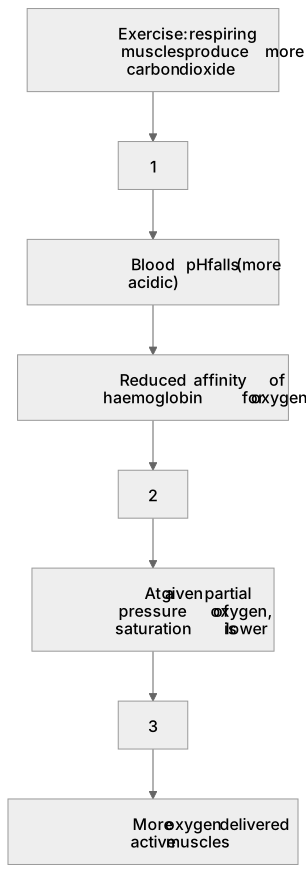
1Box 1
2Box 2
3Box 3
There is more to this lesson
The full lesson goes on to check your understanding and help you earn the marks. Create a free account to carry on, with your progress saved.
A week of Premium from your first lesson · Then the free plan continues · No card, no charge
Test your understanding of Cardiovascular system: Bohr shift.
Active recall beats re-reading. Take an instant quiz now to test what you’ve learned and lock it into long-term memory.
A week of Premium from your first lesson · Then the free plan continues · No card, no charge