AQA · A-Level · Physical Education
Course version: 7582 · Version from Sept 2016
Efficiency of information processing to include:: Environment.
The environment is the source of all information a performer detects during play.
Checked against the AQA 7582 specification (opens in a new tab) on .
- Point 2 of 30
- 4 key terms
Study notes
From the checked teaching notes for this specification point.
The idea
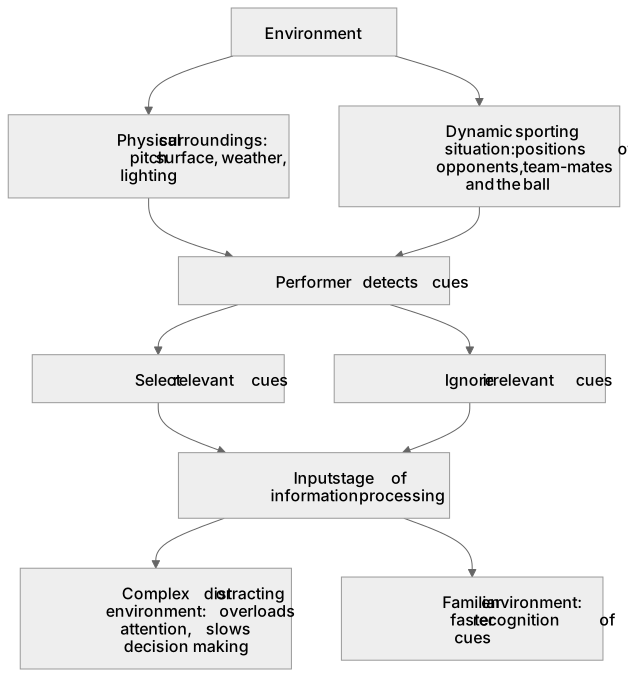
The environment is the source of all information a performer detects during play. It includes the physical surroundings, such as the pitch surface, weather and lighting, and the dynamic sporting situation, such as the positions of opponents, team-mates and the ball. Efficient information processing depends on the performer selecting relevant cues from this environment and ignoring irrelevant ones. For example, a hockey player in heavy rain must detect the speed of the ball on a wet surface while ignoring crowd noise. A noisy or visually cluttered environment can overload attention and slow decision making, whereas a familiar environment allows faster recognition of cues. The environment therefore provides the input stage of the information processing model, and its complexity directly affects how efficiently a performer can decide and respond.
What earns the marks
- The environment is the source of sensory information that a performer detects during performance.
- Efficient processing requires selecting relevant cues from the environment and ignoring irrelevant ones.
- A complex or distracting environment can reduce the speed and accuracy of decision making.
Common mistakes and how to put them right
Treating the environment as only the weather or pitch.
Put it right: It also includes the positions and movements of other players and the ball.
Assuming all environmental information is useful.
Put it right: Performers must selectively attend to relevant cues and ignore distractions.
Confusing the environment with feedback.
Put it right: The environment supplies input, while feedback is information about the performer's own movement or its outcome.
Exam tips
- When a question describes a sporting situation, identify which environmental cues are relevant to the performer's decision.
- Link environmental complexity to its effect on processing speed or accuracy rather than describing it in isolation.
- Use sporting examples that match the scenario given, such as surface conditions or opponent positioning.
Try the lesson
The start of the Efficiency of information processing to include:: Environment. lesson, made from checked teaching notes for this specification point.
Have a go first
In the environmental approach to information processing, what does the term 'environment' refer to?
Listen
The environment is the source of all information a performer detects during play. It includes the physical surroundings, such as the pitch surface, weather and lighting, and the dynamic sporting situation, such as the positions of opponents, team-mates and the ball. Efficient information processing depends on the performer selecting relevant cues from this environment and ignoring irrelevant ones. For example, a hockey player in heavy rain must detect the speed of the ball on a wet surface while ignoring crowd noise. A noisy or visually cluttered environment can overload attention and slow decision making, whereas a familiar environment allows faster recognition of cues. The environment therefore provides the input stage of the information processing model, and its complexity directly affects how efficiently a performer can decide and respond. A strong answer earns marks for these points. The environment is the source of sensory information that a performer detects during performance. Efficient processing requires selecting relevant cues from the environment and ignoring irrelevant ones. A complex or distracting environment can reduce the speed and accuracy of decision making. Exam tip: When a question describes a sporting situation, identify which environmental cues are relevant to the performer's decision.
See it
Key words
Say what each word means before you turn the card.
Environmental cues
Try answering aloud or in your head before turning the card.
Selective attention
Try answering aloud or in your head before turning the card.
Physical conditions
Try answering aloud or in your head before turning the card.
Decision making
Try answering aloud or in your head before turning the card.
See every definition
- Environmental cues
- The relevant pieces of information a performer detects from the physical surroundings and the dynamic sporting situation, such as the positions of opponents, team-mates and the ball.
- Selective attention
- Selecting relevant cues from the environment and ignoring irrelevant ones, on which efficient information processing depends.
- Physical conditions
- Part of the environment including the pitch surface, weather and lighting.
- Decision making
- The process whose speed and accuracy can be reduced by a complex or distracting environment.
Label the diagram
Some boxes have lost their names. Pick the right name for each number.
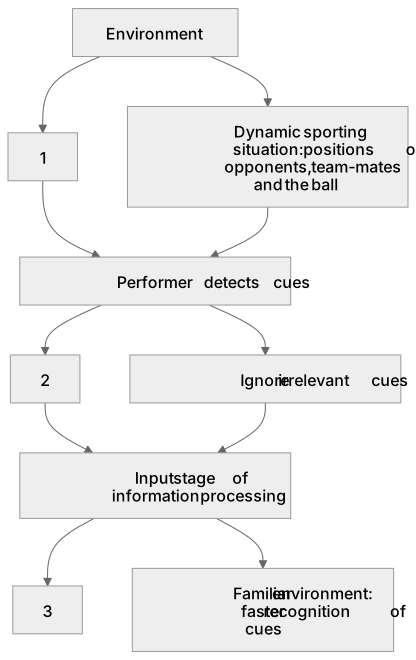
1Box 1
2Box 2
3Box 3
There is more to this lesson
The full lesson goes on to check your understanding and help you earn the marks. Create a free account to carry on, with your progress saved.
A week of Premium from your first lesson · Then the free plan continues · No card, no charge
Test your understanding of Efficiency of information processing to include:: Environment.
Active recall beats re-reading. Take an instant quiz now to test what you’ve learned and lock it into long-term memory.
A week of Premium from your first lesson · Then the free plan continues · No card, no charge