AQA · A-Level · Physical Education
Course version: 7582 · Version from Sept 2016
Efficiency of information processing to include:: Response outcomes.
Response outcomes describe what a performer actually does after information has been processed, so they are the observable end of the model.
Checked against the AQA 7582 specification (opens in a new tab) on .
- Point 27 of 30
- 4 key terms
Study notes
From the checked teaching notes for this specification point.
The idea
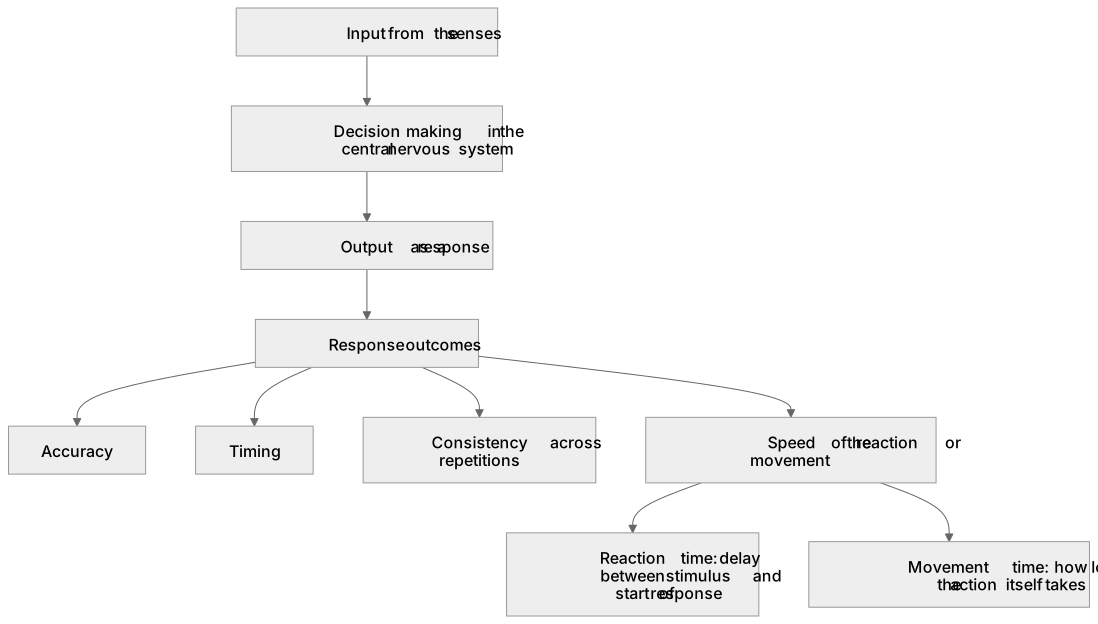
Response outcomes describe what a performer actually does after information has been processed, so they are the observable end of the model. In AQA A-Level Physical Education, the chain runs: input from the senses, decision making in the central nervous system, then output as a response. Response outcomes include the accuracy of the movement, its timing, its consistency across repetitions and the speed of the reaction or movement. A closed skill such as a golf putt is judged mainly on accuracy and consistency; an open skill such as a pass in a game is judged on accuracy and timing under pressure. Reaction time is the delay between stimulus and the start of the response, while movement time is how long the action itself takes. A performer with efficient processing shows short reaction time, accurate movement and repeatable outcomes.
What earns the marks
- Response outcomes are the observable results of the input–decision–output sequence, not the internal processing itself.
- Accuracy, timing, consistency and speed of response are the main measurable outcomes of information processing.
- Reaction time is the delay between the stimulus and the start of the response; movement time is the duration of the response itself.
- Closed skills are judged mainly on accuracy and consistency, while open skills are judged on accuracy and timing under pressure.
- Efficient processing produces short reaction time, accurate movement and repeatable outcomes across attempts.
Common mistakes and how to put them right
Confusing reaction time with movement time.
Put it right: Reaction time is the delay before the response begins, whereas movement time is how long the response itself lasts.
Treating response outcomes as internal mental events.
Put it right: They are observable behaviours such as accuracy, timing and consistency that a coach or test can record.
Assuming faster is always better.
Put it right: A fast but inaccurate response is a poor outcome, so speed must be judged alongside accuracy and timing.
Ignoring consistency: one accurate attempt is not evidence of efficient processing; repeatable outcomes across trials matter.
Exam tips
- Define reaction time and movement time precisely before applying them to a sporting example, because the two are easily confused.
- Use one closed skill and one open skill to show how the criteria for a good response outcome differ.
- When evaluating efficiency, refer to accuracy, timing, consistency and speed together rather than naming only one.
- Link each outcome back to the input–decision–output chain so the answer shows understanding of the whole model.
Try the lesson
The start of the Efficiency of information processing to include:: Response outcomes. lesson, made from checked teaching notes for this specification point.
Have a go first
In information processing, what is meant by a response outcome?
Listen
Response outcomes describe what a performer actually does after information has been processed, so they are the observable end of the model. In AQA A-Level Physical Education, the chain runs: input from the senses, decision making in the central nervous system, then output as a response. Response outcomes include the accuracy of the movement, its timing, its consistency across repetitions and the speed of the reaction or movement. A closed skill such as a golf putt is judged mainly on accuracy and consistency; an open skill such as a pass in a game is judged on accuracy and timing under pressure. Reaction time is the delay between stimulus and the start of the response, while movement time is how long the action itself takes. A performer with efficient processing shows short reaction time, accurate movement and repeatable outcomes. A strong answer earns marks for these points. Response outcomes are the observable results of the input–decision–output sequence, not the internal processing itself. Accuracy, timing, consistency and speed of response are the main measurable outcomes of information processing. Reaction time is the delay between the stimulus and the start of the response; movement time is the duration of the response itself. Closed skills are judged mainly on accuracy and consistency, while open skills are judged on accuracy and timing under pressure. Exam tip: Define reaction time and movement time precisely before applying them to a sporting example, because the two are easily confused.
See it
Key words
Say what each word means before you turn the card.
Information processing model
Try answering aloud or in your head before turning the card.
Input–decision–output sequence
Try answering aloud or in your head before turning the card.
Reaction time and movement time
Try answering aloud or in your head before turning the card.
Accuracy, timing and consistency of response
Try answering aloud or in your head before turning the card.
See every definition
- Information processing model
- A chain running from input from the senses, through decision making in the central nervous system, to output as a response.
- Input–decision–output sequence
- The order in which information is processed, beginning with input from the senses and ending with output as a response.
- Reaction time and movement time
- Reaction time is the delay between stimulus and the start of the response, while movement time is how long the action itself takes.
- Accuracy, timing and consistency of response
- Observable response outcomes that include the accuracy of the movement, its timing and its consistency across repetitions.
Label the diagram
Some boxes have lost their names. Pick the right name for each number.
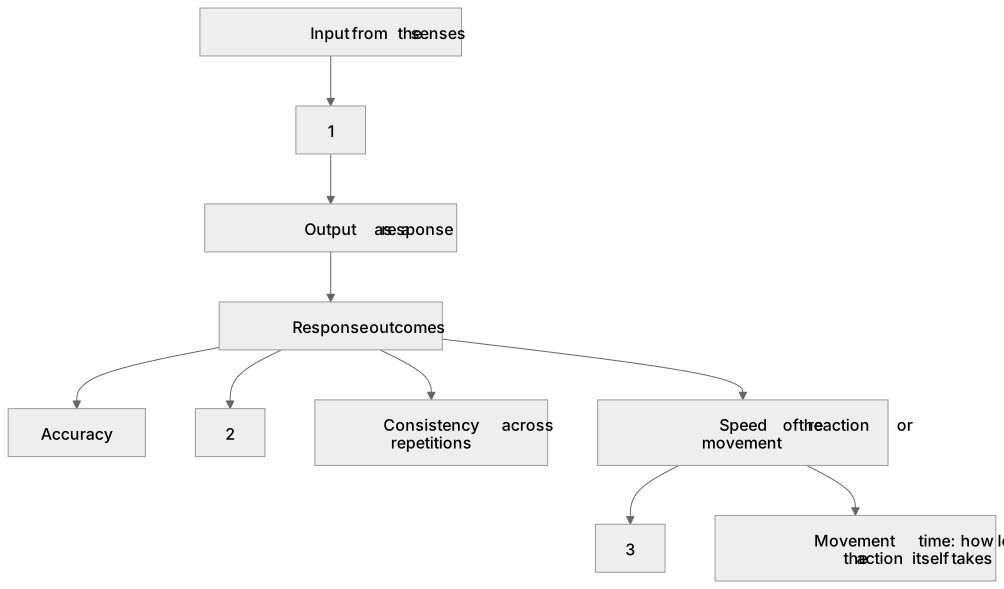
1Box 1
2Box 2
3Box 3
There is more to this lesson
The full lesson goes on to check your understanding and help you earn the marks. Create a free account to carry on, with your progress saved.
A week of Premium from your first lesson · Then the free plan continues · No card, no charge
Test your understanding of Efficiency of information processing to include:: Response outcomes.
Active recall beats re-reading. Take an instant quiz now to test what you’ve learned and lock it into long-term memory.
A week of Premium from your first lesson · Then the free plan continues · No card, no charge