AQA · A-Level · Physical Education
Course version: 7582 · Version from Sept 2016
Efficiency of information processing to include:: Sensory consequences.
Sensory consequences form a crucial element of Schmidt's recognition schema.
Checked against the AQA 7582 specification (opens in a new tab) on .
- Point 26 of 30
- 4 key terms
Study notes
From the checked teaching notes for this specification point.
The idea
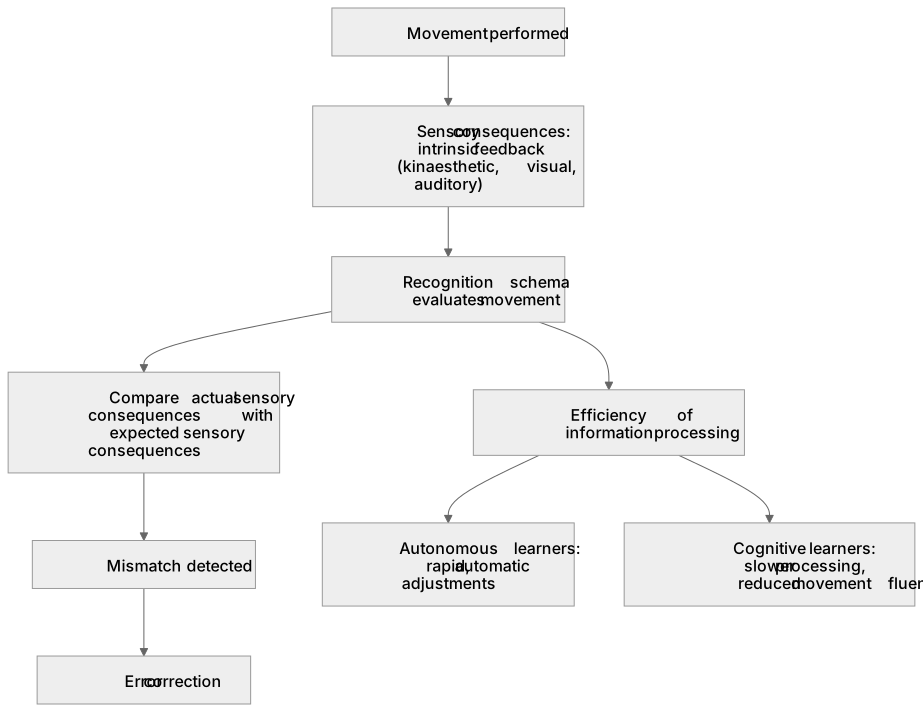
Sensory consequences form a crucial element of Schmidt's recognition schema. They refer to the intrinsic feedback a performer receives during and after a movement, primarily involving kinaesthetic information, such as the physical feeling of a tennis racket striking a ball. The performer uses this sensory information to evaluate their movement by comparing actual sensory consequences with expected sensory consequences. If a mismatch is detected, error correction occurs. The efficiency of information processing is vital here; autonomous performers process sensory consequences highly efficiently, allowing for rapid, automatic adjustments during performance, whereas cognitive learners process this feedback more slowly, reducing movement fluency.
What earns the marks
- Sensory consequences refer to the intrinsic feedback (kinaesthetic, visual, auditory) gathered during or after a movement.
- Performers compare actual sensory consequences with expected sensory consequences to detect errors and make corrections.
- The efficiency of processing sensory consequences determines how quickly a performer can adjust movements; autonomous learners process this feedback more efficiently than cognitive learners.
Common mistakes and how to put them right
Confusing sensory consequences with response outcome.
Put it right: Response outcome relates to the end result of the action (knowledge of results), whereas sensory consequences relate to the intrinsic feel of the movement (knowledge of performance).
Ignoring the role of processing efficiency.
Put it right: Do not just define the term; recognise that the speed and efficiency with which a performer processes sensory consequences affect their ability to make immediate movement adjustments.
Believing sensory consequences are part of the recall schema.
Put it right: They belong to the recognition schema, which evaluates movement, whereas the recall schema initiates movement.
Exam tips
- Explicitly mention kinaesthetic feedback when defining sensory consequences in the context of schema theory.
- Link the concept to the recognition schema and the process of error detection.
- Contrast how efficiently autonomous and cognitive learners process sensory consequences to highlight the impact on performance fluency.
Try the lesson
The start of the Efficiency of information processing to include:: Sensory consequences. lesson, made from checked teaching notes for this specification point.
Have a go first
In Schmidt's Schema Theory, which of the following best describes the 'sensory consequences' of a movement?
Listen
Sensory consequences form a crucial element of Schmidt's recognition schema. They refer to the intrinsic feedback a performer receives during and after a movement, primarily involving kinaesthetic information, such as the physical feeling of a tennis racket striking a ball. The performer uses this sensory information to evaluate their movement by comparing actual sensory consequences with expected sensory consequences. If a mismatch is detected, error correction occurs. The efficiency of information processing is vital here; autonomous performers process sensory consequences highly efficiently, allowing for rapid, automatic adjustments during performance, whereas cognitive learners process this feedback more slowly, reducing movement fluency. A strong answer earns marks for these points. Sensory consequences refer to the intrinsic feedback (kinaesthetic, visual, auditory) gathered during or after a movement. Performers compare actual sensory consequences with expected sensory consequences to detect errors and make corrections. The efficiency of processing sensory consequences determines how quickly a performer can adjust movements; autonomous learners process this feedback more efficiently than cognitive learners. A common slip: Confusing sensory consequences with response outcome. Instead, Response outcome relates to the end result of the action (knowledge of results), whereas sensory consequences relate to the intrinsic feel of the movement (knowledge of performance). Exam tip: Explicitly mention kinaesthetic feedback when defining sensory consequences in the context of schema theory.
See it
Key words
Say what each word means before you turn the card.
Sensory consequences
Try answering aloud or in your head before turning the card.
Schema theory
Try answering aloud or in your head before turning the card.
Intrinsic feedback
Try answering aloud or in your head before turning the card.
Error detection
Try answering aloud or in your head before turning the card.
See every definition
- Sensory consequences
- The intrinsic feedback a performer receives during and after a movement, primarily involving kinaesthetic information.
- Schema theory
- A theory in which sensory consequences form a crucial element of Schmidt's recognition schema.
- Intrinsic feedback
- Information received during and after a movement, such as the physical feeling of a tennis racket striking a ball.
- Error detection
- Comparing actual sensory consequences with expected sensory consequences, so that if a mismatch is detected, error correction occurs.
Label the diagram
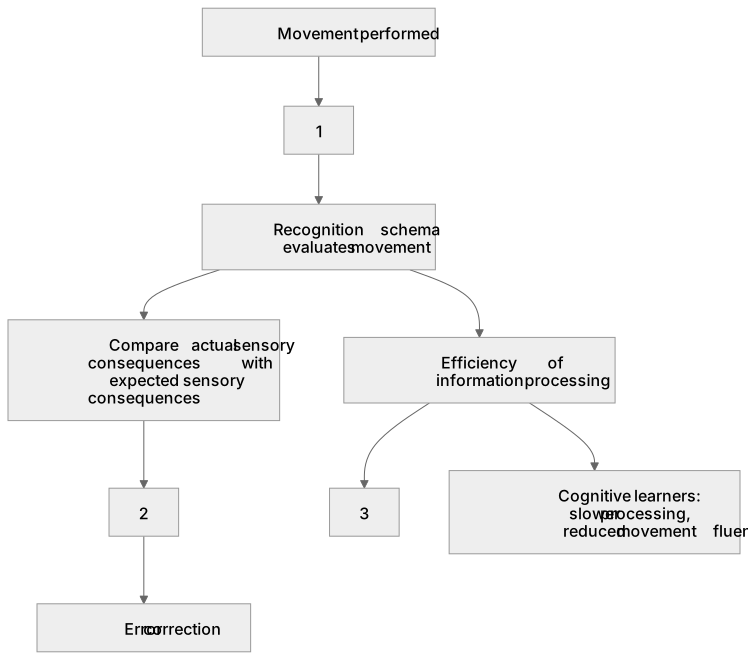
Some boxes have lost their names. Pick the right name for each number.
1Box 1
2Box 2
3Box 3
There is more to this lesson
The full lesson goes on to check your understanding and help you earn the marks. Create a free account to carry on, with your progress saved.
A week of Premium from your first lesson · Then the free plan continues · No card, no charge
Test your understanding of Efficiency of information processing to include:: Sensory consequences.
Active recall beats re-reading. Take an instant quiz now to test what you’ve learned and lock it into long-term memory.
A week of Premium from your first lesson · Then the free plan continues · No card, no charge