AQA · A-Level · Physical Education
Course version: 7582 · Version from Sept 2016
Strategies to improve information processing.
Full specification wording
Efficiency of information processing to include:: Strategies to improve information processing.
Information processing in sport involves detecting stimuli, selecting relevant cues, interpreting them and producing a response.
Checked against the AQA 7582 specification (opens in a new tab) on .
- Point 28 of 30
- 4 key terms
Study notes
From the checked teaching notes for this specification point.
The idea
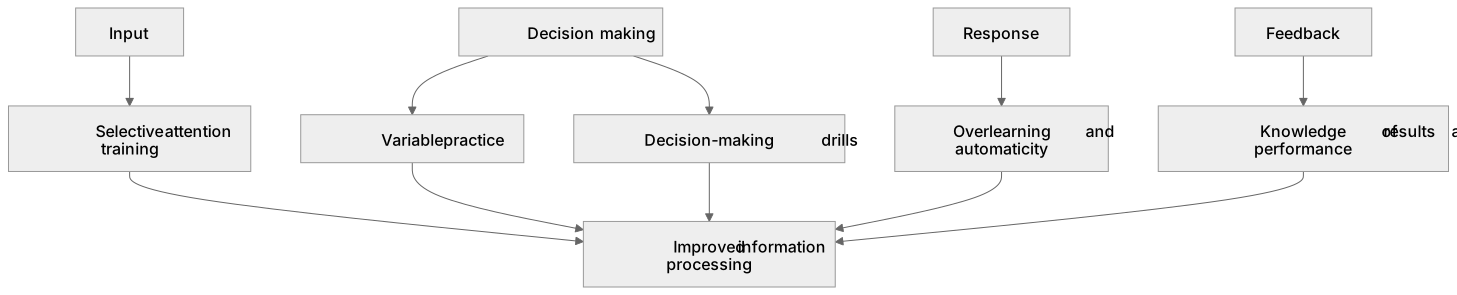
Information processing in sport involves detecting stimuli, selecting relevant cues, interpreting them and producing a response. Strategies to improve it target each stage. For input, selective attention training helps learners ignore irrelevant cues. For decision making, practising in variable conditions and using decision-making drills improve speed and accuracy. For response, overlearning and automaticity free attention for tactics. For feedback, using knowledge of results and performance supports error correction. A concrete method is a small-sided game where the coach calls a colour; players must scan, decide and pass accordingly, progressively increasing speed and complexity. This trains attention, decision speed and response execution together.
What earns the marks
- Selective attention training: practising with distractions to focus on relevant cues.
- Variable practice: changing conditions to improve decision making and adaptability.
- Decision-making drills: small-sided games or scenarios that require rapid choices.
- Overlearning: repeating skills until automatic, freeing attention for tactics.
- Feedback: using knowledge of results and performance to refine processing.
Common mistakes and how to put them right
Misunderstanding: thinking information processing is only about reaction time.
Put it right: It includes attention, perception, decision making, response and feedback.
Misunderstanding: believing practice should always be blocked and predictable.
Put it right: Variable and random practice can improve decision making and transfer.
Misunderstanding: ignoring feedback. Correction: feedback is essential for error detection and correction, and should be specific and timely.
Exam tips
- Link each strategy to a specific stage of information processing (input, decision, output, feedback).
- Use sporting examples to show how the strategy improves performance.
- Compare strategies in terms of their demands and benefits for different learners.
Try the lesson
The start of the Efficiency of information processing to include:: Strategies to improve information processing. lesson, made from checked teaching notes for this specification point.
Have a go first
A coach wants a performer to detect the flight of a ball earlier in a rally. Which strategy most directly improves the speed of information processing at the input stage?
Listen
Information processing in sport involves detecting stimuli, selecting relevant cues, interpreting them and producing a response. Strategies to improve it target each stage. For input, selective attention training helps learners ignore irrelevant cues. For decision making, practising in variable conditions and using decision-making drills improve speed and accuracy. For response, overlearning and automaticity free attention for tactics. For feedback, using knowledge of results and performance supports error correction. A concrete method is a small-sided game where the coach calls a colour; players must scan, decide and pass accordingly, progressively increasing speed and complexity. This trains attention, decision speed and response execution together. A strong answer earns marks for these points. Selective attention training: practising with distractions to focus on relevant cues. Variable practice: changing conditions to improve decision making and adaptability. Decision-making drills: small-sided games or scenarios that require rapid choices. Overlearning: repeating skills until automatic, freeing attention for tactics. A common slip: Misunderstanding: thinking information processing is only about reaction time. Instead, it includes attention, perception, decision making, response and feedback. Exam tip: Link each strategy to a specific stage of information processing (input, decision, output, feedback).
See it
Key words
Say what each word means before you turn the card.
Selective attention training
Try answering aloud or in your head before turning the card.
Variable practice
Try answering aloud or in your head before turning the card.
Decision-making drills
Try answering aloud or in your head before turning the card.
Overlearning
Try answering aloud or in your head before turning the card.
See every definition
- Selective attention training
- Practising with distractions to focus on relevant cues, helping learners ignore irrelevant cues at the input stage.
- Variable practice
- Changing conditions to improve decision making and adaptability.
- Decision-making drills
- Small-sided games or scenarios that require rapid choices.
- Overlearning
- Repeating skills until automatic, freeing attention for tactics.
Label the diagram
Some boxes have lost their names. Pick the right name for each number.
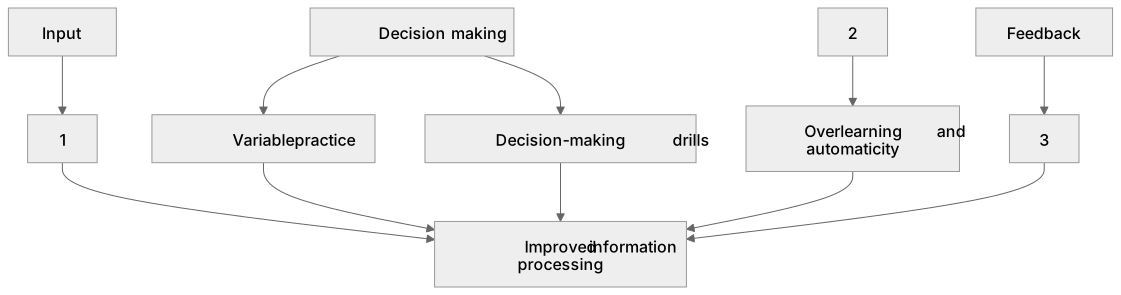
1Box 1
2Box 2
3Box 3
There is more to this lesson
The full lesson goes on to check your understanding and help you earn the marks. Create a free account to carry on, with your progress saved.
A week of Premium from your first lesson · Then the free plan continues · No card, no charge
Test your understanding of Efficiency of information processing to include:: Strategies to improve information processing.
Active recall beats re-reading. Take an instant quiz now to test what you’ve learned and lock it into long-term memory.
A week of Premium from your first lesson · Then the free plan continues · No card, no charge