AQA · A-Level · Physical Education
Course version: 7582 · Version from Sept 2016
Efficiency of information processing to include:: Schmidt’s schema theory.
Schmidt's schema theory explains how performers adapt to different situations without storing a separate motor programme for every possible movement.
Checked against the AQA 7582 specification (opens in a new tab) on .
- Point 21 of 30
- 4 key terms
Study notes
From the checked teaching notes for this specification point.
The idea
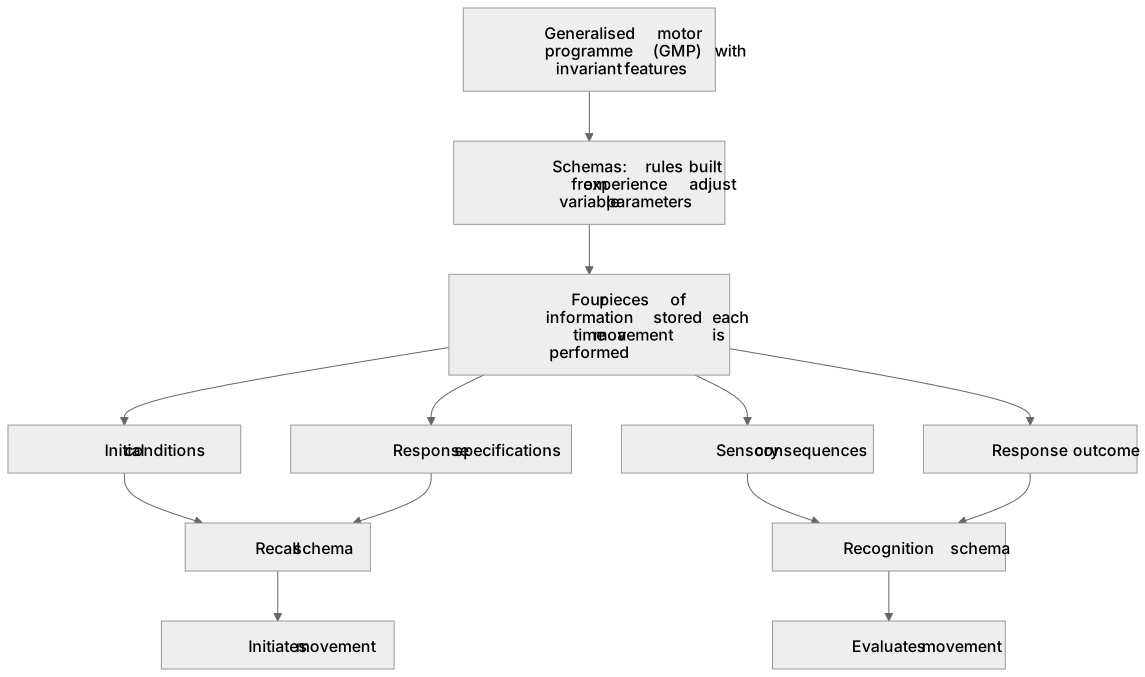
Schmidt's schema theory explains how performers adapt to different situations without storing a separate motor programme for every possible movement. Instead, they store a generalised motor programme (GMP) containing invariant features, and use schemas (rules built from experience) to adjust variable parameters like force or speed. Every time a movement is performed, four pieces of information are stored: initial conditions, response specifications, sensory consequences, and response outcome. These form two schemas: the recall schema (initial conditions and response specifications) which initiates movement, and the recognition schema (sensory consequences and outcome) which evaluates it.
What earns the marks
- Schmidt's schema theory proposes that performers store generalised motor programmes (GMPs) adapted by schemas, rather than individual programmes for every movement.
- A schema is a set of rules or relationships developed from past experiences of performing a skill.
- Four types of information are stored: initial conditions, response specifications, sensory consequences, and response outcome.
- The recall schema uses initial conditions and response specifications to initiate the movement by selecting parameters.
- The recognition schema uses sensory consequences and response outcomes to evaluate and correct the movement.
Common mistakes and how to put them right
Confusing the recall schema (which initiates movement) with the recognition schema (which evaluates movement).
Believing that schema theory requires a separate motor programme for every single movement variation.
Put it right: It actually uses a generalised motor programme adapted by schemas.
Failing to identify the four specific types of information gathered during a movement.
Put it right: Initial conditions, response specifications, sensory consequences, and response outcome must all be known.
Exam tips
- Clearly distinguish between the recall schema (before/during initiation) and the recognition schema (during/after movement).
- List the four sources of information (initial conditions, response specifications, sensory consequences, response outcome) when explaining how schemas are formed.
- Use a sporting example, such as a netball shot, to illustrate how varied practice builds stronger schemas.
Try the lesson
The start of the Efficiency of information processing to include:: Schmidt’s schema theory. lesson, made from checked teaching notes for this specification point.
Have a go first
According to Schmidt's schema theory, what is a schema?
Listen
Schmidt's schema theory explains how performers adapt to different situations without storing a separate motor programme for every possible movement. Instead, they store a generalised motor programme (GMP) containing invariant features, and use schemas (rules built from experience) to adjust variable parameters like force or speed. Every time a movement is performed, four pieces of information are stored: initial conditions, response specifications, sensory consequences, and response outcome. These form two schemas: the recall schema (initial conditions and response specifications) which initiates movement, and the recognition schema (sensory consequences and outcome) which evaluates it. A strong answer earns marks for these points. Schmidt's schema theory proposes that performers store generalised motor programmes (GMPs) adapted by schemas, rather than individual programmes for every movement. A schema is a set of rules or relationships developed from past experiences of performing a skill. Four types of information are stored: initial conditions, response specifications, sensory consequences, and response outcome. The recall schema uses initial conditions and response specifications to initiate the movement by selecting parameters. Exam tip: Clearly distinguish between the recall schema (before/during initiation) and the recognition schema (during/after movement).
See it
Key words
Say what each word means before you turn the card.
Generalised motor programme (GMP)
Try answering aloud or in your head before turning the card.
Schema
Try answering aloud or in your head before turning the card.
Recall schema
Try answering aloud or in your head before turning the card.
Recognition schema
Try answering aloud or in your head before turning the card.
See every definition
- Generalised motor programme (GMP)
- A programme containing invariant features that performers store and adapt by schemas, rather than storing a separate motor programme for every possible movement.
- Schema
- A set of rules or relationships developed from past experiences of performing a skill, used to adjust variable parameters like force or speed.
- Recall schema
- The schema that uses initial conditions and response specifications to initiate the movement by selecting parameters.
- Recognition schema
- The schema that uses sensory consequences and response outcomes to evaluate and correct the movement.
Label the diagram
Some boxes have lost their names. Pick the right name for each number.
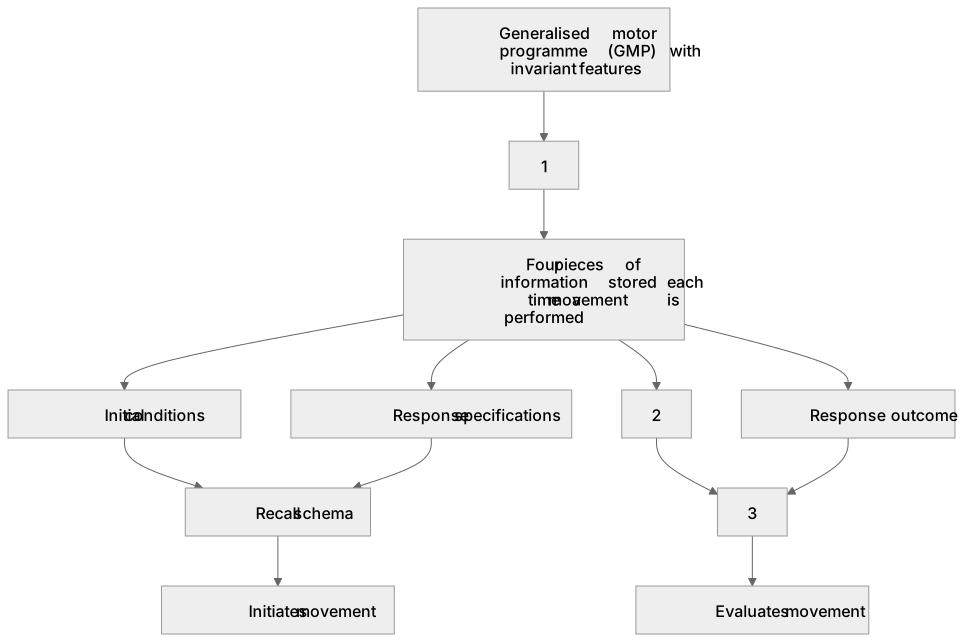
1Box 1
2Box 2
3Box 3
There is more to this lesson
The full lesson goes on to check your understanding and help you earn the marks. Create a free account to carry on, with your progress saved.
A week of Premium from your first lesson · Then the free plan continues · No card, no charge
Test your understanding of Efficiency of information processing to include:: Schmidt’s schema theory.
Active recall beats re-reading. Take an instant quiz now to test what you’ve learned and lock it into long-term memory.
A week of Premium from your first lesson · Then the free plan continues · No card, no charge