AQA · A-Level · Physical Education
Course version: 7582 · Version from Sept 2016
Anaerobic energy systems (ATP-PC system, anaerobic glycolytic system).
Full specification wording
Energy systems: Anaerobic energy systems (ATP-PC system, anaerobic glycolytic system).
Anaerobic systems resynthesise ATP without oxygen and are used at the onset of exercise and during high-intensity efforts.
Checked against the AQA 7582 specification (opens in a new tab) on .
- Point 4 of 26
- 4 key terms
Study notes
From the checked teaching notes for this specification point.
The idea
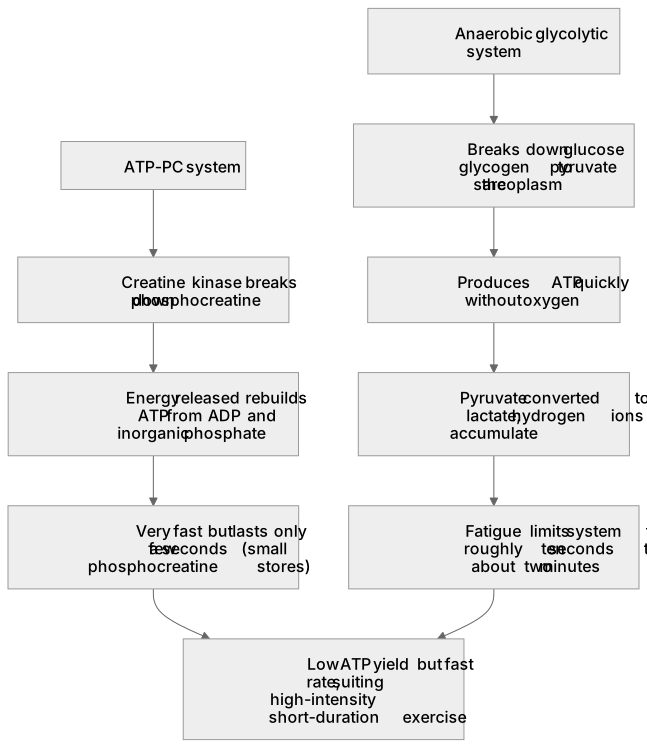
Anaerobic systems resynthesise ATP without oxygen and are used at the onset of exercise and during high-intensity efforts. The ATP-PC (phosphocreatine) system uses creatine kinase to break down phosphocreatine, and the energy released rebuilds ATP from ADP and inorganic phosphate; it is very fast but lasts only a few seconds because phosphocreatine stores are small. The anaerobic glycolytic (lactate) system breaks down glucose or glycogen to pyruvate in the sarcoplasm, producing ATP quickly without oxygen; when pyruvate is converted to lactate, hydrogen ions accumulate and contribute to fatigue, limiting the system to roughly ten seconds to about two minutes of maximal work. Both systems have a low ATP yield compared with the aerobic system but a much faster rate, which suits sprinting, jumping and repeated high-intensity efforts.
What earns the marks
- The ATP-PC system uses phosphocreatine breakdown, catalysed by creatine kinase, to resynthesise ATP from ADP and inorganic phosphate.
- The ATP-PC system is very fast but limited by small phosphocreatine stores, lasting only a few seconds.
- The anaerobic glycolytic system breaks down glucose or glycogen to pyruvate in the sarcoplasm without oxygen.
- Pyruvate conversion to lactate is associated with hydrogen ion accumulation, which contributes to fatigue and limits duration.
- Anaerobic systems have a low ATP yield but a fast rate, suiting high-intensity, short-duration exercise.
- Anaerobic glycolysis supplies ATP for roughly ten seconds to about two minutes of maximal work.
Common mistakes and how to put them right
Saying the ATP-PC system uses oxygen.
Put it right: It is anaerobic and relies on phosphocreatine breakdown.
Believing lactate itself is the sole cause of fatigue.
Put it right: Hydrogen ion accumulation is the key contributor, and lactate is a by-product.
Thinking anaerobic glycolysis occurs in the mitochondrion.
Put it right: It takes place in the sarcoplasm.
Confusing the duration of the two systems.
Put it right: ATP-PC lasts only a few seconds, while anaerobic glycolysis extends to about two minutes.
Exam tips
- Name the enzyme creatine kinase when describing ATP-PC breakdown to show precise knowledge.
- Distinguish clearly between lactate as a by-product and hydrogen ions as the cause of fatigue.
- Link each system to a sporting example, such as a 100 m sprint for ATP-PC and a 400 m or 800 m race for anaerobic glycolysis.
- Compare anaerobic and aerobic systems in terms of rate, yield and duration to answer 'explain' questions fully.
Try the lesson
The start of the Energy systems: Anaerobic energy systems (ATP-PC system, anaerobic glycolytic system). lesson, made from checked teaching notes for this specification point.
Have a go first
Which fuel is broken down by creatine kinase to resynthesise ATP in the ATP-PC system?
Listen
Anaerobic systems resynthesise ATP without oxygen and are used at the onset of exercise and during high-intensity efforts. The ATP-PC (phosphocreatine) system uses creatine kinase to break down phosphocreatine, and the energy released rebuilds ATP from ADP and inorganic phosphate; it is very fast but lasts only a few seconds because phosphocreatine stores are small. The anaerobic glycolytic (lactate) system breaks down glucose or glycogen to pyruvate in the sarcoplasm, producing ATP quickly without oxygen; when pyruvate is converted to lactate, hydrogen ions accumulate and contribute to fatigue, limiting the system to roughly ten seconds to about two minutes of maximal work. Both systems have a low ATP yield compared with the aerobic system but a much faster rate, which suits sprinting, jumping and repeated high-intensity efforts. A strong answer earns marks for these points. The ATP-PC system uses phosphocreatine breakdown, catalysed by creatine kinase, to resynthesise ATP from ADP and inorganic phosphate. The ATP-PC system is very fast but limited by small phosphocreatine stores, lasting only a few seconds. The anaerobic glycolytic system breaks down glucose or glycogen to pyruvate in the sarcoplasm without oxygen. Pyruvate conversion to lactate is associated with hydrogen ion accumulation, which contributes to fatigue and limits duration. Exam tip: Name the enzyme creatine kinase when describing ATP-PC breakdown to show precise knowledge.
See it
Key words
Say what each word means before you turn the card.
ATP resynthesis without oxygen
Try answering aloud or in your head before turning the card.
Phosphocreatine breakdown
Try answering aloud or in your head before turning the card.
Lactate and fatigue
Try answering aloud or in your head before turning the card.
Intensity and duration of exercise
Try answering aloud or in your head before turning the card.
See every definition
- ATP resynthesis without oxygen
- Anaerobic systems resynthesise ATP without oxygen and are used at the onset of exercise and during high-intensity efforts.
- Phosphocreatine breakdown
- The ATP-PC system uses creatine kinase to break down phosphocreatine, and the energy released rebuilds ATP from ADP and inorganic phosphate.
- Lactate and fatigue
- When pyruvate is converted to lactate, hydrogen ions accumulate and contribute to fatigue, limiting the system to roughly ten seconds to about two minutes of maximal work.
- Intensity and duration of exercise
- Both systems have a low ATP yield compared with the aerobic system but a much faster rate, which suits sprinting, jumping and repeated high-intensity efforts.
Label the diagram
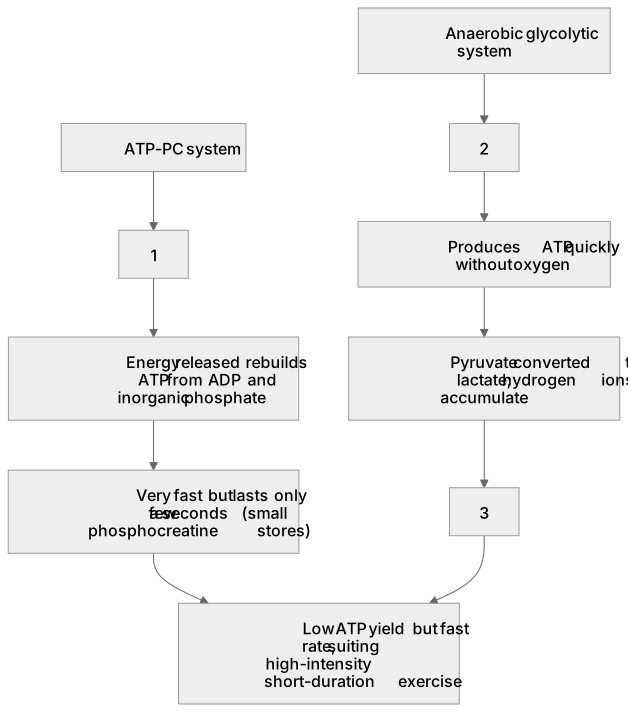
Some boxes have lost their names. Pick the right name for each number.
1Box 1
2Box 2
3Box 3
There is more to this lesson
The full lesson goes on to check your understanding and help you earn the marks. Create a free account to carry on, with your progress saved.
A week of Premium from your first lesson · Then the free plan continues · No card, no charge
Test your understanding of Energy systems: Anaerobic energy systems (ATP-PC system, anaerobic glycolytic system).
Active recall beats re-reading. Take an instant quiz now to test what you’ve learned and lock it into long-term memory.
A week of Premium from your first lesson · Then the free plan continues · No card, no charge