AQA · A-Level · Physical Education
Course version: 7582 · Version from Sept 2016
Energy systems: Energy continuum of physical activity.
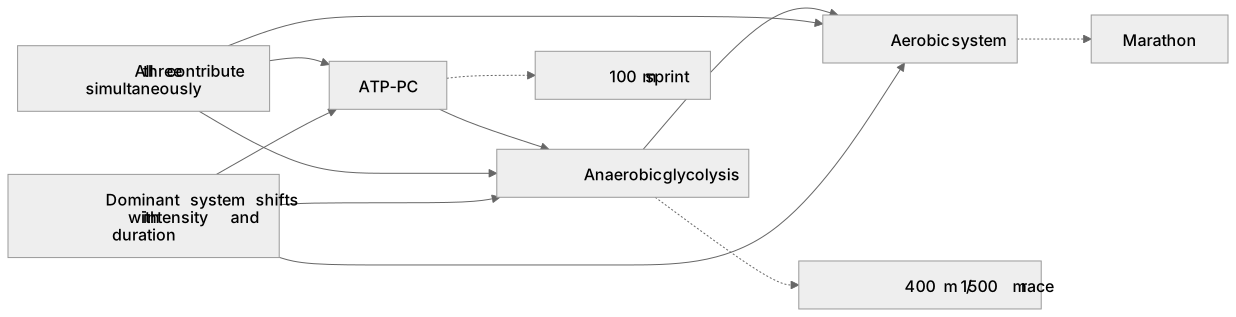
The energy continuum describes how the three energy systems — ATP-PC, anaerobic glycolysis and the aerobic system — contribute simultaneously rather than switching on and off.
Checked against the AQA 7582 specification (opens in a new tab) on .
- Point 5 of 26
- 4 key terms
Study notes
From the checked teaching notes for this specification point.
The idea
The energy continuum describes how the three energy systems — ATP-PC, anaerobic glycolysis and the aerobic system — contribute simultaneously rather than switching on and off. At one end, short, explosive activity such as a 100 m sprint relies mainly on ATP-PC, with anaerobic glycolysis contributing as the effort continues. At the other end, prolonged submaximal activity such as a marathon relies mainly on the aerobic system. Between these extremes, events such as a 400 m or 1500 m race sit at different points, with the dominant system shifting as intensity rises and duration lengthens. The continuum is a model of relative contribution, not an absolute boundary, so a performer never uses only one system.
What earns the marks
- The three energy systems are ATP-PC, anaerobic glycolysis and the aerobic system.
- All three systems contribute at the same time; the continuum shows their relative contribution.
- ATP-PC dominates very short, very high-intensity efforts such as a 100 m sprint.
- Anaerobic glycolysis contributes increasingly as high-intensity effort continues beyond the initial seconds.
- The aerobic system dominates prolonged submaximal activity such as a marathon.
- The dominant system shifts with both intensity and duration, not duration alone.
Common mistakes and how to put them right
Believing the systems work one after another in strict sequence.
Put it right by stating they overlap and contribute simultaneously, with only the dominant contribution changing.
Thinking a single system supplies all ATP at any moment.
Put it right by describing a relative contribution that shifts along the continuum.
Assuming duration alone decides the dominant system.
Put it right by linking the shift to both intensity and duration together.
Exam tips
- Anchor each point on the continuum to a named activity and its intensity and duration.
- Use the phrase relative contribution to show you understand overlap rather than switching.
- Check whether the question asks which system dominates or how contributions change, and answer that specific demand.
Try the lesson
The start of the Energy systems: Energy continuum of physical activity. lesson, made from checked teaching notes for this specification point.
Have a go first
During a 100 m sprint lasting about 10 seconds, which energy system supplies the greatest proportion of the ATP used?
Listen
The energy continuum describes how the three energy systems — ATP-PC, anaerobic glycolysis and the aerobic system — contribute simultaneously rather than switching on and off. At one end, short, explosive activity such as a 100 m sprint relies mainly on ATP-PC, with anaerobic glycolysis contributing as the effort continues. At the other end, prolonged submaximal activity such as a marathon relies mainly on the aerobic system. Between these extremes, events such as a 400 m or 1500 m race sit at different points, with the dominant system shifting as intensity rises and duration lengthens. The continuum is a model of relative contribution, not an absolute boundary, so a performer never uses only one system. A strong answer earns marks for these points. The three energy systems are ATP-PC, anaerobic glycolysis and the aerobic system. All three systems contribute at the same time; the continuum shows their relative contribution. ATP-PC dominates very short, very high-intensity efforts such as a 100 m sprint. Anaerobic glycolysis contributes increasingly as high-intensity effort continues beyond the initial seconds. A common slip: Believing the systems work one after another in strict sequence. Instead, stating they overlap and contribute simultaneously, with only the dominant contribution changing. Exam tip: Anchor each point on the continuum to a named activity and its intensity and duration.
See it
Key words
Say what each word means before you turn the card.
Simultaneous contribution of energy systems
Try answering aloud or in your head before turning the card.
Relative dominance along a continuum
Try answering aloud or in your head before turning the card.
Intensity and duration as determinants
Try answering aloud or in your head before turning the card.
Application to named sporting activities
Try answering aloud or in your head before turning the card.
See every definition
- Simultaneous contribution of energy systems
- All three systems contribute at the same time, with only the dominant contribution changing rather than the systems working one after another in strict sequence.
- Relative dominance along a continuum
- The continuum is a model of relative contribution, not an absolute boundary, so a performer never uses only one system.
- Intensity and duration as determinants
- The dominant system shifts with both intensity and duration, not duration alone.
- Application to named sporting activities
- A 100 m sprint relies mainly on ATP-PC, a marathon relies mainly on the aerobic system, and events such as a 400 m or 1500 m race sit at different points between these extremes.
Label the diagram
Some boxes have lost their names. Pick the right name for each number.
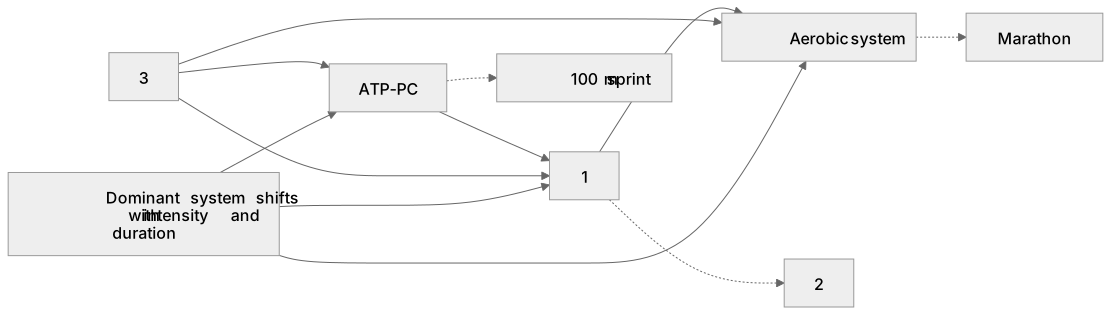
1Box 1
2Box 2
3Box 3
There is more to this lesson
The full lesson goes on to check your understanding and help you earn the marks. Create a free account to carry on, with your progress saved.
A week of Premium from your first lesson · Then the free plan continues · No card, no charge
Test your understanding of Energy systems: Energy continuum of physical activity.
Active recall beats re-reading. Take an instant quiz now to test what you’ve learned and lock it into long-term memory.
A week of Premium from your first lesson · Then the free plan continues · No card, no charge