AQA · A-Level · Physical Education
Course version: 7582 · Version from Sept 2016
Consideration for physical activity and sport of different intensities and…
Full specification wording
Energy systems: Consideration for physical activity and sport of different intensities and durations.
Choosing the right energy system for a given activity depends on analysing its intensity and duration together.
Checked against the AQA 7582 specification (opens in a new tab) on .
- Point 6 of 26
- 4 key terms
Study notes
From the checked teaching notes for this specification point.
The idea
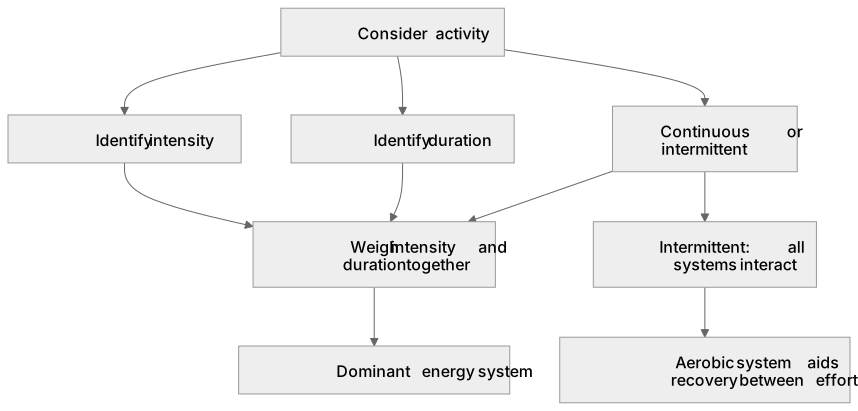
Choosing the right energy system for a given activity depends on analysing its intensity and duration together. A maximal 100 m sprint lasts around ten seconds, so ATP-PC dominates. A 400 m race at high intensity lasts longer, so anaerobic glycolysis contributes strongly. A 1500 m race is a continuous, high-intensity event where the aerobic system supports sustained work alongside anaerobic contributions. A football match involves intermittent, repeated high-intensity efforts, so all systems interact, with the aerobic system aiding recovery between sprints. A marathon at submaximal intensity is dominated by the aerobic system. When considering an activity, identify its intensity, duration and whether it is continuous or intermittent to explain which system dominates.
What earns the marks
- Intensity and duration must be considered together when judging the dominant energy system.
- Very short maximal efforts such as a 100 m sprint are dominated by ATP-PC.
- High-intensity efforts lasting longer, such as a 400 m race, involve strong anaerobic glycolysis contribution.
- Continuous high-intensity events like a 1500 m race rely on the aerobic system for sustained work alongside anaerobic systems.
- Prolonged submaximal activity such as a marathon is dominated by the aerobic system.
- Intermittent activities such as team games require interaction of all systems, with the aerobic system aiding recovery between efforts.
- Recovery periods allow partial resynthesis of ATP-PC and clearance of metabolic by-products.
Common mistakes and how to put them right
Judging the dominant system from duration alone.
Put it right by weighing intensity and duration together.
Treating intermittent team games as purely anaerobic.
Put it right by explaining that the aerobic system supports recovery and sustained periods.
Ignoring recovery between efforts.
Put it right by stating that recovery allows ATP-PC resynthesis and reduces fatigue.
Confusing continuous high-intensity events like a 1500 m race with intermittent activities.
Put it right by noting the 1500 m is continuous and relies on the aerobic system for sustained work.
Exam tips
- Name the activity, state its intensity and duration, then justify the dominant system.
- For intermittent activities, explain how recovery periods change the contribution of each system.
- Use comparative language such as predominantly or mainly rather than claiming exclusive use.
Try the lesson
The start of the Energy systems: Consideration for physical activity and sport of different intensities and durations. lesson, made from checked teaching notes for this specification point.
Have a go first
Which type of physical activity relies mainly on the aerobic energy system?
Listen
Choosing the right energy system for a given activity depends on analysing its intensity and duration together. A maximal 100 m sprint lasts around ten seconds, so ATP-PC dominates. A 400 m race at high intensity lasts longer, so anaerobic glycolysis contributes strongly. A 1500 m race is a continuous, high-intensity event where the aerobic system supports sustained work alongside anaerobic contributions. A football match involves intermittent, repeated high-intensity efforts, so all systems interact, with the aerobic system aiding recovery between sprints. A marathon at submaximal intensity is dominated by the aerobic system. When considering an activity, identify its intensity, duration and whether it is continuous or intermittent to explain which system dominates. A strong answer earns marks for these points. Intensity and duration must be considered together when judging the dominant energy system. Very short maximal efforts such as a 100 m sprint are dominated by ATP-PC. High-intensity efforts lasting longer, such as a 400 m race, involve strong anaerobic glycolysis contribution. Continuous high-intensity events like a 1500 m race rely on the aerobic system for sustained work alongside anaerobic systems. A common slip: Judging the dominant system from duration alone. Instead, weighing intensity and duration together. Exam tip: Name the activity, state its intensity and duration, then justify the dominant system.
See it
Key words
Say what each word means before you turn the card.
Intensity and duration analysis
Try answering aloud or in your head before turning the card.
Dominant system selection
Try answering aloud or in your head before turning the card.
Intermittent versus continuous activity
Try answering aloud or in your head before turning the card.
Recovery and system interaction
Try answering aloud or in your head before turning the card.
See every definition
- Intensity and duration analysis
- Considering intensity and duration together when judging which energy system dominates an activity.
- Dominant system selection
- Identifying an activity's intensity, duration and whether it is continuous or intermittent to explain which system dominates.
- Intermittent versus continuous activity
- Intermittent activities such as team games require interaction of all systems, whereas continuous high-intensity events rely on the aerobic system for sustained work alongside anaerobic systems.
- Recovery and system interaction
- Recovery periods allow partial resynthesis of ATP-PC and clearance of metabolic by-products, with the aerobic system aiding recovery between efforts.
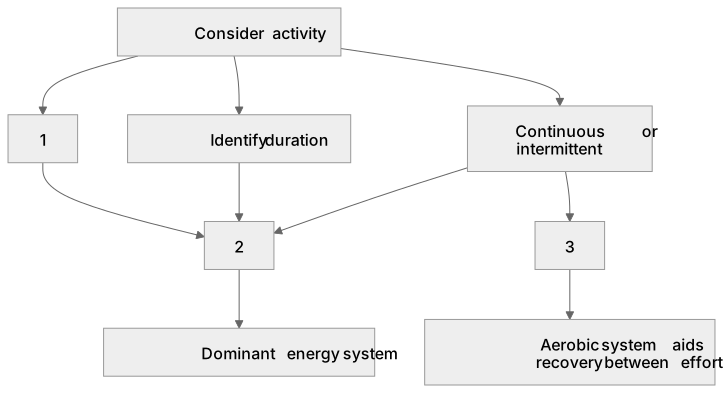
Label the diagram
Some boxes have lost their names. Pick the right name for each number.
1Box 1
2Box 2
3Box 3
There is more to this lesson
The full lesson goes on to check your understanding and help you earn the marks. Create a free account to carry on, with your progress saved.
A week of Premium from your first lesson · Then the free plan continues · No card, no charge
Test your understanding of Energy systems: Consideration for physical activity and sport of different intensities and durations.
Active recall beats re-reading. Take an instant quiz now to test what you’ve learned and lock it into long-term memory.
A week of Premium from your first lesson · Then the free plan continues · No card, no charge