AQA · A-Level · Physical Education
Course version: 7582 · Version from Sept 2016
Energy systems: Measurements of energy expenditure.
Energy expenditure is the total energy a performer uses, expressed in kilojoules (kJ) or kilocalories (kcal), where 1 kcal ≈ 4.2 kJ.
Checked against the AQA 7582 specification (opens in a new tab) on .
- Point 17 of 26
- 4 key terms
Study notes
From the checked teaching notes for this specification point.
The idea
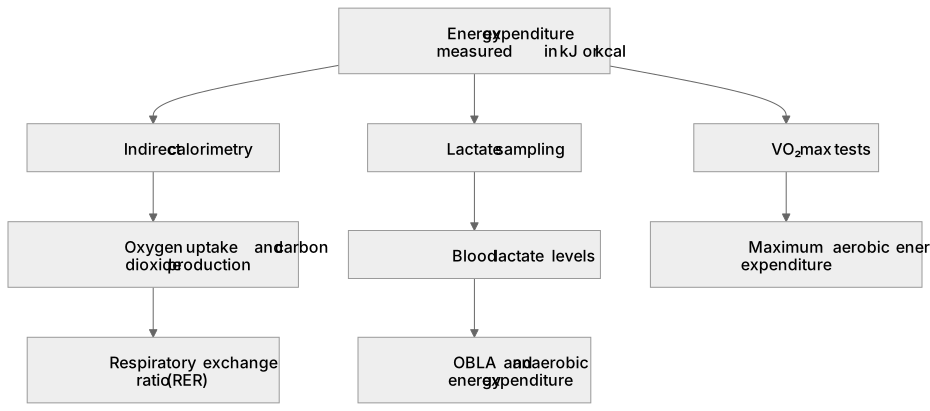
Energy expenditure is the total energy a performer uses, expressed in kilojoules (kJ) or kilocalories (kcal), where 1 kcal ≈ 4.2 kJ. At rest and during exercise, the body releases energy by aerobic and anaerobic resynthesis of ATP. Measurements of energy expenditure include indirect calorimetry, lactate sampling and VO₂ max tests. Indirect calorimetry estimates expenditure from oxygen uptake and carbon dioxide production, using the respiratory exchange ratio (RER). Lactate sampling measures blood lactate levels to determine the onset of blood lactate accumulation (OBLA) and anaerobic energy expenditure. VO₂ max tests, such as the multi-stage fitness test or laboratory gas analysis, measure the maximum aerobic energy expenditure. These measurements help evaluate fitness, monitor training intensity and estimate the energy cost of specific exercises.
What earns the marks
- Energy expenditure is the energy used by the body for ATP resynthesis, measured in kJ or kcal (1 kcal ≈ 4.2 kJ).
- Indirect calorimetry estimates energy expenditure by measuring oxygen uptake and carbon dioxide production to calculate the respiratory exchange ratio (RER).
- Lactate sampling measures blood lactate concentration to assess anaerobic energy expenditure and identify the lactate threshold or OBLA.
- VO₂ max tests evaluate maximum aerobic energy expenditure and can be conducted via laboratory gas analysis or field tests.
Common mistakes and how to put them right
Thinking energy expenditure is measured only in kcal.
Put it right: The SI unit is the kilojoule (kJ), and kcal is a common alternative (1 kcal ≈ 4.2 kJ).
Confusing the purpose of lactate sampling.
Put it right: It measures anaerobic energy expenditure and OBLA, not aerobic capacity.
Assuming VO₂ max tests only measure oxygen uptake.
Put it right: They are also a key method for evaluating maximum aerobic energy expenditure.
Exam tips
- Learn the unit conversion 1 kcal ≈ 4.2 kJ and be ready to convert between kJ and kcal.
- Link each measurement method to its specific energy system: indirect calorimetry and VO₂ max tests for aerobic, lactate sampling for anaerobic.
- Be prepared to identify indirect calorimetry, lactate sampling and VO₂ max tests as the specified methods for measuring energy expenditure.
Try the lesson
The start of the Energy systems: Measurements of energy expenditure. lesson, made from checked teaching notes for this specification point.
Have a go first
Which measurement of energy expenditure is obtained by placing a performer in a sealed chamber and measuring the heat they release?
Listen
Energy expenditure is the total energy a performer uses, expressed in kilojoules (kJ) or kilocalories (kcal), where 1 kcal ≈ 4.2 kJ. At rest and during exercise, the body releases energy by aerobic and anaerobic resynthesis of ATP. Measurements of energy expenditure include indirect calorimetry, lactate sampling and VO₂ max tests. Indirect calorimetry estimates expenditure from oxygen uptake and carbon dioxide production, using the respiratory exchange ratio (RER). Lactate sampling measures blood lactate levels to determine the onset of blood lactate accumulation (OBLA) and anaerobic energy expenditure. VO₂ max tests, such as the multi-stage fitness test or laboratory gas analysis, measure the maximum aerobic energy expenditure. These measurements help evaluate fitness, monitor training intensity and estimate the energy cost of specific exercises. A strong answer earns marks for these points. Energy expenditure is the energy used by the body for ATP resynthesis, measured in kJ or kcal (1 kcal ≈ 4.2 kJ). Indirect calorimetry estimates energy expenditure by measuring oxygen uptake and carbon dioxide production to calculate the respiratory exchange ratio (RER). Lactate sampling measures blood lactate concentration to assess anaerobic energy expenditure and identify the lactate threshold or OBLA. VO₂ max tests evaluate maximum aerobic energy expenditure and can be conducted via laboratory gas analysis or field tests. Exam tip: Learn the unit conversion 1 kcal ≈ 4.2 kJ and be ready to convert between kJ and kcal.
See it
Key words
Say what each word means before you turn the card.
Energy expenditure
Try answering aloud or in your head before turning the card.
Indirect calorimetry
Try answering aloud or in your head before turning the card.
Lactate sampling
Try answering aloud or in your head before turning the card.
VO₂ max tests
Try answering aloud or in your head before turning the card.
See every definition
- Energy expenditure
- The total energy a performer uses, expressed in kilojoules (kJ) or kilocalories (kcal), where 1 kcal ≈ 4.2 kJ.
- Indirect calorimetry
- A measurement that estimates energy expenditure from oxygen uptake and carbon dioxide production, using the respiratory exchange ratio (RER).
- Lactate sampling
- A measurement of blood lactate levels to determine the onset of blood lactate accumulation (OBLA) and anaerobic energy expenditure.
- VO₂ max tests
- Tests, such as the multi-stage fitness test or laboratory gas analysis, that measure the maximum aerobic energy expenditure.
Label the diagram
Some boxes have lost their names. Pick the right name for each number.
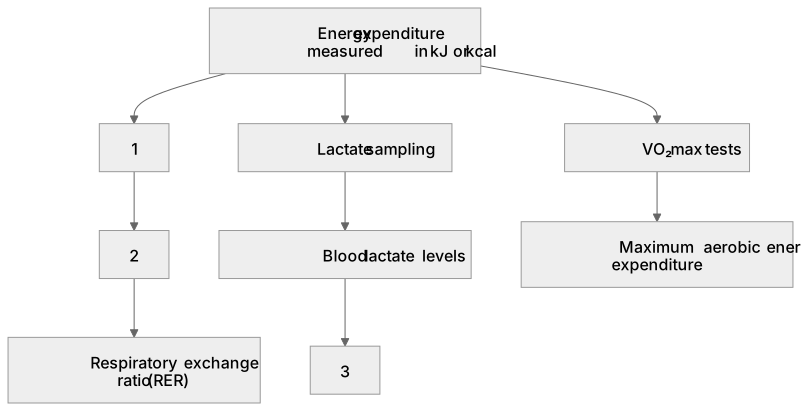
1Box 1
2Box 2
3Box 3
There is more to this lesson
The full lesson goes on to check your understanding and help you earn the marks. Create a free account to carry on, with your progress saved.
A week of Premium from your first lesson · Then the free plan continues · No card, no charge
Test your understanding of Energy systems: Measurements of energy expenditure.
Active recall beats re-reading. Take an instant quiz now to test what you’ve learned and lock it into long-term memory.
A week of Premium from your first lesson · Then the free plan continues · No card, no charge