AQA · A-Level · Physical Education
Course version: 7582 · Version from Sept 2016
Energy systems: Factors affecting VO₂ max/aerobic power.
VO₂ max, also called aerobic power, is the maximum rate at which the body can take up, transport and use oxygen during intense exercise.
Checked against the AQA 7582 specification (opens in a new tab) on .
- Point 16 of 26
- 4 key terms
Study notes
From the checked teaching notes for this specification point.
The idea
VO₂ max, also called aerobic power, is the maximum rate at which the body can take up, transport and use oxygen during intense exercise. It can be expressed as an absolute value in litres per minute (L/min) or as a relative value in millilitres of oxygen per kilogram of body mass per minute (ml·kg⁻¹·min⁻¹). Several factors affect it. Genetic makeup sets a ceiling, while training can improve it. Age and sex influence typical values: young adults often have higher values than older adults, and males often have higher values than females. Body composition matters because a higher proportion of lean muscle mass supports a greater VO₂ max. The efficiency of the cardiovascular and respiratory systems, including cardiac output, stroke volume, haemoglobin concentration and muscle capillary density, also affects oxygen delivery and use.
What earns the marks
- VO₂ max is the maximum rate of oxygen uptake, transport and use during exercise, expressed in L/min (absolute) or ml·kg⁻¹·min⁻¹ (relative).
- Genetic makeup sets an individual's upper limit for VO₂ max.
- Training, especially aerobic training, can increase VO₂ max by improving cardiac output, stroke volume and capillary density.
- Age and sex affect typical VO₂ max values: it tends to be higher in young adults and often higher in males than females.
- Body composition, particularly a high proportion of lean muscle mass, is associated with a higher VO₂ max.
- Cardiovascular and respiratory efficiency, including haemoglobin concentration and oxygen delivery, influences VO₂ max.
Common mistakes and how to put them right
Confusing VO₂ max with lung volume.
Put it right: VO₂ max depends on oxygen uptake, transport and use, not just how much air the lungs can hold.
Thinking VO₂ max is fixed and cannot change.
Put it right: Training can improve it, although genetics set an upper limit.
Believing VO₂ max is the same for everyone of the same age.
Put it right: Sex, body composition and training status also cause differences.
Assuming VO₂ max can only be measured in one way.
Put it right: It can be absolute (L/min) or relative to body mass (ml·kg⁻¹·min⁻¹).
Exam tips
- Check whether the question asks for a factor that affects VO₂ max or for the definition of VO₂ max.
- When a factor is given, link it to oxygen delivery or use rather than just naming it.
- Remember that both genetic and training factors can affect VO₂ max, so avoid options that say only one matters.
- Pay attention to the units provided: L/min for absolute VO₂ max and ml·kg⁻¹·min⁻¹ for relative VO₂ max.
Try the lesson
The start of the Energy systems: Factors affecting VO₂ max/aerobic power. lesson, made from checked teaching notes for this specification point.
Have a go first
Which of the following physiological factors directly determines a performer's VO₂ max?
Listen
VO₂ max, also called aerobic power, is the maximum rate at which the body can take up, transport and use oxygen during intense exercise. It can be expressed as an absolute value in litres per minute (L/min) or as a relative value in millilitres of oxygen per kilogram of body mass per minute (ml·kg⁻¹·min⁻¹). Several factors affect it. Genetic makeup sets a ceiling, while training can improve it. Age and sex influence typical values: young adults often have higher values than older adults, and males often have higher values than females. Body composition matters because a higher proportion of lean muscle mass supports a greater VO₂ max. The efficiency of the cardiovascular and respiratory systems, including cardiac output, stroke volume, haemoglobin concentration and muscle capillary density, also affects oxygen delivery and use. A strong answer earns marks for these points. VO₂ max is the maximum rate of oxygen uptake, transport and use during exercise, expressed in L/min (absolute) or ml·kg⁻¹·min⁻¹ (relative). Genetic makeup sets an individual's upper limit for VO₂ max. Training, especially aerobic training, can increase VO₂ max by improving cardiac output, stroke volume and capillary density. Age and sex affect typical VO₂ max values: it tends to be higher in young adults and often higher in males than females. Exam tip: Check whether the question asks for a factor that affects VO₂ max or for the definition of VO₂ max.
See it
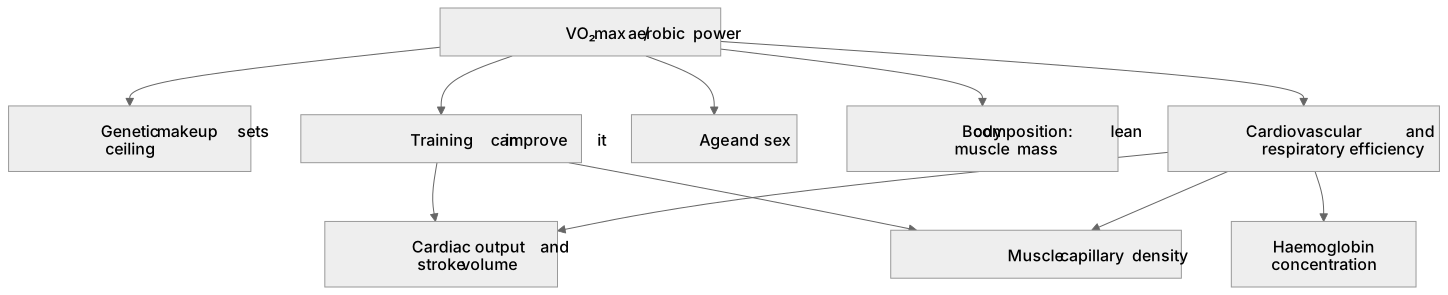
Key words
Say what each word means before you turn the card.
VO₂ max
Try answering aloud or in your head before turning the card.
Absolute and relative values
Try answering aloud or in your head before turning the card.
Genetic makeup
Try answering aloud or in your head before turning the card.
Body composition
Try answering aloud or in your head before turning the card.
See every definition
- VO₂ max
- The maximum rate at which the body can take up, transport and use oxygen during intense exercise, also called aerobic power.
- Absolute and relative values
- Expressed as an absolute value in litres per minute (L/min) or as a relative value in millilitres of oxygen per kilogram of body mass per minute (ml·kg⁻¹·min⁻¹).
- Genetic makeup
- Sets a ceiling for VO₂ max, while training can improve it.
- Body composition
- Matters because a higher proportion of lean muscle mass supports a greater VO₂ max.
Label the diagram
Some boxes have lost their names. Pick the right name for each number.
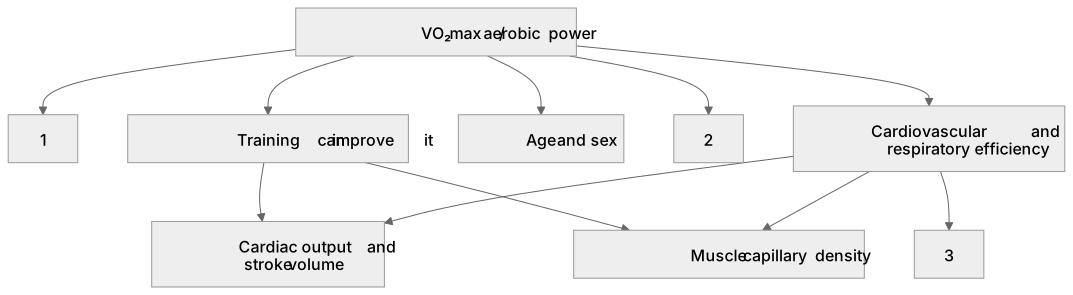
1Box 1
2Box 2
3Box 3
There is more to this lesson
The full lesson goes on to check your understanding and help you earn the marks. Create a free account to carry on, with your progress saved.
A week of Premium from your first lesson · Then the free plan continues · No card, no charge
Test your understanding of Energy systems: Factors affecting VO₂ max/aerobic power.
Active recall beats re-reading. Take an instant quiz now to test what you’ve learned and lock it into long-term memory.
A week of Premium from your first lesson · Then the free plan continues · No card, no charge