AQA · A-Level · Physical Education
Course version: 7582 · Version from Sept 2016
Oxygen consumption during exercise (maximal and submaximal oxygen deficit).
Full specification wording
Energy systems: Oxygen consumption during exercise (maximal and submaximal oxygen deficit).
Oxygen consumption rises at the start of exercise because aerobic respiration cannot meet ATP demand immediately.
Checked against the AQA 7582 specification (opens in a new tab) on .
- Point 14 of 26
- 4 key terms
Study notes
From the checked teaching notes for this specification point.
The idea
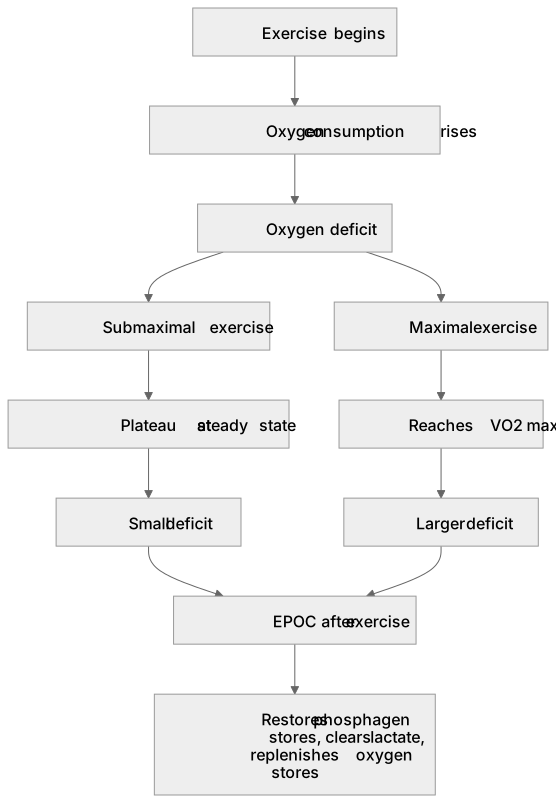
Oxygen consumption rises at the start of exercise because aerobic respiration cannot meet ATP demand immediately. The oxygen deficit is the difference between the oxygen actually consumed and the oxygen that would have been consumed if aerobic metabolism had been fully engaged from the start. During submaximal exercise, oxygen consumption rises until it plateaus at a steady state, where ATP demand is met aerobically and the deficit remains small. During maximal exercise, oxygen consumption rises until it reaches maximal oxygen consumption, or VO2 max, and the deficit is larger because anaerobic systems must contribute more ATP. After exercise, excess post-exercise oxygen consumption, or EPOC, repays the deficit by restoring phosphagen stores, clearing lactate and replenishing oxygen stores.
What earns the marks
- Oxygen deficit is the shortfall between actual oxygen consumption and the oxygen that aerobic metabolism would have required from the start of exercise.
- At the onset of exercise, anaerobic systems such as ATP-PC and anaerobic glycolysis supply ATP before aerobic respiration accelerates.
- Submaximal exercise allows oxygen consumption to plateau at a steady state, so the oxygen deficit is relatively small.
- Maximal exercise drives oxygen consumption to VO2 max, and the oxygen deficit is larger because anaerobic contribution is greater.
- EPOC is the elevated oxygen consumption after exercise that helps restore the body to its pre-exercise state.
- EPOC supports replenishment of phosphagen stores, lactate clearance and restoration of myoglobin and blood oxygen stores.
- Trained performers reach steady state faster and have a higher VO2 max, which reduces the relative oxygen deficit at a given intensity.
Common mistakes and how to put them right
Confusing oxygen deficit with EPOC.
Put it right: The deficit occurs at the start of exercise, while EPOC occurs after exercise.
Thinking oxygen deficit only happens in maximal exercise.
Put it right: A deficit occurs whenever exercise begins, but it is larger in maximal work.
Believing steady state means no anaerobic contribution at all.
Put it right: At steady state, aerobic metabolism meets most ATP demand, but the initial deficit still had to be covered anaerobically.
Treating VO2 max as the oxygen consumed at any intensity.
Put it right: VO2 max is the highest rate of oxygen uptake achievable during maximal exercise.
Exam tips
- Sketch or describe the oxygen consumption curve: rapid rise at the start, plateau at steady state in submaximal work, continued rise to VO2 max in maximal work, then slow decline during EPOC.
- Use the term steady state when oxygen consumption plateaus and ATP demand is met aerobically.
- Link the size of the oxygen deficit to exercise intensity: higher intensity means a larger anaerobic contribution and a larger deficit.
- Explain EPOC functions with specific examples, such as restoring phosphagen stores and clearing lactate.
Try the lesson
The start of the Energy systems: Oxygen consumption during exercise (maximal and submaximal oxygen deficit). lesson, made from checked teaching notes for this specification point.
Have a go first
What name is given to the shortfall between the oxygen actually consumed at the start of exercise and the oxygen that would be needed to supply all the ATP aerobically?
Listen
Oxygen consumption rises at the start of exercise because aerobic respiration cannot meet ATP demand immediately. The oxygen deficit is the difference between the oxygen actually consumed and the oxygen that would have been consumed if aerobic metabolism had been fully engaged from the start. During submaximal exercise, oxygen consumption rises until it plateaus at a steady state, where ATP demand is met aerobically and the deficit remains small. During maximal exercise, oxygen consumption rises until it reaches maximal oxygen consumption, or VO2 max, and the deficit is larger because anaerobic systems must contribute more ATP. After exercise, excess post-exercise oxygen consumption, or EPOC, repays the deficit by restoring phosphagen stores, clearing lactate and replenishing oxygen stores. A strong answer earns marks for these points. Oxygen deficit is the shortfall between actual oxygen consumption and the oxygen that aerobic metabolism would have required from the start of exercise. At the onset of exercise, anaerobic systems such as ATP-PC and anaerobic glycolysis supply ATP before aerobic respiration accelerates. Submaximal exercise allows oxygen consumption to plateau at a steady state, so the oxygen deficit is relatively small. Maximal exercise drives oxygen consumption to VO2 max, and the oxygen deficit is larger because anaerobic contribution is greater. Exam tip: Sketch or describe the oxygen consumption curve: rapid rise at the start, plateau at steady state in submaximal work, continued rise to VO2 max in maximal work, then slow decline during EPOC.
See it
Key words
Say what each word means before you turn the card.
Oxygen deficit
Try answering aloud or in your head before turning the card.
Steady state
Try answering aloud or in your head before turning the card.
VO2 max
Try answering aloud or in your head before turning the card.
EPOC and recovery
Try answering aloud or in your head before turning the card.
See every definition
- Oxygen deficit
- The difference between the oxygen actually consumed and the oxygen that would have been consumed if aerobic metabolism had been fully engaged from the start.
- Steady state
- The point during submaximal exercise where oxygen consumption plateaus and ATP demand is met aerobically, so the deficit remains small.
- VO2 max
- The maximal oxygen consumption reached during maximal exercise, when oxygen consumption rises until it reaches this level.
- EPOC and recovery
- Excess post-exercise oxygen consumption, which repays the deficit by restoring phosphagen stores, clearing lactate and replenishing oxygen stores.
Label the diagram
Some boxes have lost their names. Pick the right name for each number.
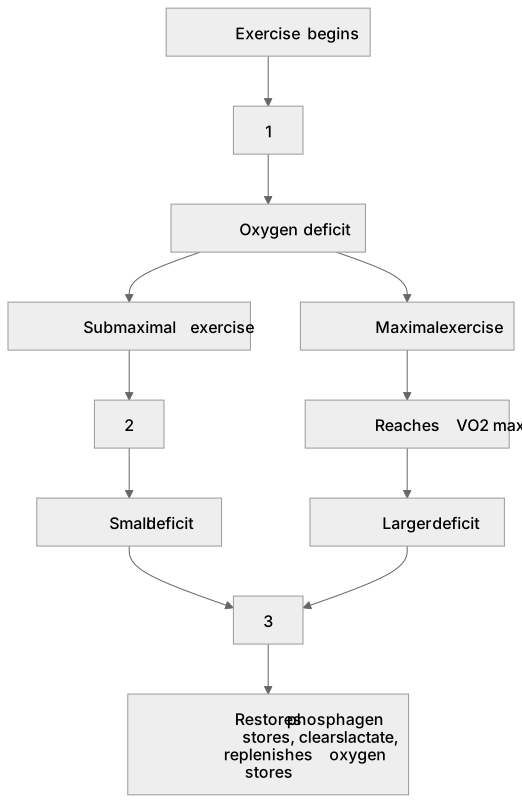
1Box 1
2Box 2
3Box 3
There is more to this lesson
The full lesson goes on to check your understanding and help you earn the marks. Create a free account to carry on, with your progress saved.
A week of Premium from your first lesson · Then the free plan continues · No card, no charge
Test your understanding of Energy systems: Oxygen consumption during exercise (maximal and submaximal oxygen deficit).
Active recall beats re-reading. Take an instant quiz now to test what you’ve learned and lock it into long-term memory.
A week of Premium from your first lesson · Then the free plan continues · No card, no charge