AQA · A-Level · Physical Education
Course version: 7582 · Version from Sept 2016
Oxygen consumption during recovery (excess post-exercise oxygen…
Full specification wording
Energy systems: Oxygen consumption during recovery (excess post-exercise oxygen consumption EPOC).
After exercise stops, oxygen consumption does not fall instantly to resting level; it stays elevated for a period.
Checked against the AQA 7582 specification (opens in a new tab) on .
- Point 15 of 26
- 4 key terms
Study notes
From the checked teaching notes for this specification point.
The idea
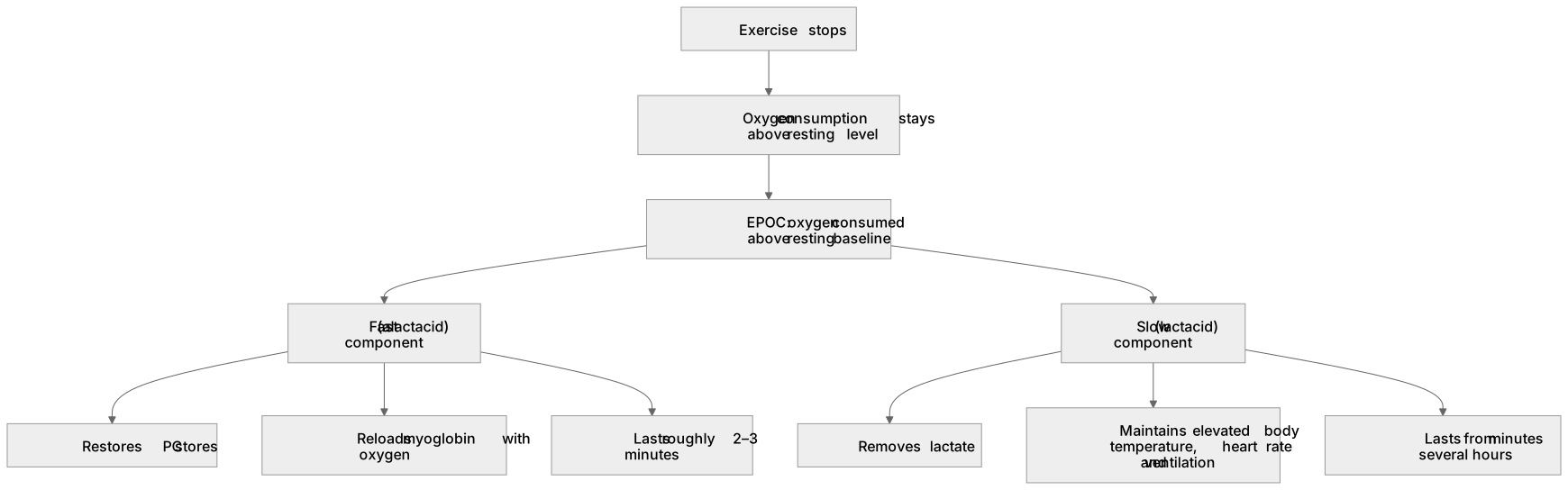
After exercise stops, oxygen consumption does not fall instantly to resting level; it stays elevated for a period. This extra oxygen is called excess post-exercise oxygen consumption (EPOC). EPOC has two components. The fast (alactacid) component restores phosphocreatine (PC) stores and reloads myoglobin with oxygen; it lasts roughly 2–3 minutes. The slow (lactacid) component removes lactate and maintains elevated body temperature, heart rate and ventilation; it can last from minutes to several hours. EPOC is measured as the volume of oxygen consumed above resting baseline during recovery, often expressed in litres (L) or millilitres per kilogram (ml·kg⁻¹). A student should be able to identify what EPOC is, why it occurs and how the two components differ.
What earns the marks
- EPOC is the volume of oxygen consumed above resting baseline after exercise ends.
- The fast (alactacid) component lasts about 2–3 minutes and replenishes PC stores and myoglobin oxygen.
- The slow (lactacid) component lasts longer and is associated with lactate removal, elevated heart rate, ventilation and body temperature.
- EPOC can be expressed as a volume in litres (L) or millilitres per kilogram (ml·kg⁻¹).
- EPOC is not the same as the oxygen deficit at the start of exercise.
Common mistakes and how to put them right
Confusing EPOC with the oxygen deficit.
Put it right: EPOC occurs after exercise, whereas the oxygen deficit occurs at the start of exercise before steady state is reached.
Thinking EPOC is only about lactate removal.
Put it right: The fast component restores PC and myoglobin oxygen, while the slow component deals with lactate and other recovery processes.
Believing EPOC ends as soon as breathing returns to normal.
Put it right: Ventilation may normalise before the slow component is complete, so EPOC can continue for hours.
Stating that EPOC is a rate of oxygen consumption.
Put it right: It is a volume of oxygen consumed above resting baseline, measured in L or ml·kg⁻¹, not ml·kg⁻¹·min⁻¹.
Exam tips
- Read the question carefully to check whether it asks about the fast component, the slow component or EPOC as a whole.
- Use the correct units when a value is given: ml·kg⁻¹ for relative oxygen volume or L for absolute volume.
- Link each component to its main recovery process rather than just naming it.
- Eliminate options that describe the oxygen deficit or lactate production during exercise, as these are not EPOC.
Try the lesson
The start of the Energy systems: Oxygen consumption during recovery (excess post-exercise oxygen consumption EPOC). lesson, made from checked teaching notes for this specification point.
Have a go first
After a performer stops exercising, oxygen consumption stays above resting level for a period. What name is given to this raised oxygen uptake during recovery?
Listen
After exercise stops, oxygen consumption does not fall instantly to resting level; it stays elevated for a period. This extra oxygen is called excess post-exercise oxygen consumption (EPOC). EPOC has two components. The fast (alactacid) component restores phosphocreatine (PC) stores and reloads myoglobin with oxygen; it lasts roughly 2–3 minutes. The slow (lactacid) component removes lactate and maintains elevated body temperature, heart rate and ventilation; it can last from minutes to several hours. EPOC is measured as the volume of oxygen consumed above resting baseline during recovery, often expressed in litres (L) or millilitres per kilogram (ml·kg⁻¹). A student should be able to identify what EPOC is, why it occurs and how the two components differ. A strong answer earns marks for these points. EPOC is the volume of oxygen consumed above resting baseline after exercise ends. The fast (alactacid) component lasts about 2–3 minutes and replenishes PC stores and myoglobin oxygen. The slow (lactacid) component lasts longer and is associated with lactate removal, elevated heart rate, ventilation and body temperature. EPOC can be expressed as a volume in litres (L) or millilitres per kilogram (ml·kg⁻¹). Exam tip: Read the question carefully to check whether it asks about the fast component, the slow component or EPOC as a whole.
See it
Key words
Say what each word means before you turn the card.
EPOC
Try answering aloud or in your head before turning the card.
Fast (alactacid) component
Try answering aloud or in your head before turning the card.
Slow (lactacid) component
Try answering aloud or in your head before turning the card.
Oxygen deficit
Try answering aloud or in your head before turning the card.
See every definition
- EPOC
- The volume of oxygen consumed above resting baseline during recovery after exercise ends, staying elevated rather than falling instantly to resting level.
- Fast (alactacid) component
- The component that restores phosphocreatine stores and reloads myoglobin with oxygen, lasting roughly 2–3 minutes.
- Slow (lactacid) component
- The component that removes lactate and maintains elevated body temperature, heart rate and ventilation, lasting from minutes to several hours.
- Oxygen deficit
- Occurs at the start of exercise before steady state is reached and is not the same as EPOC.
Label the diagram
Some boxes have lost their names. Pick the right name for each number.
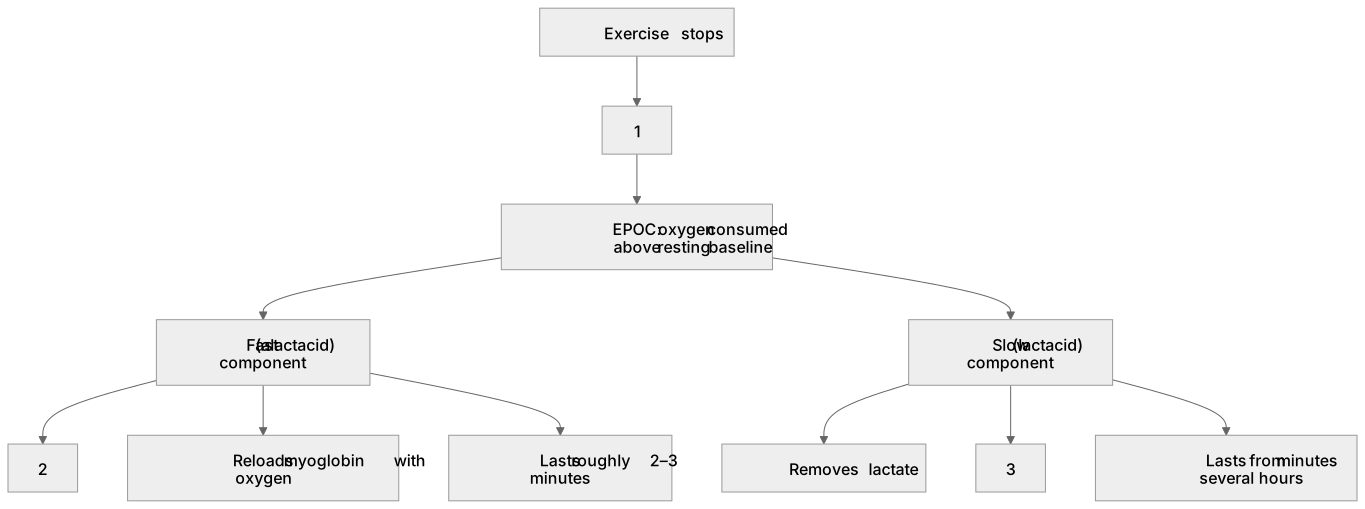
1Box 1
2Box 2
3Box 3
There is more to this lesson
The full lesson goes on to check your understanding and help you earn the marks. Create a free account to carry on, with your progress saved.
A week of Premium from your first lesson · Then the free plan continues · No card, no charge
Test your understanding of Energy systems: Oxygen consumption during recovery (excess post-exercise oxygen consumption EPOC).
Active recall beats re-reading. Take an instant quiz now to test what you’ve learned and lock it into long-term memory.
A week of Premium from your first lesson · Then the free plan continues · No card, no charge