AQA · A-Level · Physical Education
Course version: 7582 · Version from Sept 2016
Energy systems: Respiratory exchange ratio (RER).
The respiratory exchange ratio compares the volume of carbon dioxide a performer exhales with the volume of oxygen they consume over the same period, so RER = VCO₂ ÷ VO₂.
Checked against the AQA 7582 specification (opens in a new tab) on .
- Point 21 of 26
- 4 key terms
Study notes
From the checked teaching notes for this specification point.
The idea
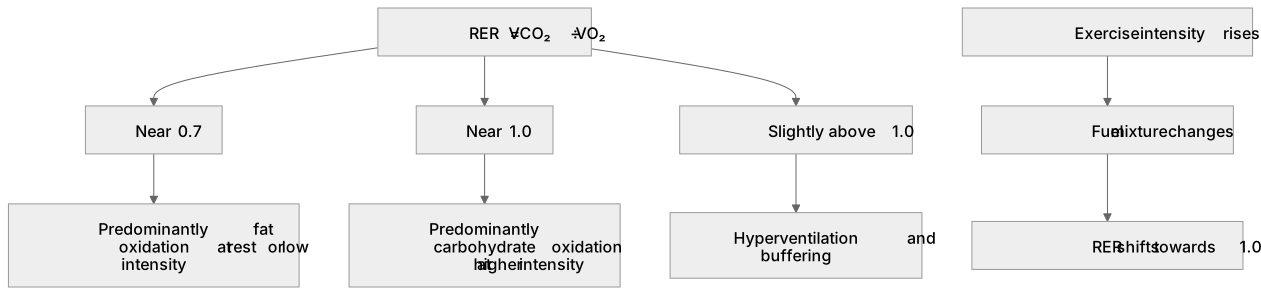
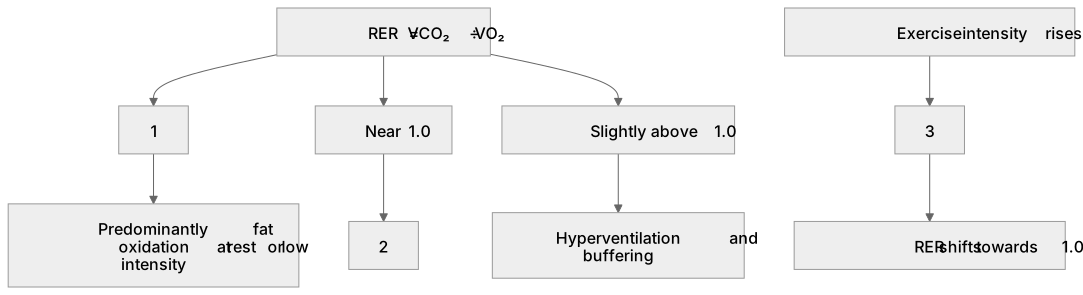
The respiratory exchange ratio compares the volume of carbon dioxide a performer exhales with the volume of oxygen they consume over the same period, so RER = VCO₂ ÷ VO₂. At rest, fat oxidation dominates and the ratio sits near 0.7; as exercise intensity rises and carbohydrate becomes the main fuel, the ratio climbs towards 1.0, and values slightly above 1.0 can occur during very intense work as extra carbon dioxide is driven off by hyperventilation and buffering. A student should be able to read a ratio, state which fuel mixture it suggests, and explain why the value shifts with intensity.
For example: An RER of 0.85 indicates a mixed contribution from fat and carbohydrate, whereas 0.95 points strongly towards carbohydrate use.
What earns the marks
- RER = VCO₂ ÷ VO₂, comparing carbon dioxide produced with oxygen consumed.
- A value near 0.7 indicates predominantly fat oxidation at rest or low intensity.
- A value near 1.0 indicates predominantly carbohydrate oxidation at higher intensity.
- Values slightly above 1.0 can reflect hyperventilation and buffering rather than pure fuel use.
- RER shifts with exercise intensity because the fuel mixture changes.
- RER is a whole-body estimate of substrate use, not a direct measure of one muscle's fuel.
Common mistakes and how to put them right
Reversing the ratio and writing VO₂ ÷ VCO₂.
Put it right: The correct form is carbon dioxide produced divided by oxygen consumed.
Assuming RER always equals exactly 1.0 during hard exercise.
Put it right: Values can exceed 1.0 because of hyperventilation and buffering.
Treating RER as a direct measure of fat or carbohydrate burned in a single muscle.
Put it right: It is a whole-body estimate of substrate use.
Confusing RER with RQ (respiratory quotient) measured at tissue level.
Put it right: RER is measured at the mouth from exchanged gases.
Exam tips
- Learn the formula and the two anchor values, 0.7 for fat and 1.0 for carbohydrate, so you can reason from any given figure.
- When a question supplies an RER value, state the dominant fuel and justify it with the ratio rather than guessing.
- Link RER to exercise intensity: as intensity rises, carbohydrate contribution increases and the ratio moves towards 1.0.
Try the lesson
The start of the Energy systems: Respiratory exchange ratio (RER). lesson, made from checked teaching notes for this specification point.
Have a go first
A performer is exercising steadily and their respiratory exchange ratio (RER) is measured as 0.70. Which fuel is being used almost exclusively at this intensity?
Listen
The respiratory exchange ratio compares the volume of carbon dioxide a performer exhales with the volume of oxygen they consume over the same period, so RER = VCO₂ ÷ VO₂. At rest, fat oxidation dominates and the ratio sits near 0.7; as exercise intensity rises and carbohydrate becomes the main fuel, the ratio climbs towards 1.0, and values slightly above 1.0 can occur during very intense work as extra carbon dioxide is driven off by hyperventilation and buffering. A student should be able to read a ratio, state which fuel mixture it suggests, and explain why the value shifts with intensity. For example, an RER of 0.85 indicates a mixed contribution from fat and carbohydrate, whereas 0.95 points strongly towards carbohydrate use. A strong answer earns marks for these points. RER = VCO₂ ÷ VO₂, comparing carbon dioxide produced with oxygen consumed. A value near 0.7 indicates predominantly fat oxidation at rest or low intensity. A value near 1.0 indicates predominantly carbohydrate oxidation at higher intensity. Values slightly above 1.0 can reflect hyperventilation and buffering rather than pure fuel use. Exam tip: Learn the formula and the two anchor values, 0.7 for fat and 1.0 for carbohydrate, so you can reason from any given figure.
See it
Key words
Say what each word means before you turn the card.
RER
Try answering aloud or in your head before turning the card.
Fuel mixture and substrate use
Try answering aloud or in your head before turning the card.
Exercise intensity and energy contribution
Try answering aloud or in your head before turning the card.
Interpretation of physiological data
Try answering aloud or in your head before turning the card.
See every definition
- RER
- A ratio comparing the volume of carbon dioxide a performer exhales with the volume of oxygen they consume over the same period, calculated as VCO₂ ÷ VO₂.
- Fuel mixture and substrate use
- A value near 0.7 indicates predominantly fat oxidation, while a value near 1.0 indicates predominantly carbohydrate oxidation.
- Exercise intensity and energy contribution
- As exercise intensity rises and carbohydrate becomes the main fuel, the ratio climbs towards 1.0.
- Interpretation of physiological data
- Values slightly above 1.0 can reflect hyperventilation and buffering rather than pure fuel use.
Label the diagram
Some boxes have lost their names. Pick the right name for each number.
1Box 1
2Box 2
3Box 3
There is more to this lesson
The full lesson goes on to check your understanding and help you earn the marks. Create a free account to carry on, with your progress saved.
A week of Premium from your first lesson · Then the free plan continues · No card, no charge
Test your understanding of Energy systems: Respiratory exchange ratio (RER).
Active recall beats re-reading. Take an instant quiz now to test what you’ve learned and lock it into long-term memory.
A week of Premium from your first lesson · Then the free plan continues · No card, no charge