AQA · A-Level · Physical Education
Course version: 7582 · Version from Sept 2016
Energy systems: Speed Agility Quickness.
Speed, agility and quickness (SAQ) is a training approach that develops the ability to move quickly and change direction efficiently.
Checked against the AQA 7582 specification (opens in a new tab) on .
- Point 26 of 26
- 4 key terms
Study notes
From the checked teaching notes for this specification point.
The idea
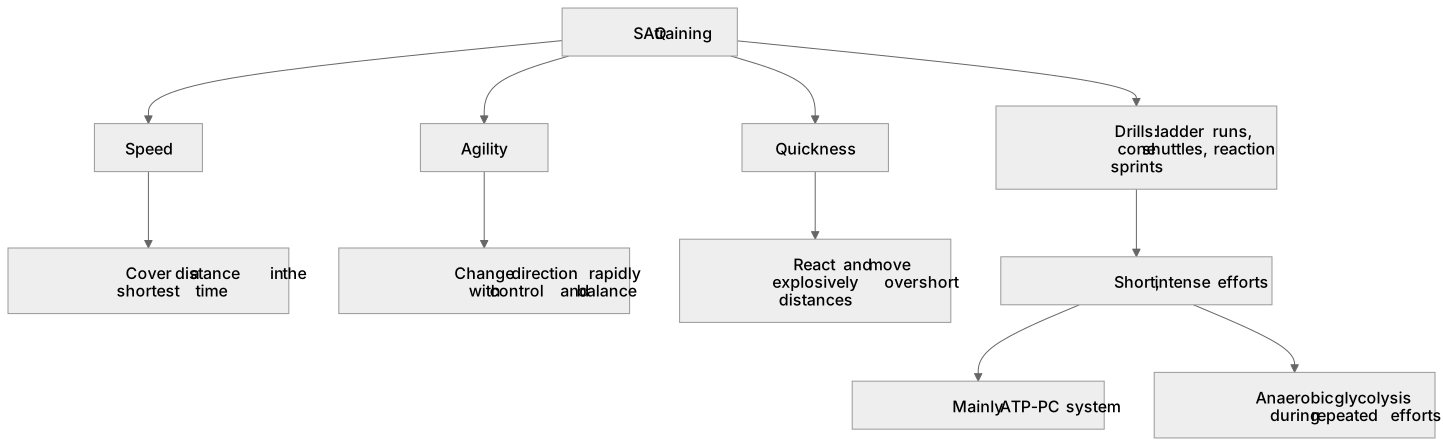
Speed, agility and quickness (SAQ) is a training approach that develops the ability to move quickly and change direction efficiently. Speed is the ability to cover a distance in the shortest time; agility is the ability to change direction rapidly while maintaining control and balance; quickness is the ability to react and move explosively over short distances. SAQ drills include ladder runs, cone shuttles and reaction sprints. These efforts are short and intense, so they depend mainly on the ATP-PC energy system, with some contribution from anaerobic glycolysis during repeated efforts. SAQ training improves neuromuscular coordination, reaction time and the ability to produce force quickly, which transfers to sports such as football, rugby and tennis.
What earns the marks
- Speed is the ability to cover a given distance in the shortest possible time.
- Agility is the ability to change direction quickly and under control while maintaining balance.
- Quickness is the ability to react and move explosively over very short distances.
- SAQ drills include ladder runs, cone shuttles and reaction sprints.
- Short, intense SAQ efforts are fuelled mainly by the ATP-PC energy system, with anaerobic glycolysis contributing during repeated efforts.
- SAQ training develops neuromuscular coordination, reaction time and rapid force production, which transfer to game situations.
Common mistakes and how to put them right
Treating speed, agility and quickness as the same quality.
Put it right: Speed is straight-line movement over a distance, agility involves controlled changes of direction, and quickness is explosive reaction over short distances.
Assuming SAQ training is mainly aerobic.
Put it right: The efforts are short and intense, so the ATP-PC system dominates, with anaerobic glycolysis contributing during repeated bouts.
Thinking agility is only about physical speed.
Put it right: It also requires balance, control and the ability to react to a stimulus such as an opponent or a ball.
Exam tips
- Define each of the three components separately before explaining how a drill develops them.
- Name a specific drill and state which component it mainly targets.
- Link the intensity and duration of SAQ work to the energy system that fuels it.
Try the lesson
The start of the Energy systems: Speed Agility Quickness. lesson, made from checked teaching notes for this specification point.
Have a go first
Which component of Speed Agility Quickness describes the ability to change direction rapidly while maintaining control of the body?
Listen
Speed, agility and quickness (SAQ) is a training approach that develops the ability to move quickly and change direction efficiently. Speed is the ability to cover a distance in the shortest time; agility is the ability to change direction rapidly while maintaining control and balance; quickness is the ability to react and move explosively over short distances. SAQ drills include ladder runs, cone shuttles and reaction sprints. These efforts are short and intense, so they depend mainly on the ATP-PC energy system, with some contribution from anaerobic glycolysis during repeated efforts. SAQ training improves neuromuscular coordination, reaction time and the ability to produce force quickly, which transfers to sports such as football, rugby and tennis. A strong answer earns marks for these points. Speed is the ability to cover a given distance in the shortest possible time. Agility is the ability to change direction quickly and under control while maintaining balance. Quickness is the ability to react and move explosively over very short distances. SAQ drills include ladder runs, cone shuttles and reaction sprints. Exam tip: Define each of the three components separately before explaining how a drill develops them.
See it
Key words
Say what each word means before you turn the card.
Speed
Try answering aloud or in your head before turning the card.
Agility
Try answering aloud or in your head before turning the card.
Quickness
Try answering aloud or in your head before turning the card.
ATP-PC energy system
Try answering aloud or in your head before turning the card.
See every definition
- Speed
- The ability to cover a given distance in the shortest possible time.
- Agility
- The ability to change direction quickly and under control while maintaining balance.
- Quickness
- The ability to react and move explosively over very short distances.
- ATP-PC energy system
- The system that mainly fuels short, intense SAQ efforts, with anaerobic glycolysis contributing during repeated efforts.
Label the diagram
Some boxes have lost their names. Pick the right name for each number.
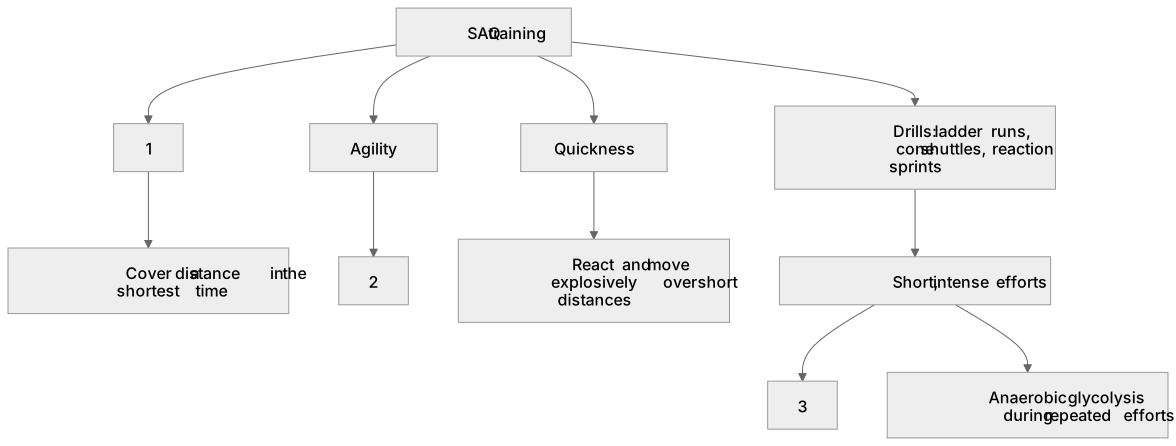
1Box 1
2Box 2
3Box 3
There is more to this lesson
The full lesson goes on to check your understanding and help you earn the marks. Create a free account to carry on, with your progress saved.
A week of Premium from your first lesson · Then the free plan continues · No card, no charge
Test your understanding of Energy systems: Speed Agility Quickness.
Active recall beats re-reading. Take an instant quiz now to test what you’ve learned and lock it into long-term memory.
A week of Premium from your first lesson · Then the free plan continues · No card, no charge