AQA · A-Level · Physical Education
Course version: 7582 · Version from Sept 2016
Energy systems: Plyometrics.
Plyometrics is a training method that uses the stretch-shortening cycle to develop explosive power.
Checked against the AQA 7582 specification (opens in a new tab) on .
- Point 25 of 26
- 4 key terms
Study notes
From the checked teaching notes for this specification point.
The idea
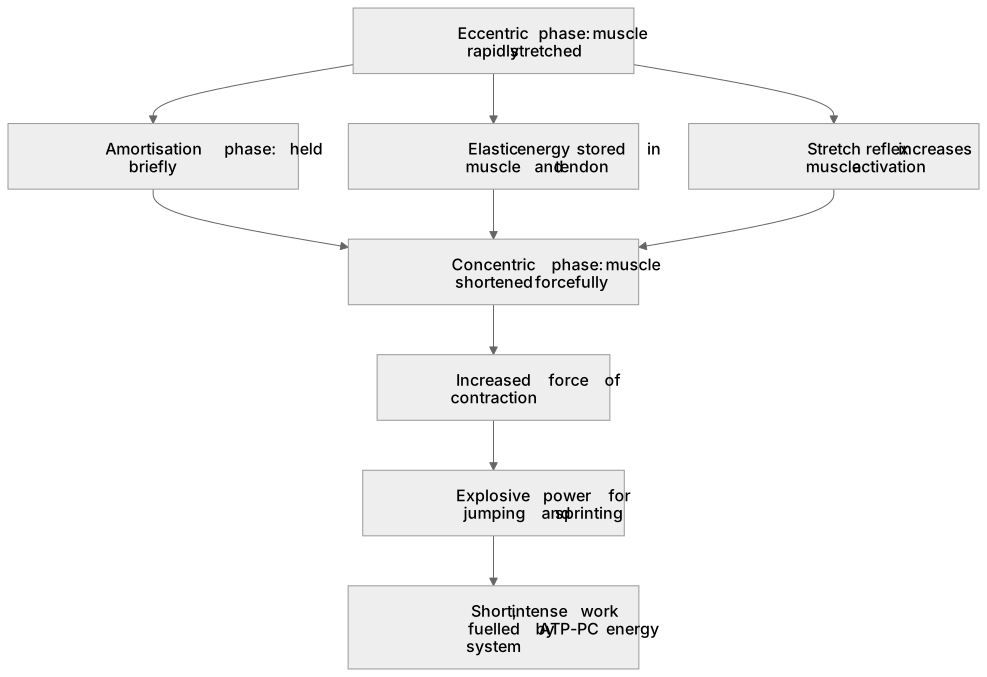
Plyometrics is a training method that uses the stretch-shortening cycle to develop explosive power. A muscle is rapidly stretched (eccentric phase), held briefly (amortisation phase), then shortened forcefully (concentric phase). The stored elastic energy in the tendon and the stretch reflex both increase the force of the subsequent contraction. A typical example is a depth jump: the performer steps off a box, lands and immediately jumps upward. The shorter the amortisation phase, the more elastic energy is reused. Plyometrics is assessed by its ability to improve power for activities such as jumping and sprinting, and it links to the ATP-PC energy system because the work is short and intense.
What earns the marks
- Plyometrics uses the stretch-shortening cycle, involving an eccentric phase, an amortisation phase and a concentric phase.
- Elastic energy is stored in the muscle and tendon during the eccentric phase and released during the concentric phase.
- The stretch reflex increases muscle activation, adding to the force produced.
- A short amortisation phase allows more stored elastic energy to be reused, increasing power output.
- Plyometric work is short and intense, so it is fuelled mainly by the ATP-PC (phosphocreatine) energy system.
- Examples include depth jumps, bounding and hurdle hops, which develop explosive power for jumping and sprinting.
Common mistakes and how to put them right
Thinking plyometrics trains aerobic endurance.
Put it right: It develops explosive power through short, intense efforts, so it relies on the ATP-PC system rather than aerobic metabolism.
Believing the amortisation phase should be long.
Put it right: A long pause lets stored elastic energy dissipate as heat, so the amortisation phase should be as short as possible.
Confusing the eccentric phase with the concentric phase.
Put it right: The eccentric phase is the rapid stretching of the muscle as it lengthens under tension, while the concentric phase is the forceful shortening that produces the jump.
Exam tips
- Link each phase of the stretch-shortening cycle to what happens in the muscle and tendon, not just to the name of the exercise.
- When a question asks why plyometrics improves power, refer to both stored elastic energy and the stretch reflex.
- Use a named example such as a depth jump and state which energy system fuels it.
Try the lesson
The start of the Energy systems: Plyometrics. lesson, made from checked teaching notes for this specification point.
Have a go first
Which energy system is the main supplier of ATP during the short, explosive stretch-shortening cycle of a plyometric jump?
Listen
Plyometrics is a training method that uses the stretch-shortening cycle to develop explosive power. A muscle is rapidly stretched (eccentric phase), held briefly (amortisation phase), then shortened forcefully (concentric phase). The stored elastic energy in the tendon and the stretch reflex both increase the force of the subsequent contraction. A typical example is a depth jump: the performer steps off a box, lands and immediately jumps upward. The shorter the amortisation phase, the more elastic energy is reused. Plyometrics is assessed by its ability to improve power for activities such as jumping and sprinting, and it links to the ATP-PC energy system because the work is short and intense. A strong answer earns marks for these points. Plyometrics uses the stretch-shortening cycle, involving an eccentric phase, an amortisation phase and a concentric phase. Elastic energy is stored in the muscle and tendon during the eccentric phase and released during the concentric phase. The stretch reflex increases muscle activation, adding to the force produced. A short amortisation phase allows more stored elastic energy to be reused, increasing power output. Exam tip: Link each phase of the stretch-shortening cycle to what happens in the muscle and tendon, not just to the name of the exercise.
See it
Key words
Say what each word means before you turn the card.
Stretch-shortening cycle
Try answering aloud or in your head before turning the card.
Elastic energy storage and reuse
Try answering aloud or in your head before turning the card.
Stretch reflex
Try answering aloud or in your head before turning the card.
ATP-PC energy system and explosive power
Try answering aloud or in your head before turning the card.
See every definition
- Stretch-shortening cycle
- A cycle involving an eccentric phase, an amortisation phase and a concentric phase, used by plyometrics to develop explosive power.
- Elastic energy storage and reuse
- Energy is stored in the muscle and tendon during the eccentric phase and released during the concentric phase.
- Stretch reflex
- A reflex that increases muscle activation, adding to the force produced.
- ATP-PC energy system and explosive power
- Short and intense plyometric work is fuelled mainly by this system, which develops explosive power for jumping and sprinting.
Label the diagram
Some boxes have lost their names. Pick the right name for each number.
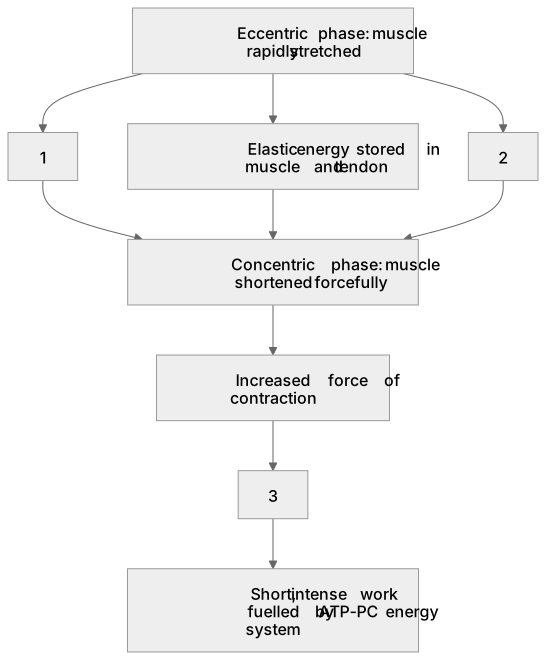
1Box 1
2Box 2
3Box 3
There is more to this lesson
The full lesson goes on to check your understanding and help you earn the marks. Create a free account to carry on, with your progress saved.
A week of Premium from your first lesson · Then the free plan continues · No card, no charge
Test your understanding of Energy systems: Plyometrics.
Active recall beats re-reading. Take an instant quiz now to test what you’ve learned and lock it into long-term memory.
A week of Premium from your first lesson · Then the free plan continues · No card, no charge