AQA · A-Level · Physical Education
Course version: 7582 · Version from Sept 2016
Fluid mechanics: Drag and lift.
Drag and lift are the two main fluid forces acting on a body moving through air or water.
Checked against the AQA 7582 specification (opens in a new tab) on .
- Point 2 of 6
- 4 key terms
Study notes
From the checked teaching notes for this specification point.
The idea
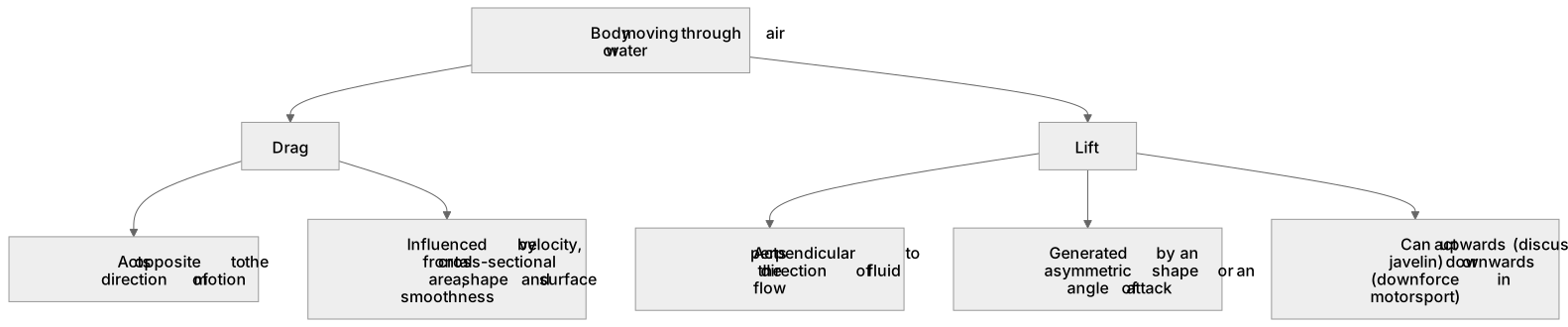
Drag and lift are the two main fluid forces acting on a body moving through air or water. Drag acts opposite to the direction of motion, resisting forward movement. It is influenced by velocity, frontal cross-sectional area, shape and surface smoothness. For example, a cyclist reduces drag by adopting an aerodynamic posture to decrease frontal area. Lift acts perpendicular to the direction of fluid flow and can be generated by an asymmetric shape or an angle of attack. Lift is essential in sports such as discus and javelin, where it generates an upward force to increase flight time, or in motorsport (such as Formula 1), where downward lift (downforce) improves tyre grip.
What earns the marks
- Drag is a fluid force that opposes motion and acts in the opposite direction to velocity.
- Lift is a fluid force that acts perpendicular to the direction of fluid flow.
- Drag is increased by higher velocity, larger frontal cross-sectional area and rougher surfaces.
- Lift can be generated by an asymmetric shape (aerofoil) or an appropriate angle of attack.
- In sport, drag reduces performance in cycling and swimming, while lift can generate upward force in discus or javelin.
Common mistakes and how to put them right
Confusing drag and lift.
Put it right: Drag acts opposite to motion, while lift acts perpendicular to the direction of motion.
Assuming lift only acts upwards.
Put it right: Lift acts perpendicular to flow, so it can act downwards (downforce) to increase grip in motorsport.
Believing surface area alone determines drag.
Put it right: Frontal cross-sectional area and shape are critical factors in determining fluid resistance.
Exam tips
- Define drag and lift clearly by stating their direction relative to the fluid flow.
- Use sporting examples to explain how athletes manipulate drag, such as a swimmer wearing a smooth cap.
- Explain how lift is created using the angle of attack in throwing events like the discus.
Try the lesson
The start of the Fluid mechanics: Drag and lift. lesson, made from checked teaching notes for this specification point.
Have a go first
A cyclist rides forwards into still air. In which direction does the drag force from the air act on the cyclist?
Listen
Drag and lift are the two main fluid forces acting on a body moving through air or water. Drag acts opposite to the direction of motion, resisting forward movement. It is influenced by velocity, frontal cross-sectional area, shape and surface smoothness. For example, a cyclist reduces drag by adopting an aerodynamic posture to decrease frontal area. Lift acts perpendicular to the direction of fluid flow and can be generated by an asymmetric shape or an angle of attack. Lift is essential in sports such as discus and javelin, where it generates an upward force to increase flight time, or in motorsport (such as Formula 1), where downward lift (downforce) improves tyre grip. A strong answer earns marks for these points. Drag is a fluid force that opposes motion and acts in the opposite direction to velocity. Lift is a fluid force that acts perpendicular to the direction of fluid flow. Drag is increased by higher velocity, larger frontal cross-sectional area and rougher surfaces. Lift can be generated by an asymmetric shape (aerofoil) or an appropriate angle of attack. Exam tip: Define drag and lift clearly by stating their direction relative to the fluid flow.
See it
Key words
Say what each word means before you turn the card.
Drag
Try answering aloud or in your head before turning the card.
Lift
Try answering aloud or in your head before turning the card.
Downforce
Try answering aloud or in your head before turning the card.
Angle of attack
Try answering aloud or in your head before turning the card.
See every definition
- Drag
- A fluid force that opposes motion and acts in the opposite direction to velocity.
- Lift
- A fluid force that acts perpendicular to the direction of fluid flow.
- Downforce
- Downward lift that improves tyre grip in motorsport such as Formula 1.
- Angle of attack
- An appropriate angle that can generate lift, as in throwing events like the discus.
Label the diagram
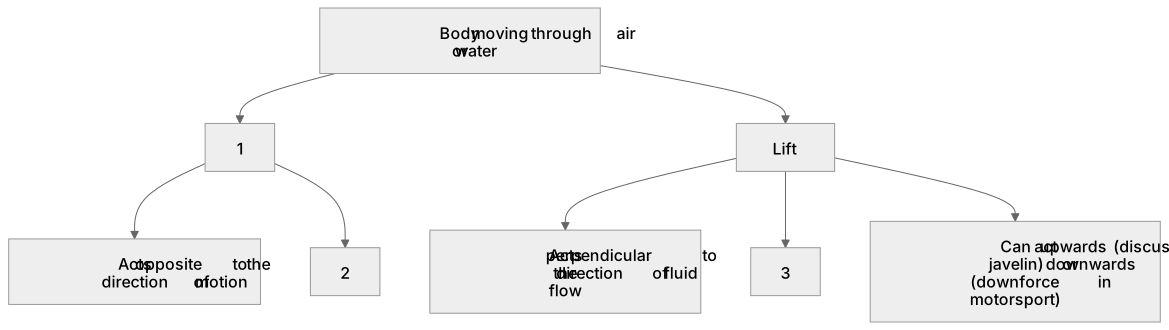
Some boxes have lost their names. Pick the right name for each number.
1Box 1
2Box 2
3Box 3
There is more to this lesson
The full lesson goes on to check your understanding and help you earn the marks. Create a free account to carry on, with your progress saved.
A week of Premium from your first lesson · Then the free plan continues · No card, no charge
Test your understanding of Fluid mechanics: Drag and lift.
Active recall beats re-reading. Take an instant quiz now to test what you’ve learned and lock it into long-term memory.
A week of Premium from your first lesson · Then the free plan continues · No card, no charge